Daily life during the La Belle Époque period: habits and urban routines Bucharest residents had at the end of the 19th century
- Articles
- 17 APR 26
The end of the 19th century represented for Bucharest a period of profound transformations, marked by accelerated modernization, Western influences and a redefinition of urban identity. This era, known as La Belle Époque, coincided with a stage of relative stability and economic development, in which Romania’s capital began to acquire the features of a modern European city.
The historical context and the transformation of Bucharest into a modern city
After the proclamation of Romania’s independence in 1877 and the consolidation of the national state, Bucharest became an increasingly important political, administrative and cultural center. Reforms in the field of infrastructure, such as the introduction of public lighting, the paving of streets and the development of urban transport, radically changed the appearance of the city. The appearance of the horse-drawn tram, later followed by the electric one, facilitated the mobility of the inhabitants and contributed to the expansion of the city.
In this context, the daily life of Bucharest residents adapted to the new realities. Although social differences were still evident, especially between elites and the popular classes, Western influences began to be felt in all aspects of urban life. The lifestyle, habits and daily routines gradually became more sophisticated, reflecting the aspirations of a society in full transformation.
The organization of the day and the rhythm of urban life
Daily life in Bucharest at the end of the 19th century was structured around well-defined routines, which reflected both social status and the occupation of each individual. The day began early for most inhabitants, especially for those from the working classes, who had to reach their workplaces in workshops, factories or markets.
For the bourgeoisie and elites, mornings had a more relaxed rhythm. Breakfast was an important moment, often served within the family, and included products such as coffee, bread, butter, jam or pastries. Reading the newspaper had already become a habit, offering information about the political, social and cultural events of the day.
The daily schedule was influenced by professional activities. Public officials and employees in institutions had a relatively stable program, while merchants organized their day depending on the flow of customers. The afternoon was often dedicated to social meetings or walks, especially in the case of the upper classes.
The evening represented a moment of relaxation and socialization. Families gathered for dinner, and afterwards participated in various recreational activities. The rhythm of urban life was thus marked by an alternation between work and leisure time, in which each moment of the day had a well-defined role.
The dwelling and domestic life
The dwellings of Bucharest residents directly reflected social position and standard of living. In central areas and elegant neighborhoods, houses were spacious, well decorated and equipped with modern facilities for that time. These dwellings generally belonged to the bourgeoisie and the urban elite, who invested in comfort and aesthetics.
The interiors were arranged with Western-inspired furniture, carpets, draperies and decorative objects. The salon had a central role, being the place where guests were received and where social activities took place. Domestic life was organized with the help of household staff, which allowed family members to focus on cultural or social activities.
In contrast, the dwellings of the popular classes were modest, often overcrowded and lacking comfort. However, even in these environments there were well-established routines and a strong community spirit. Neighbors knew each other, and social life often took place in public space, on the street or in shared courtyards.
The household was an essential element of daily life. Women had a central role in managing the home, from preparing meals to educating children. Domestic activities were time-consuming and required careful organization, especially in the absence of modern technologies.
Food and culinary habits
The diet of Bucharest residents at the end of the 19th century reflected both local traditions and external influences. The cuisine was varied, and meals had a clear structure, especially in well-off families. Breakfast was relatively simple, but lunch and dinner were more substantial and included several courses.
In bourgeois homes, menus were often inspired by French cuisine, considered a model of refinement. Soups, roasts, elaborate sauces and sophisticated desserts were frequently encountered. The serving of the meal respected strict rules of etiquette, and the tableware and cutlery were carefully chosen.
For the popular classes, the diet was simpler and based on local products: bread, vegetables, cheeses and meat, depending on possibilities. However, meals had a special social importance, being moments of family gathering.
The city’s markets played an essential role in supply. Here fresh products were found, and the interaction between sellers and buyers contributed to the dynamics of urban life. Culinary habits were thus integrated into the daily rhythm of the city.
Social life and meeting spaces
Social life in Bucharest during La Belle Époque was vibrant and diversified. Cafés, restaurants and public gardens were meeting places for different social categories. Here ideas were discussed, plans were made and relationships were built.
For elites, participation in social events was essential. Balls, receptions and cultural soirées were frequently organized and represented opportunities for social affirmation. Clothing, behavior and conversation were carefully regulated, reflecting the norms of the era.
Parks and boulevards were frequented for promenade, a popular activity among Bucharest residents. Afternoon walks were not only a form of relaxation, but also an opportunity for socialization and observation of urban life.
The cinema, which appeared toward the end of the century, began to gain popularity, alongside theater and musical performances. Thus, entertainment options diversified, contributing to the dynamism of daily life.
Fashion and concern for appearance
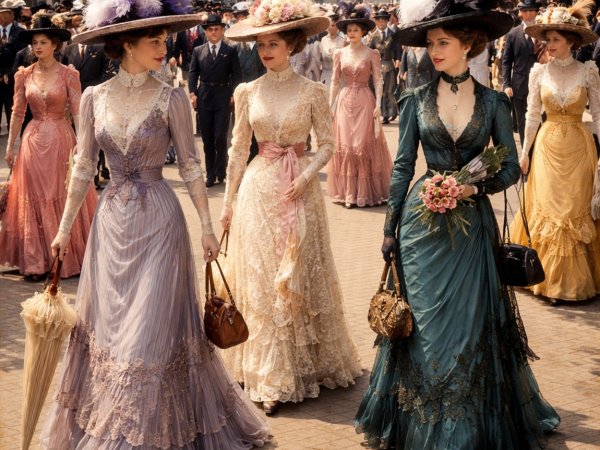
Fashion occupied an important place in the lives of Bucharest residents, especially among the upper classes. Parisian influences were evident, and elegance had become a social standard. Women wore elaborate dresses, refined accessories and paid special attention to details.
Men adopted elegant suits, hats and canes, and public appearance was carefully prepared. Clothing was not only an expression of personal taste, but also an indicator of social status.
Personal grooming and etiquette were essential aspects. Rules of behavior were well defined, and their observance was considered proof of education and refinement. Thus, public image had become an important component of urban identity.
Education and cultural values
Education experienced significant development during this period. Schools multiplied, and access to education became broader, although still limited by social conditions. Bourgeois families invested in the education of their children, considering it essential for future success.
Culture was present in daily life through reading, participation in performances and interest in the arts. Magazines and newspapers contributed to informing the public and shaping public opinion.
The promoted values included discipline, respect, education and the desire for progress. These reflected the aspirations of a society in full process of modernization.
A city between tradition and modernity
Daily life in Bucharest at the end of the 19th century was marked by a complex combination between tradition and modernity. While Western influences were transforming the city and the lifestyle of its inhabitants, traditional elements continued to play an important role.
Urban routines, habits and values reflected a society in change, in which modernization did not mean only material progress, but also a redefinition of cultural identity. Bucharest thus became a space of contrasts, but also of opportunities.
This period left a lasting imprint on the city, contributing to the formation of a distinct urban identity. The legacy of La Belle Époque continues to be visible even today, offering a valuable perspective on the evolution of Romanian society and on the way in which the past influences the present.
We also recommend: Stories from pre-war Bucharest: grand balls, luxury, Western influences and La Belle Époque