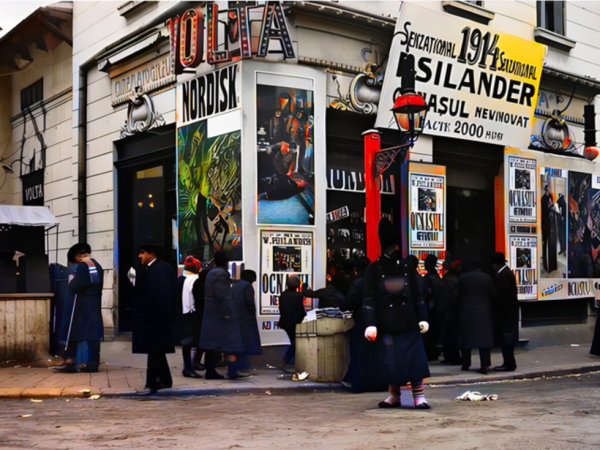
Cinema Volta in Bucharest, the beginnings of Romanian cinematography and the history of the “technological miracle”
- Articles
- 12 MAR 26
At the beginning of the 20th century, Bucharest was going through a period of rapid transformations. The capital of Romania was becoming increasingly modern, and the new technological and cultural discoveries were beginning to change the daily life of its inhabitants. In this context, the appearance of cinema represented one of the most spectacular innovations of the era, captivating the public and inaugurating a completely new form of entertainment.
The appearance of cinema in Bucharest at the beginning of the 20th century
The year 1909 marks an essential moment in the history of Romanian cinematography. Then Cinema Volta was opened, located on Doamnei Street no. 7, in the center of Bucharest. It is considered the first cinema in Romania with permanent operation, which meant that film screenings were no longer occasional or experimental, but were becoming part of the usual cultural life of the city.
Until that moment, films were presented only sporadically in various improvised spaces. Screenings took place in theater halls, in cafés or in other temporary locations, where the equipment was installed only for certain events. The public was attracted by this spectacular invention, but access to films was not constant.
The opening of Cinema Volta radically changed the situation. For the first time, spectators could go to the cinema regularly, exactly as they went to the theater or the opera. Thus, film was beginning to become a stable form of entertainment and an important element of urban cultural life.
Cinema Volta – the first permanent cinema in Romania
Cinema Volta was not just a simple projection hall, but a symbol of modernity. Its location on Doamnei Street, in a central and frequented area of Bucharest, contributed to the rapid popularity of the cinema. The inhabitants of the capital, attracted by novelty and by the promise of a spectacular experience, came to discover what the press of the time often called the “technological miracle” of the era.
The films presented in that period were very different from those we know today. They were silent productions, made in black and white and usually of short duration. Cinematographic technology was still at the beginning, and the stories were simple, focused more on action and visual effect than on the complex development of characters.
To compensate for the lack of sound, the screenings were accompanied by live music. In the cinema hall there was often a pianist or even a small musical ensemble that accompanied the images on the screen. The music had the role of emphasizing the emotion of the scenes, of creating atmosphere and of transforming the screening into a complete show.
The public reacted with enthusiasm to these experiences. For many spectators, moving images represented a revelation. The idea that people, cities or events could be captured on film and then projected on a screen seemed almost magical. Thus, cinema was quickly becoming one of the most fascinating forms of entertainment of the era.
How Cinema Volta changed the cultural life of the city
The impact of Cinema Volta on the cultural life of Bucharest was considerable. The appearance of a hall dedicated exclusively to cinematographic screenings contributed to consolidating the status of film as a popular form of entertainment. If initially cinema was perceived rather as a technical experiment or as a curiosity, gradually it began to be integrated into the cultural offer of the city.
The inhabitants of Bucharest came to Cinema Volta not only to see films, but also to experience the atmosphere of a modern world. The hall became a place of social meeting, where people from different environments gathered to discover the images projected on the screen. This democratization of entertainment contributed to the popularization of cinematography.
Also, Cinema Volta had an important role in educating the taste of the public. Romanian spectators thus had the opportunity to watch the first international productions, coming especially from France, Italy or the United States, countries in which the cinematographic industry was already beginning to develop rapidly. These films offered the public an image of how cinema could tell stories, could create emotions and could reflect reality.
Through the constant contact with foreign productions, spectators began to understand the artistic potential of film. Gradually, the interest in cinematography increased, and the idea of making Romanian productions began to take shape.
The place where the interest for Romanian film was born
Although Cinema Volta was not the place where the first Romanian films were actually produced, its influence on the development of national cinematography was significant. Through regular screenings and through the direct contact of the public with this form of expression, the cinema contributed to the emergence of a local cinematographic culture.
For many spectators of that time, the experience of watching films was the first contact with this type of visual art. The fascination generated by moving images determined some entrepreneurs, artists or technicians to explore the possibility of making local productions.
In the years that followed, the interest in Romanian film gradually increased. The pioneers of cinematography in Romania began to experiment with filming equipment and editing techniques, being inspired by the foreign productions presented in Bucharest cinemas. Thus, the foundations of an industry that was to evolve considerably in the following decades were laid.
Cinema Volta contributed indirectly to this process. By offering a permanent space for screenings, the cinema maintained the public's interest in film and demonstrated that there was a real demand for this type of entertainment.
The cultural legacy of Cinema Volta
Today, Cinema Volta is regarded as a symbol of the beginnings of Romanian cinematography. Although it was a relatively modest space in terms of size, its role in the development of cinematographic culture in Romania was huge.
Through the appearance of this cinema, film became accessible to a wide public and began to be perceived as an important cultural experience. From the first silent screenings, accompanied by live music, to the later development of the cinematographic industry, everything started from that pioneering period.
Cinema Volta reminds of the moment when the moving image began to definitively conquer the Romanian public. In an era in which film technology was still rudimentary, the enthusiasm of spectators and the curiosity for the new transformed cinema into a cultural phenomenon.
Today, when cinematography is one of the most influential creative industries in the world, its beginnings may seem modest. However, history demonstrates that each stage was essential for later evolution. In Romania, one of the most important starting points was, without doubt, Cinema Volta.
This place remains an important part of the cultural memory of Bucharest. Even if the city has profoundly changed over time, the story of the first permanent cinema in Romania continues to be evoked as a defining moment of Romanian modernity.
In the end, Cinema Volta can be considered more than a simple projection hall. It was the place where the Romanian public discovered the magic of film, where moving images became a form of show accessible to everyone and where, symbolically, the road of Romanian cinematography began. A small space in size, but immense in importance for the culture and the history of entertainment in Romania.
We also recommend: Cinema București, the history of the former interwar Trianon cinema where Romania’s first sound film was screened