Cinema LUX, the Bank of the Romanian Financial Society, and the Zografi Brothers’ Beer Hall: The History of the Establishment on Doamnei Street
- Articles
- 08 SEP 26
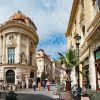
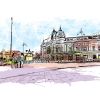
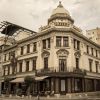
Today, at the intersection of Doamnei and Academiei streets, in central Bucharest, stands the building known as Adriatica or Tehnoimport, a structure with an unusual silhouette dominated by the semicircular shape of its façade. Few of those who pass through this area still know, however, that one of Bucharest’s important early twentieth-century cinemas once stood on the same site: Cinema Lux. The history of the building is much older than that of the cinema. Before film screenings were held here, the premises housed a financial institution, followed by a well-known beer hall; later, the space was converted into a cinema. These changes in function reflect the spectacular transformations Bucharest underwent between the late nineteenth century and the interwar period, when older buildings were gradually replaced by financial institutions, restaurants, cinemas, and modern structures. Some sources attribute the building to the architect Paul Gottereau. However, research into the Gottereau family identifies Jean Alfred Gottereau, Paul’s father, as the architect responsible for the 1873 construction. Alfred Gottereau designed several important projects in Bucharest during the same period, while Paul, born in 1843, would later become one of Romania’s prominent architects.
A Building Erected for a Financial Society
The history of this plot begins in 1873, at a time when Bucharest was consolidating its modern institutions and transforming its centre into an important financial and commercial hub. Banks and commercial companies sought premises near the city’s main thoroughfares and the areas where economic activity was concentrated.
That year, the building intended for the Romanian Financial Society was erected at the corner of Doamnei and Academiei streets. Research into Jean Alfred Gottereau’s work explicitly mentions his 1873 project for this society.
The institution, however, was not to have a long existence. The Romanian Financial Society encountered financial difficulties and went bankrupt in 1878. Documents published in the Monitorul Oficial show that, as early as 1877, the society was offering the very premises it occupied for sale or lease, a sign of the problems it was facing.
The bankruptcy did not mean the disappearance of the building. The structure remained standing and subsequently received an entirely different function, as the city centre became increasingly lively.
From Bank to the Zografi Brothers’ Beer Hall
After the disappearance of the Romanian Financial Society, the building entered a new phase. Around 1900, the Zografi brothers’ restaurant or beer hall was recorded at this address, transforming the former financial headquarters into a place intended for the public and for social life.
This change of use was representative of Bucharest’s development at the end of the nineteenth and the beginning of the twentieth century. Central buildings increasingly housed restaurants, beer halls, shops, and entertainment venues, while older commercial areas adapted to new urban habits.
Nearby was Blanduziei Garden, one of the period’s well-known leisure destinations. Photographic documentation of the area preserves images and information about the old building and its subsequent transformations.
The Zografi brothers’ beer hall thus represented an important, though intermediate, stage in the building’s history. On the same plot, two very different worlds had already followed one another: the financial world represented by the society of the 1870s, and the world of establishments devoted to consumption and socialising at the beginning of the following century.
How Cinema Lux Came into Being
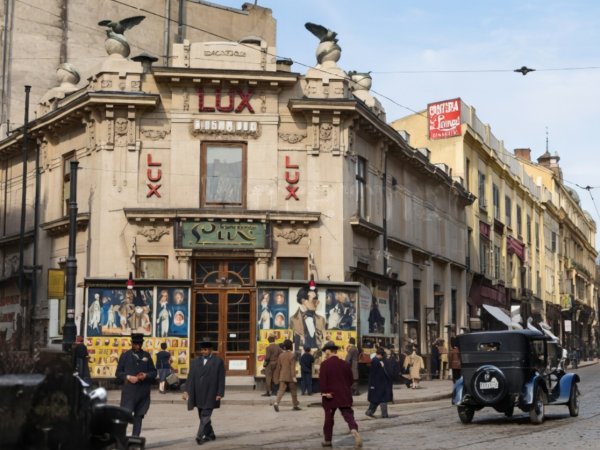
Around 1912, the building was raised by an additional storey and remodelled, becoming Cinema Lux. It is important to stress that this was the same building on the plot previously occupied by the financial society and the Zografi brothers’ beer hall, rather than an entirely new structure erected for the cinema.
The appearance of the cinema must be viewed in the context of the rapid development of cinematography in Bucharest. Film had become one of the most popular forms of urban entertainment, and cinemas were beginning to appear in increasing numbers throughout the city centre.
A study published by the Museum of the Municipality of Bucharest mentions that the 1921 Pântea Guide listed Cinema Lux at number 5. The same documentation also records other nearby cinemas: Apollo at number 7 and Terra at number 11.
Why Cinema Lux Disappeared
Cinema Lux continued to operate during the 1920s, but the old building was eventually lost amid the urban transformations of the interwar period.
Sources concerning the development of the plot indicate the period 1925–1936 for the disappearance of the old structure and the construction of the new building. Here, another important distinction must be made: the demolition of the old building should not be confused with the demolition of Cinema Terra, which stood at a different location.
In place of the old structure that had housed Cinema Lux, the Adriatica building was erected, later also known as Tehnoimport. The new building had a completely different architectural character, typical of interwar modernism, and its semicircular form became one of its most recognisable features.
Research by the Museum of the Municipality of Bucharest indicates that the new building, constructed between 1925 and 1936, contained a cinema hall on the ground floor. Thus, a cinema-related function continued to exist on the same plot after the disappearance of the old Cinema Lux, but it was no longer the same building, nor should it automatically be regarded as the same cinema hall.
The Adriatica Building and the Intersection’s New Image
The new building radically changed the appearance of the site. In place of the structure that had successively housed a financial institution, a beer hall, and Cinema Lux, a modern, considerably taller building appeared, adapted to the new image of interwar Bucharest.
Urban documentation produced by Bucharest City Hall notes that, in 1936, the cinema at the corner of Academiei and Doamnei streets had been replaced by the building known as Tehnoimport or Adriatica. The block became part of the process of modernising and densifying the city centre.
The building later served other functions as well. A publication issued by the National Bank of Romania mentions that the Timișoara Bank subsequently operated in the building with the semicircular façade.
Thus, although the old Cinema Lux disappeared, the plot remained associated with commercial, financial, and entertainment functions. In a certain sense, the new structure preserved the site’s connection with its past, but in a completely transformed architectural form.
What Remains of the Story of Cinema Lux
The history of the site can therefore be followed without confusing the different buildings and cinema halls. In 1873, the building of the Romanian Financial Society was erected here, based on a design attributed to Jean Alfred Gottereau. After the society’s bankruptcy, the premises were put to other uses.
Around 1900, the Zografi brothers’ beer hall or restaurant operated in the same building. Around 1912, the structure was raised and converted into Cinema Lux, which later appears in 1920s documents at number 5.
Then, between 1925 and 1936, the old structure disappeared, and the Adriatica/Tehnoimport building was erected on the plot. The new building also contained a cinema hall on the ground floor, extending the site’s cinematic tradition in a different form.
Viewed as a whole, this is one of the most interesting stories of Bucharest’s transformation. A single plot evolved from finance to commerce and entertainment, then to cinema and modernist architecture, over a period of approximately six decades.
Today, the Adriatica building is the visible landmark of the site. The old structure has disappeared, Cinema Lux no longer exists, and the former Zografi beer hall belongs to a vanished urban world. Nevertheless, documents, photographs, and historical research make it possible to reconstruct this sequence and show that, before the present building came to dominate the intersection, the site successively housed a financial society, a beer hall, and one of the cinemas that contributed to the spectacular development of Bucharest’s cinematic culture.
We also recommend: Hotel Roma, Cinema Diana and the Ladies of the Boulevard. What Calea Griviței Looked Like in Interwar Bucharest