Carol Knappe, the German who introduced oil lamps on the streets of Bucharest, has a street named after him in the Capital
- Articles
- 16 JUN 26
Today’s Bucharest, a city illuminated by thousands of modern lighting fixtures and lively until late at night, is far removed from the image it had almost two centuries ago. In the middle of the 19th century, once evening fell, much of the Capital was engulfed in darkness, and the inhabitants were forced to light their way with candles or old oil lamps. During that period of transition towards modernity, a German merchant would permanently change the way Bucharest experienced its nights. His name was Carol Knappe, a German trader who remained in the city’s history due to his innovative spirit and his contribution to the modernization of urban lighting. Although today few Bucharest residents know his story, the memory of this pioneer is preserved through a street and an entrance bearing his name in Sector 1 of the Capital, in the 1 Mai – Ion Mihalache area. Carol Knappe’s story is closely connected to the transformation of Bucharest into a European city, a process that later brought it the nickname “Little Paris.”
Carol Knappe, the merchant who brought the first modern lamps to Bucharest
In the first half of the 19th century, Bucharest was a city of contrasts. On one hand, the elite had begun to adopt Western customs, and elegant buildings and public gardens were gradually changing the appearance of the settlement. On the other hand, poorly developed streets, the lack of modern infrastructure, and the darkness that settled after sunset still reflected a city located on the border between the Orient and the West.
One of the people who contributed to changing this image was Carol Knappe, a German merchant who settled in Bucharest. He owned a business selling lamps and household items in Dedu Inn, located on Calea Victoriei, one of the most important commercial arteries of the city. Through his activity, Knappe introduced modern products to the Capital and promoted new lighting solutions at a time when candles and old oil lamps were still the main sources of light for most inhabitants.
The moment that secured his place in the history of Bucharest took place in 1854, when he introduced rapeseed oil lamps. Among the first beneficiaries of this innovation was the Great Theatre, known today as the National Theatre. The appearance of these lamps represented a significant technological advancement, providing a more efficient source of light than the candles and old oil lamps used until then.
Historian Constantin C. Giurescu also mentions in his work “The History of Bucharest,” published in 1966, that the introduction of rapeseed oil lamps by Carol Knappe was among the technical innovations that contributed to transforming the Capital into a modern city. This change prepared the ground for an even greater revolution in the field of public lighting: the use of kerosene.
Bucharest, the first city in the world illuminated with kerosene
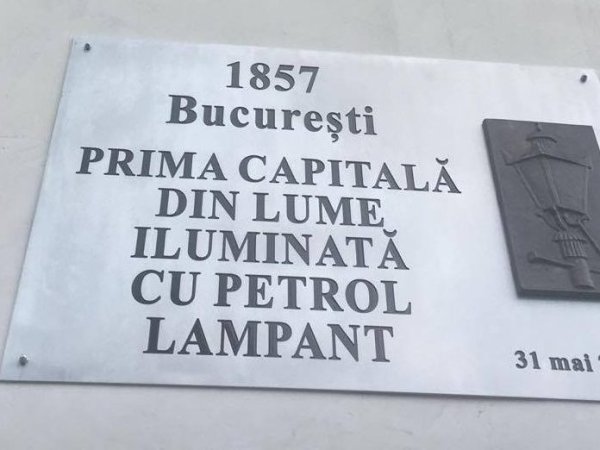
Only a few years after the appearance of rapeseed oil lamps, Bucharest would enter world history through a remarkable achievement. In 1857, the Romanian Capital became the first city in the world to be illuminated on a large scale with kerosene, a technology that would later spread to numerous other major European cities.
A decisive step was taken on October 8, 1856, when the contract for the introduction of public lighting with petroleum-fueled lamps was signed. The entrepreneur Teodor Mehedințeanu, responsible for this initiative, built a distillery in Râfov, near Ploiești. The facility began operating in March 1857, and in April of the same year the first kerosene lamps began to illuminate the streets of Bucharest.
The petroleum used was distilled in the first industrial refinery intended for this purpose, the Gas Factory in Ploiești, and Romanian petroleum thus became the first petroleum-based fuel to enter the commercial circuit. The success of this lighting system caused the number of street lamps to increase rapidly.
If at the end of 1856 there were only 28 installed lamps, by 1860 Bucharest already had 1,106 lamps, and two years later their number had reached approximately 1,800. In 1871, more than 785 kerosene lanterns were recorded, and at the beginning of the 20th century the city had a diversified lighting system consisting of 3,060 petroleum lanterns, 990 mineral oil lamps, 400 powered by coal gas, and around 200 electric bulbs, known at the time as “arc lamps.”
Compared with other major European capitals, Bucharest was at the forefront in this field. For example, Vienna introduced public lighting with petroleum only in 1859, two years after Bucharest’s streets had already been illuminated through this method.
A city of contrasts between modernity and shortcomings
Although the introduction of petroleum lighting represented an impressive advancement, the benefits of this innovation did not immediately reach all areas of the city. Historian Dan Falcan emphasizes that kerosene lighting was present mainly in central Bucharest, while the suburban districts remained in darkness.
For the inhabitants of these areas, life after sunset continued almost exactly as before. People lit candles inside their homes and carried improvised light sources when moving along the streets. Once night arrived, many neighborhoods were swallowed by darkness, and numerous Bucharest residents ended their daily activities as soon as evening came.
This difference between the modernized center and the poor districts was a characteristic of Bucharest during that period. The city impressed foreign travelers through its unusual mixture of elegance and deprivation.
American military doctor James Oscar Noyes, who visited Bucharest in 1854, described the city as a place of powerful contrasts, where luxury and poverty, beauty and ugliness coexisted in a surprising manner. In his observations, he noted the existence of a civilization situated between two worlds, where modernization was intertwined with the difficult social realities of the time.
German military doctor Wilhelm Derblich also recorded his impressions of Bucharest. Although he criticized and mocked certain aspects of the city, he was impressed by Cișmigiu Garden, which he considered an elegant promenade area comparable to recreational spaces in civilized Western states.
The legacy left by Carol Knappe in today’s Bucharest
Although Carol Knappe’s name is not as well known as that of other personalities who contributed to Bucharest’s development, the impact of his activity on the city is undeniable. The introduction of rapeseed oil lamps in 1854 represented the first step toward the modernization of public and private lighting in the Capital, paving the way for the revolution brought by kerosene and, later, by electricity.
Today, the memory of the German merchant is preserved through a street and an entrance that bear his name in Sector 1 of Bucharest. These places represent a form of recognition of the contribution of a man who, through a simple business selling lamps and household items, influenced the way Bucharest residents began to experience their evenings.
The story of Carol Knappe is, at the same time, the story of Bucharest’s transformation from a city dominated by the darkness of candles and old oil lamps into a capital that quickly embraced the new technological discoveries of the 19th century. Such lesser-known figures demonstrate that the evolution of a city is not determined only by great rulers or famous architects, but also by merchants, inventors, and entrepreneurs who had the courage to bring change.
We also recommend: How Public Street Lighting Appeared in Bucharest and Who Paid for “the Light on the Street”