Bucharest's Sector 4: 4 reasons to love it, 4 reasons to hate it
- Articles
- 19 AUG 26
Sector 4 has 262,780 residents, according to the latest census, spread over 34 square kilometers. It starts around Piața Unirii and runs south, through Berceni, all the way to the Ilfov county line. It's a district built on contrast: massive parks and a budget the size of City Hall's, a metro line pushing further out, and a car tax that keeps climbing.
Bucharest's Sector 4. Why to love it
Văcărești Nature Park
Back in the '80s, the communist regime started a hydraulic engineering project here meant to create a reservoir lake, complete with evictions and demolitions, including the Văcărești Monastery. The project was abandoned unfinished, and the area sat empty for years, until nature took over on its own: marshes, reeds, underground springs. In 2016, the state officially recognized what had already happened and declared the site a nature park, by government decision, the first urban nature park in Romania. It covers 183 hectares, shelters more than 100 species of birds, reptiles, and mammals, and entry is free.
Tineretului Park
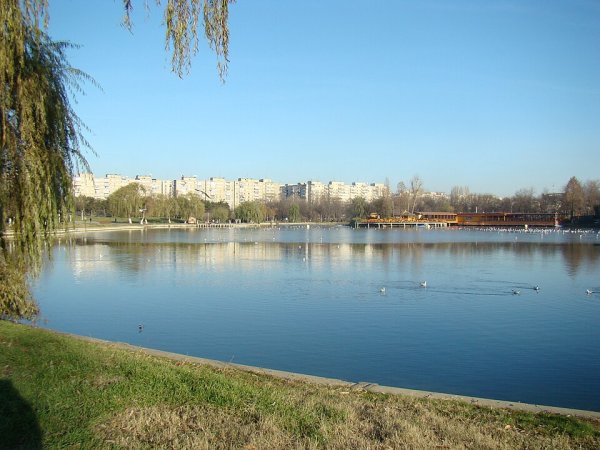
At nearly 90 hectares, it's one of the largest parks in Bucharest, after Herăstrău and Văcărești. Construction started in 1965 and wrapped up in 1974, based on plans by architect Valentin Donose, on land once known as Valea Plângerii, the Valley of Weeping. At its center sits a lake with three islands, and on a hill near the Șerban Vodă end stands the Cenușa Crematorium, opened in 1928 to a design by architect Duiliu Marcu and listed as a historic monument only in 2011. It's been closed to use since 2002 and is rarely visited, hidden behind a curtain of trees, but its silhouette remains one of the park's strangest landmarks.
Bellu Cemetery
Operating since 1858, it covers close to 30 hectares and remains one of the few places in Bucharest where the country's cultural history lies, literally, buried along numbered lanes. This is where Mihai Eminescu, Nicolae Titulescu, and dozens of writers, actors, and statesmen are buried. Entry is free, and the cemetery is still active today, with ongoing burials, not just an open-air museum.
The metro finally reaching south
Tudor Arghezi station opened in November 2023, at the end of the M2 line, extending the network 1.6 kilometers toward Berceni. That's just the start. The M4 line extension, between Gara de Nord and Gara Progresul, already has a financing contract worth nearly 17 billion lei and 14 new planned stations, even though actual construction won't wrap up before 2033. For a district that went without a nearby metro line for years, even a promise with that long a timeline matters.
Bucharest's Sector 4. Why to hate it
The car tax that keeps climbing
In December 2024, the city hall introduced a "special urban development tax" for drivers registered in the district without a residential parking spot: 540 lei per car. Originally presented as a perk, letting owners park free on public spots, the tax rose to 593 lei in 2026, an increase of nearly 10%, justified by inflation. What started as a benefit has effectively become a fixed annual tax.
A budget the size of City Hall's, with debt to match
For 2026, Sector 4 proposed spending of over 12 billion lei, more than 2.2 billion euros. That's nearly as much as the entire Bucharest City Hall's general budget. At the same time, the local council was preparing to double a bank loan taken out in the fall of 2025, pushing the district's public debt to 200 million lei. The administration also reported a surplus of nearly 10 million lei left unspent from the previous year. Unused money on one side, doubled debt on the other.
300 million euros for street aesthetics
The current contract for maintaining and developing public space, signed in 2022 with the company Totul Verde S.A., expires in October 2026. To keep the services running, the city hall is preparing a new framework agreement, and the estimated value of street aesthetics in the district was set at roughly 300 million euros. It's a sum few residents could tie directly to what they actually see on the street.
Big projects, held hostage by shaky politics
The M2 metro extension toward the commune of Berceni, in Ilfov county, is stalled because the commune still hasn't granted the necessary approval. And hanging over every plan in the district is an open conflict between Mayor Daniel Băluță and Bucharest's general mayor, Ciprian Ciucu, who publicly accused him of "rigged schemes" in how the city's money gets divided. As long as major infrastructure projects depend on political relationships this hard to predict, residents can only wait.
There's still a gap between the two lists that's hard to ignore. The parks, the cemetery, the metro line slowly pushing south, all of it is tangible, something anyone can see and use. The taxes, the debt, the political conflicts are just as tangible, only they show up mostly in people's wallets and in local council meetings, not on the street. Sector 4 isn't short on reasons, in either direction.
Photo: De la Ana Zecheru / Wikipedia