Bucharest fought the heat 90 years ago too, and those stories are surprisingly alive
- Articles
- 03 JUL 26
On July 25, 1937, the newspaper România wrote about a summer day that turned the capital into an oven: the pavement went scorching hot, the city's walls soaked up heat, and residents, according to the reporter, spent the hours in outright misery. The mercury climbed steadily from dawn on, and by noon the press of the day was reporting a number hard to believe today: 60 degrees.
That figure wouldn't survive a modern meteorological check — a thermometer left on asphalt, in direct sun, reads something entirely different from the official temperature, measured in shade, under standard conditions. Romania's absolute record, 44.5 degrees, wasn't set until fourteen years later, on August 10, 1951, at the Ion Sion station, in Râmnicelu commune, Brăila county — though even that "official" record has been questioned by researchers, who found the station wasn't part of the certified network of the time and kept incomplete data. Still, the number from the interwar press says something worth keeping: for the person on the street in 1937, that heat genuinely felt like 60 degrees, whatever the right instrument would have shown.
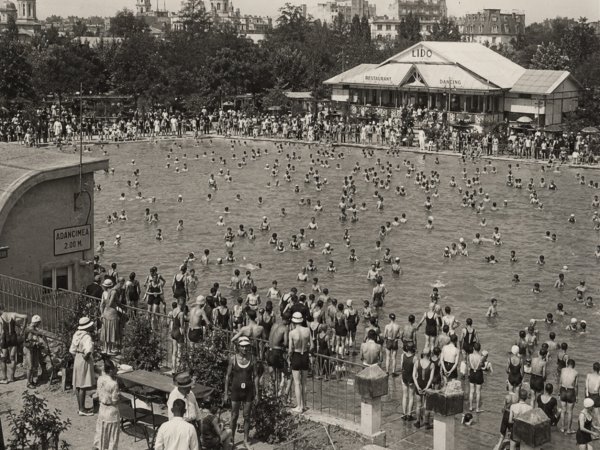
Bucharest's refuge that summer wasn't air conditioning — it didn't exist yet — it was water. A 1935 city guide names the public pools as the main weapon against the heat: Obor pool, Kiseleff pool, and the wave pool at Lido. The press described the scene with a touch of dark humor: thousands rushed toward the crowded, lukewarm water of Bucharest's pools, elbowing each other for a square foot of relief. People showed up whom nobody would have expected — ladies who'd always insisted pools were for children, elderly men who normally left the house only in black formal wear. For a few hours, the heat suspended the social rules of interwar Bucharest.
Nine years later, the summer of 1946 brought another heat wave, just as brutal, but with far graver consequences: the drought that came with it contributed to the severe famine of the following winter. The press of the time joked, in the same register, about a new illness — the obsession with checking the thermometer all day — whose only cure seemed to be "winter's cold." That humor probably masked real anxiety. Bucharest in 1946 didn't yet know what was coming, but people sensed, correctly, that this wasn't an ordinary summer.
The comparison to 2026 draws itself. On June 28, Romania went through, according to meteorologists, its hottest day on record, with dozens of temperature records broken in a single day. Bucharest entered a red heat alert, with temperatures of 38–39 degrees, and the Baccalaureate exam was postponed — for the first time in the recent history of Romanian schools — because of the heat. The real difference between 1937 and 2026 isn't so much the numbers as the frequency. For interwar Bucharest, a summer like 1937 was an exception people talked about for years afterward. For today's kids, blistering summers are starting to look like a seasonal norm, not an event.
One thing hasn't changed at all: the instinct. When the heat hits hard, people go looking for water, shade, and company. The difference is that Bucharest residents 90 years ago had the Kiseleff and Lido pools an hour's walk away. Today's kids have air conditioning — and fewer and fewer shaded places to step out into.
We also recommend What Summer in Bucharest Felt Like Before Malls and Air Conditioning
AI generated photo