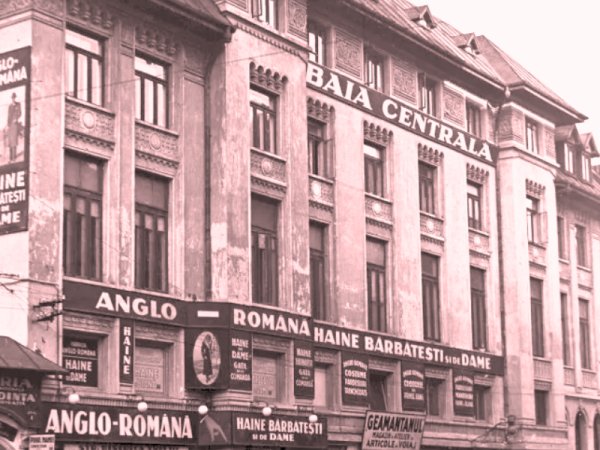
Baia Centrală in Bucharest, the building whose basement housed the laboratory of a Romanian cinema pioneer
By Raluca Ogaru
- Articles
- 17 AUG 26
The basement of Baia Centrală in Bucharest did not serve as Vasile Gociu’s home. In 1924, however, it housed his film laboratory. Surrounded by the public bath’s hot-water pipes, the cinematographer and director developed film, copied newsreels and prepared Romanian-language title cards for foreign productions screened in the capital’s cinemas.
Baia Centrală stood on Biserica Enei Street, close to present-day University Square and opposite the historic School of Architecture building. It disappeared after the earthquake of 4 March 1977, together with other buildings that had once shaped the old street. If you walk through the area today, you will find no physical trace of the public bath or of the atmosphere captured in interwar photographs.
The history of the building is not entirely free of uncertainty. The sources consulted confirm the existence of Baia Centrală, the activities carried out there and its eventual demolition, but they provide different information about the architectural transformations that the building underwent.
A public bath built at the end of the 19th century
Baia Centrală appears in documents and publications dating from the end of the 19th century. The MetaCult Encyclopedia of Architecture lists Baia Centrală on Enei Street among architect Filip Xenopol’s projects from 1895. The establishment was designed at a time when private bathrooms and readily available hot water were not yet common in Bucharest homes.
Public baths fulfilled an essential role in the city’s hygiene infrastructure. They were used by residents whose homes lacked sanitary facilities, by workers and by travellers arriving in the capital. A publication issued by the Bucharest Municipality Museum lists Baia Centrală, located at 11 Enei Street, among Bucharest’s main public baths and mentions the development of such establishments after the First World War.
The address changed over the years. According to research published by Bucureștiul uitat, the building was successively listed at numbers 11, 11 bis, 10 and, later, 8. These differences do not indicate that the public bath moved, but reflect changes made over time to the numbering system on Biserica Enei Street.
A building that also housed other businesses
Baia Centrală was not used exclusively for bathing and hydrotherapy services. The multi-storey building hosted shops and small businesses at various points in its history. The interwar press provides clear evidence. An issue of the newspaper “Universul” published in 1922, for example, carried an advertisement for a dressmaking salon located at 11 Biserica Enei Street, inside the Baia Centrală building.
Its location contributed to the establishment’s visibility. It stood close to the University, in an area crossed daily by students, civil servants, merchants and travellers. It is one of Bucharest’s best-known and most popular public baths, noting that it continued to operate during the communist period.
A photograph taken in 1965 confirms that Baia Centrală still existed and remained in use more than seven decades after it opened. Its distinctive urban profile made it easily recognisable in photographs of Biserica Enei Street. Behind its façade, however, an activity with no direct connection to public bathing also took place: film production.
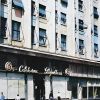
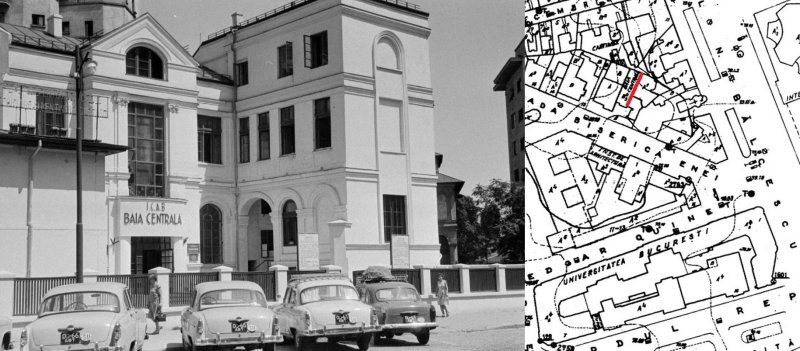 Baia Centrală during the communist era, in 1965. (Source: Bucureștiul uitat)
The laboratory where Vasile Gociu developed films
In 1924, the basement of Baia Centrală housed Vasile Gociu’s film laboratory. The information is recorded by the History of Romanian Cinema project, developed by the Kinofest Association. According to the source, the cinematographer worked “among the hot-water pipes, in infernal heat”, conditions created by the public bath’s installations.
Gociu developed and copied newsreels and documentaries there. A significant part of his work involved creating Romanian-language titles for foreign productions. During the silent-film era, these filmed cards reproduced dialogue, explained the action or offered the information that audiences needed to follow the story.
Vasile Gociu was born in 1897 and died in 1950. He worked as a cinematographer and director during a period when the Romanian film industry had very limited technical resources. He collaborated with Jean Mihail on films such as “Păcat”, released in 1924, and “Manasse”, from 1925. The cultural project Image and Sound describes him as a filmmaker who was well known in his time and mentions the 1928 documentary “Cules de vie la Mărășești”.
The laboratory at Baia Centrală reveals how improvised film production could be in Bucharest during the 1920s. The infrastructure of the studios established in later decades did not yet exist. Film stock was processed in adapted spaces, while filmmakers often performed several jobs themselves: shooting, developing and editing the material, then preparing the copies intended for cinemas.
An architectural chronology that remains partly unclear
The first Baia Centrală building is attributed to architect Filip Xenopol and dated to 1895. Another entry in the MetaCult Encyclopedia, however, includes “Wappner Building – Baia Centrală”, located at 11 bis Enei Street, among Paul Smărăndescu’s projects from 1921.
The online sources consulted do not explain whether the 1921 project involved a completely new building, an extension of the existing property or extensive alterations. The two references should therefore not be combined into an assumed chronology. They do confirm that the Baia Centrală complex underwent architectural interventions and was associated, at different times, with two prominent architects.
The old building was demolished and replaced with a modern structure in 1937. The source attributes this information to an article published by the newspaper “Adevărul” on 20 October 1937. The newspaper issue can be identified in the digital archive, but the original article cannot be consulted in full without access to the collection. Until the primary document is examined, the claim that a complete reconstruction took place in 1937 should be presented with this reservation.
The 1977 earthquake and the disappearance of Baia Centrală
Baia Centrală survived the Second World War and the first decades of the communist regime. The earthquake of 4 March 1977, however, caused severe damage in the University Square area. According to sources dedicated to Bucharest’s history, the public bath building was damaged and subsequently demolished during the interventions that followed the disaster.
Bucureștii vechi și noi records that the old buildings on Biserica Enei Street, including Baia Centrală, were removed to make way for a new urban frontage. The disappearance of the public bath coincided with the radical transformation of the area surrounding the Dunărea apartment block, which had been severely affected by the earthquake.
All that remains of Baia Centrală today are photographs, advertisements and references scattered through city guides, newspapers and histories of Romanian cinema. Together, they reconstruct the story of a building with several lives: a public bath, a commercial property and, for a time, the improvised laboratory where Vasile Gociu worked on films during the early decades of Romanian cinema.