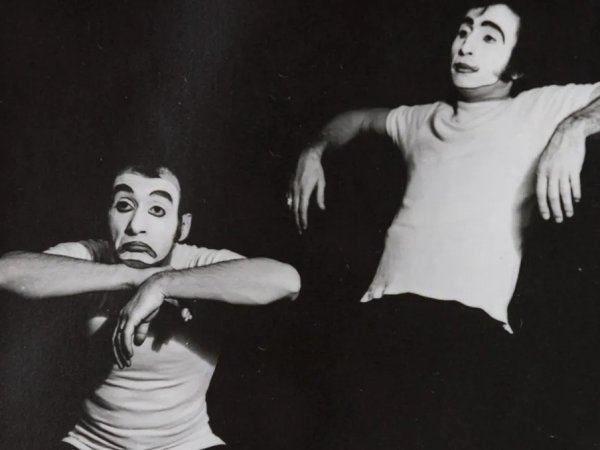
Anton and Romică, the first mime duo of Bucharest theatre. How they turned pantomime into art
- Articles
- 05 JAN 26
The history of Romanian theatre is marked by great names, memorable moments and innovations that permanently changed the way the public perceived stage performance. Among these landmarks is, without a doubt, the duo Anton and Romică, two artists who managed to take pantomime from the area of experiment into the realm of genuine art. Through talent, perseverance and a rare onstage chemistry, they transformed gesture, movement and expression into a universal language, accessible to any spectator, regardless of language or culture.
The beginnings of a unique artistic path
The story of the duo Anton and Romică begins in the 1950s, at a time when Romanian revue theatre was experiencing remarkable creative effervescence. Anton Nicoale, a talented and artistically rigorous ballet dancer, made his debut on the stage of the “Constantin Tănase” Theatre, where he quickly stood out through the elegance of his movement and choreographic precision. Initially, the public associated him with dance and moments of bodily virtuosity, but his artistic destiny was to take on a much broader direction.
The meeting with Romică, whose real name was Romulus Sîrbu, represented the turning point. Although Romică stepped onto the stage somewhat later, also in the 1950s, he brought with him a fresh vision of stage expression. Together, the two formed a duo that was to redefine the limits of comedy and pantomime in Romanian theatre.
The birth of the first mime duo of Bucharest theatre
Anton and Romică were not just two artists who shared the same stage, but became the first officially recognized mime duo in Bucharest theatre.
Their strength lay in their ability to combine movement, dance and pantomime into a coherent form of performance, in which every gesture was charged with meaning. The audience laughed, was moved and found itself in the stories told without words.
Romanian theatre of those years was in constant search of new forms of expression, and Anton and Romică came precisely with the missing ingredient: pure fantasy. They demonstrated that humor does not need elaborate lines to be effective and that bodily expressiveness can sometimes say more than a monologue.
Pantomime, from technique to art
Classical pantomime is defined as the art of conveying a story or a state solely through gestures and facial expressions. Anton and Romică quickly understood the potential of this form of expression and took it to a higher level.
They did not limit themselves to classical conventions, but introduced elements of comedy, improvisation and scenic dynamism, creating a style of their own, easily recognizable.
One of the most representative moments of their repertoire is the famous act “Puricele”. This pantomime, apparently simple, became emblematic through the ingenious way in which the two artists managed to build an entire story without uttering a single word.
Every facial expression, every hand movement or change of rhythm was carefully calculated, and the result was a captivating performance that earned prolonged applause.
Success on the stage of the “Tănase” Theatre
The “Constantin Tănase” Theatre was the place where Anton and Romică definitively consolidated their reputation. Here they became an indispensable duo, eagerly awaited by the public from one show to the next. Their presence guaranteed the success of the performances, and their acts were often the highlights of revue evenings.
Over time, the two created and performed dozens of memorable moments, included in shows that became legendary: “Excentric”, “Surorile Kessler”, “Liliput Varieté” or “Frânghia”. These combined visual comedy with dance and pantomime, offering the audience a complete performance full of energy and imagination.
International recognition and applause beyond borders
The value of the duo Anton and Romică was not limited to national success. Their art was also appreciated on international stages, where the nonverbal language of pantomime was a major advantage. Paris, Budapest, Munich, Tel Aviv and many other important cities witnessed their exceptional talent.
On these stages, the two managed to convey emotion and humor without language barriers, proving that pantomime is a universal art form. Foreign audiences were fascinated by their expressiveness and by the naturalness with which they created comic or poetic situations solely through movement.
Professional separation and individual paths
After more than three decades of collaboration, the professional paths of Anton and Romică parted in 1987. Although the separation was felt by the public, Romulus Sîrbu continued to shine on the stage of the “Tănase” Theatre, which he considered his second home. He remained faithful to revue theatre, continuing to bring fantasy and originality to his performances.
Born on March 5, 1935, in Bucharest, Romulus Sîrbu was recognized as a true master of pantomime. Even after separating from Anton, he demonstrated a remarkable ability to reinvent himself, reinterpreting established concepts and giving them a freshness that won over audiences.
Tributes, legacy and family ties
In October 2021, at the “Savoia” Gala, Romulus Sîrbu and Anton Nicoale were honored together in an emotional moment that brought together stage colleagues and admirers. The event was a clear proof of the respect and love that the two enjoyed throughout their careers.
A lesser-known detail to the general public is the fact that Romulus Sîrbu was the father of Oana Sîrbu, the actress who became famous for her roles in the films “Liceenii” and “Liceenii Rock’n’Roll”. This family connection adds a special dimension to the artistic legacy left by the great mime.
After a career of over 50 years, Romulus Sîrbu passed away on December 22, 2021, in Bucharest, leaving behind a huge void in the world of Romanian theatre. His death marked the end of an era, but not the disappearance of his work.
A lesson in art and passion
Anton and Romică remained in the history of Romanian theatre as a symbol of comedy and pantomime. Through their talent, they proved that simple gestures can tell complex stories and that bodily expression can become a complete artistic language.
Their contribution transformed pantomime into an appreciated and loved art form, and the lesson they left to future generations remains unforgettable.
We also recommend: The stars of interwar Bucharest: Oleg Danovski, the Slavic Sphinx who founded the first ballet theatre in Romania