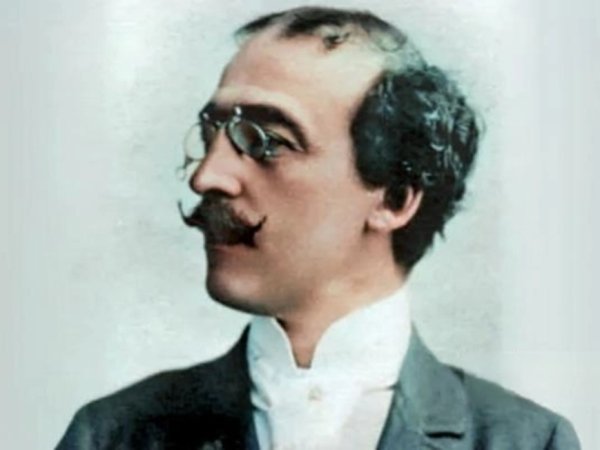
Alexandru Macedonski, the rebellious and eccentric poet of the Romanians. His rivalry with Eminescu ruined his career
- Articles
- 12 DEC 25
Considered to be the most proud and arrogant among the poets of Romanian literature, the life and work of Alexandru Macedonski have always been wrapped in controversies and scandals. Coming from a wealthy family, nicknamed “a spoiled rich boy”, the writer did not shy away from openly showing his obvious contempt for the representatives of Junimea and for his contemporaries. Alexandru Macedonski sees, for the first time, the light of day in Bucharest, on March 14, 1854, being the third son of Al. D. Macedonski, a general and minister of war during the reign of Alexandru Ioan Cuza.
The privileged childhood of a future controversial poet
The boy with black hair and sharp eyes is raised in luxury, in a privileged environment, with extremely high financial resources. He quickly gains the reputation of a “spoiled rich boy”, adopting an arrogant and difficult behavior, treating those around him with superiority.
After graduating from primary and high school courses in his hometown, Macedonski is sent abroad to study in Austria, Italy, and Switzerland.
His difficult character and his choleric outbursts do not keep him away from problems, the future poet finding himself forced to abandon his university studies. In the year 1870, Macedonski makes his literary debut with the poem “The Poet’s Desire”, published in the magazine “Telegraful român” from Sibiu.
His first book of poetry, “Prima verba”, sees the light of print two years later. During the period of glory of the Junimea members, Alexandru Macedonski positions himself in opposition to them, defaming Mihai Eminescu, Vasile Alecsandri, and Ion Luca Caragiale.
The creation of “Literatorul” and the open war against Junimea
In 1880, Macedonski founds the magazine “Literatorul”, an anti-Junimea publication, printed, with interruptions, until the year 1919. In the pages of the magazine, the symbolist poet mocks the works of his contemporaries, attracting the antipathy of the Romanian public.
The harsh attacks brought against his fellow writers begin at the moment when Vasile Alecsandri receives an honorary distinction from the Romanian Academy for his literary work. Blinded by jealousy and envy, Macedonski starts a duel in verse with his rival, whom he repeatedly scorns.
In defense of Alecsandri steps his good friend, Mihai Eminescu. The Morning Star of Romanian poetry does not back down, attacking in turn the symbolist poet:
“His poems and those of several others are not beautiful because they are national ones. We have so many noble models in older poets and especially in folk poetry that the insufficient esteem with which such literary anomalies are regarded fills you with fear, easy to explain.”
The rivalry between Eminescu and Macedonski gains astronomical proportions in the year 1883, when the Morning Star of Romanian Poetry is hospitalized in a sanatorium because of his health problems.
The epigram that destroyed Macedonski’s destiny
Alexandru Macedonski then publishes a stinging epigram aimed at Mihai Eminescu, which he dedicates to a certain “poet X”.
The work is not looked upon kindly by the Romanian public, which expresses its deep antipathy toward the symbolist poet, interpreting his poem as mockery directed at the mental health problems of the great Mihai Eminescu.
“An X claiming to be a poet now / Has gone on the most lamentable path / I would mourn him if in the madhouse / His destiny weren’t better / For until yesterday he was foolish / And today he is nothing but insane”, provokes a vehement reaction against Macedonski from readers.
Public opinion turns against him, and his attempts to justify himself are in vain. Macedonski tries, unsuccessfully, to argue that the epigram does not refer to Mihai Eminescu’s illness and that it is not addressed to him, but his explanations are interpreted by the public as acts of cowardice.
Grigore Ventura, a former collaborator of the magazine “Literatorul”, is the one who identifies the “poet X” as Mihai Eminescu, fueling the wave of indignation and criticism against Macedonski.
“As for the circular note that Mr. Al. Macedonski sent to several newspapers as an answer to the lesson I gave him, I don’t think I need to answer. There are deeds that kill the one who commits them.
For me, Macedonski is a morally dead man, and I shall not imitate his conduct toward Eminescu, striking him when he is on the ground,” wrote the journalist Grigore Ventura.
For Macedonski, the appearance of the epigram signifies the end of his literary career. After the cruel gesture committed against Eminescu, all Romanian newspapers, magazines, and publications refuse to publish his creations.
The doors close in his face, friends abandon him, colleagues no longer answer his calls, and on the street he is pointed at as the one who cowardly denigrated Mihai Eminescu during the difficult moments when the poet was already down.
Rejected by society, he withdraws to Paris, where he lives in poverty and loneliness. He publishes his poems in French newspapers, but returns to the country in 1885.
Conflicts, accusations, and the final years of a tormented writer
He begins a defamation process against Ion Luca Caragiale, accusing the playwright of having plagiarized the work “Năpasta”, being supported by his disciple Caion. In 1875, the liberal Alexandru Macedonski is thrown into prison in Craiova for 3 months for accusations of defamation and incitement to rebellion against minister Lascăr Catargiu and the Conservative Party.
In 1876, Macedonski is appointed interim prefect of the Bugeac region, being forced to leave his position after opposing certain actions imposed by the government. In the following year, C. A. Rosetti appoints him to the position of financial controller of Putna County, a function that Macedonski refuses, considering it inferior.
In the same year, he is named prefectural director of the Silistra Nouă district and settles in Cernavodă. In 1879, he becomes administrator of the Sulina district and, later, general financial inspector.
Alexandru Macedonski remains known as the father of symbolism and the first science-fiction writer in the history of Romanian literature. He passes away in 1920, defeated by illness, at the age of 66.
We also recommend: Oteteleșanu Terrace, the “academy” of Bucharest’s 19th-century elite, where high society attended lavish balls and intellectual debates