Alcalay, the Forgotten Bookstore of Prewar Bucharest: The Story of the Jewish Boy Who Distributed Pamphlets and Books on the Streets of the Capital
- Articles
- 17 MAR 26
Leon Alcalay was undoubtedly the most famous antiquarian and bookseller of Bucharest. Born in 1847 into a Sephardic Jewish family whose ancestors had settled in Wallachia long before, Leon began selling old volumes and pamphlets in the city from a very young age: “Being a child of people without means, he learned what he could of primary classes and two or three gymnasium classes, and after that he set to work and began the difficult struggle to create an honorable existence, selling books, pamphlets, and old or rare magazines, at first running around the city during the day and visiting amateurs as a peddler.”
Early Days of a Young Bookseller
After managing to accumulate a modest capital, Alcalay, in 1864, bought two large cabinets and settled at the intersection of Podul Mogoșoaiei (now Calea Victoriei) with the new boulevard, which would later be called Elisabeta, at that time a vacant lot. In 1867, construction began on the Grand Hotel du Boulevard (which still exists today), forcing the bookseller to move, spending the following years along Calea Victoriei, first near the Police Prefecture, and later at the site of today’s Nifon Palace.
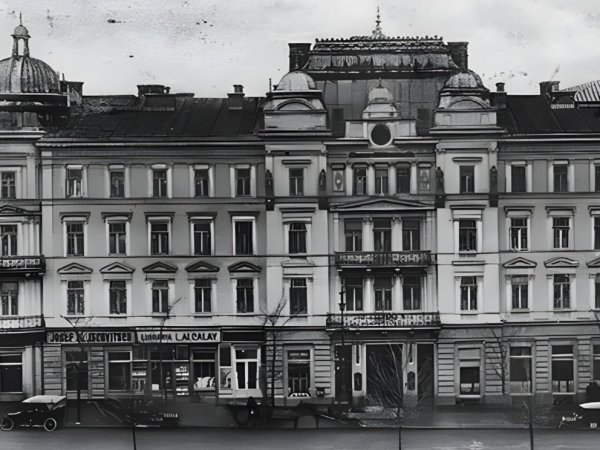
When the city hall demolished the shops to build the palace in 1883, Leon returned to the intersection of Calea Victoriei and Bulevardul Elisabeta, occupying the ground floor of the Hotel Boulevard. His shop featured an antiquarian section, a section for Romanian and foreign books, and another for stationery and schoolbooks. The antiquarian side of his business remained a constant passion for Alcalay, who could not part with it.
The Rise of Biblioteca pentru Toți
Alcalay’s fame grew exponentially after acquiring the collection Biblioteca pentru Toți from Carol Müller. Through this collection, he distributed both Romanian authors and translations from world literature at very low prices. The pocket-sized format, practical and portable, made the collection highly attractive to readers of all ages, sexes, and social categories.
One could spot the volumes in trams, trains, or on a bench in Cișmigiu Park, held by a student, a young lady, or a pensioner. No public or private library, urban or rural, lacked a few copies of Biblioteca pentru Toți. The fame of the collection provided Alcalay with significant income, allowing him to expand the number of titles, increase print runs, and improve print quality. His efforts to popularize books earned him the position of vice president of the National Association of Booksellers.
Challenges and Interwar Revival
The bookstore experienced difficulties during the Great War, which interrupted its activities. In 1923, it was taken over by Iancu Șaraga and S. Schwartz, who saved it from closure and gave it new brilliance. Whereas previously the shop had a modest appearance with a single entrance and two display windows, in the interwar period it gained a marble façade, multiple entrances, and fourteen display windows. Literary historian Ioan Massof described it as a “jewel of Bucharest.”
This expansion was made possible by purchasing the entire corner of the building facing the intersection of Calea Victoriei and Bulevardul Elisabeta, demolishing the shops and a tailor’s workshop in that wing, removing internal vaults and several partition walls. The new owners continued publishing Biblioteca pentru Toți, distributing no fewer than 50 million volumes nationwide over ten years.
Literary Impact and Collections
The bookstore and publishing house produced works by Queen Maria, Liviu Rebreanu, Mircea Eliade, Victor Eftimiu, Tudor Arghezi, Ion Agârbiceanu, Barbu Delavrancea, Emil Gârleanu, Nicolae Iorga, Marta Bibescu, Cezar Petrescu, Eugen Lovinescu, Ion Minulescu, and many others.
Additionally, they initiated new collections aimed at youth or specialized audiences, such as the Hamangiu Collection, gathering the most important Romanian legal works, and the Romanian Laws Collection, which published all the laws of the country.
A Hub for Writers and Intellectuals
Vlaicu Bârna recalls the elderly salesman Iulius, who oversaw the foreign, especially French, books during the interwar period. Bârna also recounts how, every day at noon, Liviu Rebreanu would appear, coming from his Latin classes at Mihai Viteazu High School, taking tram number 14, where he had a pass, to Alcalay. He would get off at Universitate, browse the latest publications, converse with acquaintances, and always make a small detour through Cișmigiu on his way home.
The bookstore had become a preferred meeting place for writers, particularly around lunchtime between 12 and 1 PM. Eugen Lovinescu frequented it regularly until his death, along with other writers, critics, and literary historians of the period.
Transformation and the Remus Cioflec Era
The shop changed its name in 1940 when it was taken over by Remus Cioflec, who came to Bucharest after Cluj, his hometown, was annexed by Hungary along with a significant part of Transylvania following the Vienna Diktat. The name change was also linked to the Antonescu-era policy of Romanianizing names.
The Remus Cioflec bookstore and publishing house continued to operate during the war and postwar years, maintaining the legacy of its founder while adapting to changing political and social circumstances.
Legacy and Cultural Significance
Leon Alcalay’s bookstore was more than a commercial space; it was a cultural institution that introduced thousands of readers to literature from Romania and around the world. The interwar Alcalay shop, with its marble façade and elegant displays, became a symbol of Bucharest’s literary life, a meeting place for intellectuals, and a gateway for generations of readers to access affordable and diverse books.
Its innovative approach to book distribution, especially through Biblioteca pentru Toți, demonstrated how literature could reach a broad public, from students and teachers to everyday citizens, contributing to the democratization of knowledge and culture in Romania.
The story of Leon Alcalay is the story of Bucharest itself: a tale of persistence, entrepreneurship, and a deep love for literature. From selling pamphlets on the streets as a poor Jewish boy to establishing one of the most influential bookstores in interwar Romania, Alcalay’s life reflects the power of books to shape society and culture.
Though the original bookstore has faded into memory, its impact on Romanian letters and the literary habits of countless readers endures, a testament to the dedication of a man who turned his modest beginnings into a cultural empire.
We also recommend: Symbols of Bucharest: The Cartea Românească Bookstore, the Favorite Place of Interwar Intellectuals