38 Degrees and 150,000 People. The Most Crowded Trams in Bucharest
- Articles
- 08 MAY 26
Summer arrives, the air thickens, and on the platforms of STB stations people gather with a resignation that substitutes for routine. Bucharest's trams are, during the warm months of the year, a test of character — a combination of hot metal, sticky shoulders and patience negotiated by force. But not all lines are the same. There is an unwritten hierarchy of crowding, and if you understand its topography, you can navigate the city with considerably more dignity.
Line 41: the absolute monarch
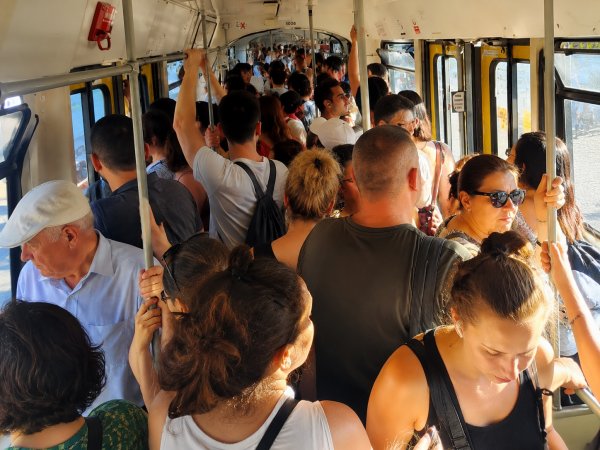
Its route of nearly nine and a half kilometres in both directions connects Piața Presei Libere to Ghencea, passing through Crângași, Militari and Drumul Taberei — four Soviet-era residential districts whose populations arrive at work simultaneously, at the same fixed hours. The first line in Romania designed with priority circulation over road traffic, line 41 serves around 150,000 passengers daily. These are figures that sound reassuring in official documents and which on the ground translate into the fact that, every working morning, there is a precise moment — somewhere between 7:40 and 8:20 — when the tram becomes a compact mass of people attempting to breathe in different directions.
Summer adds another dimension to the problem. The Imperio Metropolitan trams introduced on this line have air conditioning, but the older generations of V3A carriages running alongside them have fans of limited persuasive power. On a V3A at four in the afternoon, the interior temperature easily exceeds 38 degrees — the smell is that of a crowded sports hall, with notes of warm metal and the kind of summer fragrance you associate with a busy self-service canteen. People manage with fans and water bottles, which in August, inside a tram, looks like an improvised survival choreography.
The backbone of the route remains the section between Drumul Taberei and Podul Grant, the zone with the greatest daily crowding. The Lujerului underpass, where the tram descends below road level and for a brief moment it feels as though another city might be possible — more orderly, more predictable — is a parenthesis of a few seconds before street reality returns to the surface.
Șoseaua Progresului: the invisible node
If line 41 is the declared star, the section along Șoseaua Progresului, between Răzoare and Constantin Istrati, is the most congested in Bucharest in terms of tram flow. The reason is simple and blunt: across its three kilometres and six stops, five major lines run daily — 1, 10, 11, 25 and 47 — alongside the carriages making access and return runs for line 41 from the Alexandria and Victoria depots.
Six stops where trams follow one another with a frequency that should feel comfortable, but which becomes overwhelming when each one arrives already full from its origin neighbourhood. Line 25, which crosses Militari and ends at CFR Progresul, absorbs passengers at every stop without being able to release the pressure, because those already inside still need to travel further. STB has recently introduced modernised V3A trams on this line — with ergonomic seats, USB ports and video monitoring systems — a gesture of modernity applied to a route that otherwise remains an honest portrait of how Bucharest functions.
Line 5 and Piața Iancului: a complicated return
March 2026 brought the return of line 5 to service, after a long period of suspension, and with it a new pressure on one of the city's already strained intersections. Piața Iancului absorbed the changes with difficulty: lines 5 and 55 meet and diverge at the same point, and the switches operate without full automation. Drivers lose time at every pass, the queue of trams forming behind the stop sometimes reaches a melancholy length, and for the passenger alighting there hoping to make a connection, the timing calculation becomes a gamble.
Lines 1, 10, 21, 32, 40, 55: the middle platoon
They lack the spectacular reputation of line 41, but they carry entire districts from the periphery to the centre and back every day. On line 32, which crosses the Pantelimon area and reaches the centre, summer means stagnant air in the older carriages and people shifting sideways to make room for others when there is, in fact, no room. The lines running along Calea Călărașilor and Bulevardul Theodor Pallady operate on diverted routes due to ongoing modernisation works, adding distance and time to each journey and redistributing pressure onto the lines that remain operational.
Summer and metal: the physics of heat on rails
The ageing infrastructure — largely from the 1970s and 80s — reacts to urban heat with a degree of sensitivity that modern rail engineering could significantly reduce. During periods of extreme temperature, the rails expand and block circulation across multiple lines simultaneously: last summer, trams on lines 19, 23 and 27 were stopped on Bulevardul Camil Ressu due to exactly such an incident, while line 40 experienced similar problems on Bulevardul Basarabia.
The city is in transition: the investment of over 265 million euros signed with the European Investment Bank covers the modernisation of 50 kilometres of track and the rehabilitation of the Colentina depot. The money exists, the construction sites are open, but in the summer of 2026 the works also mean route diversions, reduced frequencies and fewer trams on the lines absorbing extra passengers from the closed sections.
How to navigate: a few concrete things
If you can avoid the 7:30–9:00 and 16:30–18:30 windows on line 41, do so. If you cannot, the Imperio trams have air conditioning and are worth waiting a few extra minutes for in the stop — let the old V3A pass and board the one that follows. STB has fitted passenger counters on the Imperio fleet, and real-time occupancy data feeds directly into Google Maps, a genuinely useful feature before you even leave for the stop.
Along Șoseaua Progresului, if your destination allows it, lines 1 or 10 can offer alternatives with less pressured boarding points. And on line 5, at least until circulation in Piața Iancului stabilises, a quick calculation of the time lost at that intersection is worth making against the alternative of a bus or a short walk.
Bucharest's trams in May have a specific quality: they are simultaneously a form of transport and a submersion into the city's temperature, into the smell of scorched asphalt drifting through wide-open windows, into the conversations that begin on the platform and continue, inexplicably, inside the carriage. It is a city experience that, once accepted for what it is, can be inhabited with considerably more curiosity and considerably less discomfort.