22 December in Bucharest: the day the city took to the streets and changed Romania’s history
By Bucharest Team
- Articles
- 22 DEC 25
The morning of 22 December 1989 did not arrive with clear signs that history was about to break. Bucharest was the same grey winter city—people rushing to work, fear compressed into small gestures, silence turned into habit. What changed, almost imperceptibly at first, was people’s behaviour. Some arrived late at work. Others chose not to go in at all. Small groups began to form—without coordination, without leaders, but with a shared intuition: this was no longer an ordinary day.
For Bucharest, 22 December was not just a historical date. It was the day the city, as a whole, decided to step out of inertia.
First gatherings and the exit from fear
In the city centre, large open spaces became points of attraction. University Square was one of the places where the crowd formed naturally, without any call to assemble. Students, workers, teachers—people who did not know one another—began to recognise each other through a simple gesture: they stayed. They did not leave. The chant “Freedom” appeared in fragments, timid at first, then increasingly loud. It was not a learned slogan, but a word spoken as release.
The atmosphere was confused. No one knew exactly what would follow. People spoke in whispers, rumours circulated, quick calculations were made: is it safe to stay? is it too late to leave? Fear had not disappeared, but it no longer ruled.
The road toward the centre of power
The crowd began to move toward the area of the Central Committee. In what was then Palace Square, people found themselves facing the buildings that symbolised the regime. The Royal Palace was there, but the real stake was the headquarters of the Communist Party. Tension rose visibly. This was no longer just a protest; it became a direct symbolic confrontation.
The moment when the Ceaușescu couple fled by helicopter was perceived differently from one person to another. Some applauded; others remained frozen in disbelief. For many Bucharest residents, that gesture marked the first real crack in a system that had seemed immovable. The city was no longer just a witness. It became an actor.
Television, between chaos and truth
Another essential focal point of the day was Romanian Television. The TVR building quickly became a place of convergence—and of tension. For the first time in decades, messages were no longer strictly controlled. Improvised broadcasts, trembling voices, the absence of a coherent narrative conveyed something more important than accuracy: authenticity.
For those in the streets, TVR was proof that what they were experiencing was not a collective illusion. For those watching from home, it was evidence that the regime no longer fully controlled reality.
A city suspended
On the streets, Bucharest operated by different rules. Traffic was blocked; people moved in groups; strangers became temporary allies. Information was shared, warnings were passed along, forms of protection were improvised. The city was vulnerable, but alive. There was no master plan—only a shared energy.
That day, Bucharest was less a city and more a state of being.
The same places, a different meaning
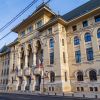
Today, these spaces are absorbed into an urban normality that rarely pauses for memory. University Square is crossed daily by cars, students, tourists, and occasional protests. The area of the former Palace Square is now an elegant cultural and administrative perimeter—restored, functional. The Romanian Television building returned long ago to its professional routine.
And yet, for those who know the history, these places are not neutral. Beneath the asphalt and renovated façades remains the imprint of a day when the city was forced to define itself.
What remains of 22 December
22 December is not easily fitted into a comfortable narrative. It lacks the coherence of a festive moment and the calm of a traditional commemoration. It remains open, unfinished, because it was lived without certainty and without guarantees.
What remains, first of all, is the experience of a city acting spontaneously. People who went into the streets without knowing whether the regime would fall, whether the army would fire, whether events would turn against them. Decisions were not heroic in a solemn sense; they were quick, instinctive, made under the pressure of fear mixed with hope. This is one of the least acknowledged realities of 22 December.
What also remains is a fragmented urban memory. Bucharest has not built a clear route of the Revolution, nor a unified public discourse about that day. The places exist; the buildings are visible; but their meaning is often left to those who already know what happened. For everyone else, the city moves on—functional, hurried, seemingly detached.
22 December remains relevant precisely through this tension: between a founding event and a memory managed discreetly, sometimes uncomfortably. It is a day that demands clarity, not pathos—and understanding rather than celebration.