What Snow Brings to the Surface in Bucharest. Infrastructure, Solidarity, Nerves, and Improvisation
By Bucharest Team
- Articles
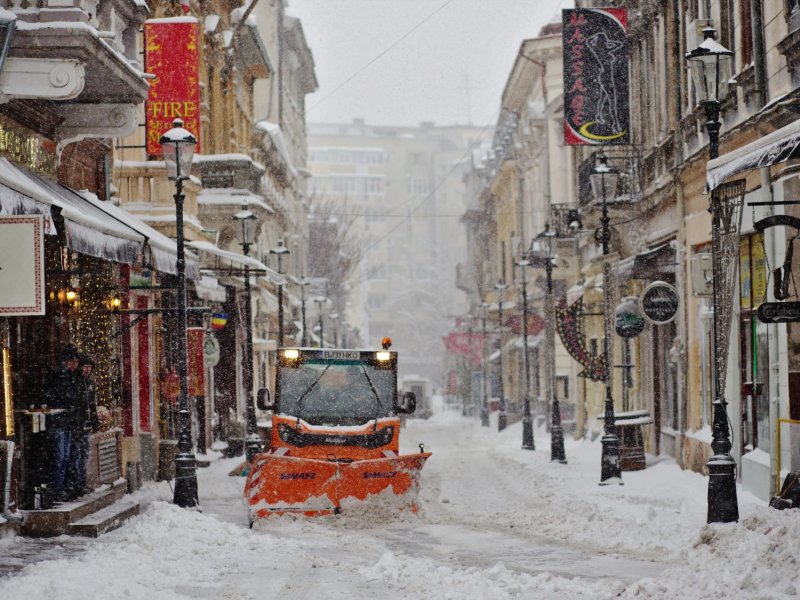
When it really snows in Bucharest, the city doesn’t change only on the surface. Snow doesn’t just turn sidewalks white and slow down traffic; it seems to pull on an invisible thread, bringing into the light everything that, for most of the year, stays hidden beneath routine. For a few days, the capital can no longer pretend. Everything becomes clearer, louder, more honest.
The first thing to emerge is the infrastructure.
Snow doesn’t create new problems; it simply underlines the old ones. Sidewalks that vanish entirely, curbs that turn into traps, pedestrian crossings that no longer lead anywhere. What looks like mere negligence in summer becomes a real obstacle in winter. Every step has to be calculated, every crossing turns into a quiet negotiation with the city. In the cold, Bucharest reminds you that it was never truly designed for walking.
Then, gradually, the nerves appear.
In cars stuck in place, in glances thrown from beneath wool hats, in short sighs on platforms or in line at the bakery. Snow slows everything down, and the city is not used to waiting. Horns sound more easily, voices rise faster, blame is searched for everywhere. Winter compresses the patience of Bucharest’s residents until it becomes visibly thin.
But almost at the same time, solidarity shows up too.
A stranger pushing an unknown car. Someone clearing a narrow path on the sidewalk with an improvised shovel. A brief gesture, without speeches, without photos. Snow creates situations where you no longer have time to decide whether “it’s your responsibility” or not. You simply help. For a few moments, the city works not through rules, but through people.
Improvisation is perhaps Bucharest’s most constant reflex under snow.
Paths that appear overnight, unofficial detours, staircases turned into makeshift slopes, street corners adapted on the fly. The city is not perfectly prepared, but it is inhabited by people who know how to manage. Everyone finds a small, temporary solution—just enough to get through the day. Not elegant, but effective.
Snow also brings out a subtle distinction: who belongs to the city and who merely passes through it.
Those who know it understand where to walk, what to avoid, where the ice gathers, where it melts first. The others look surprised, irritated, disoriented. Winter turns Bucharest into a test of adaptation, not of endurance.
And for a very short time, the city becomes more transparent.
Beautiful façades matter less when you can’t reach them. Advertisements fade into the background when you’re focused on keeping your balance. Snow reduces Bucharest to its essentials: how we move, how we help each other, how we react when things don’t go smoothly.
Snowfall is not a problem for Bucharest—it is a mirror.
It shows us, without politeness, where we are fragile, where we are quick to lose our temper, and where, surprisingly, we are better than we think. The city doesn’t break in winter; it simply becomes easier to read.
Also recommended From Vacant Lots to Playgrounds: Growing Up in Bucharest Over the Past 30 Years