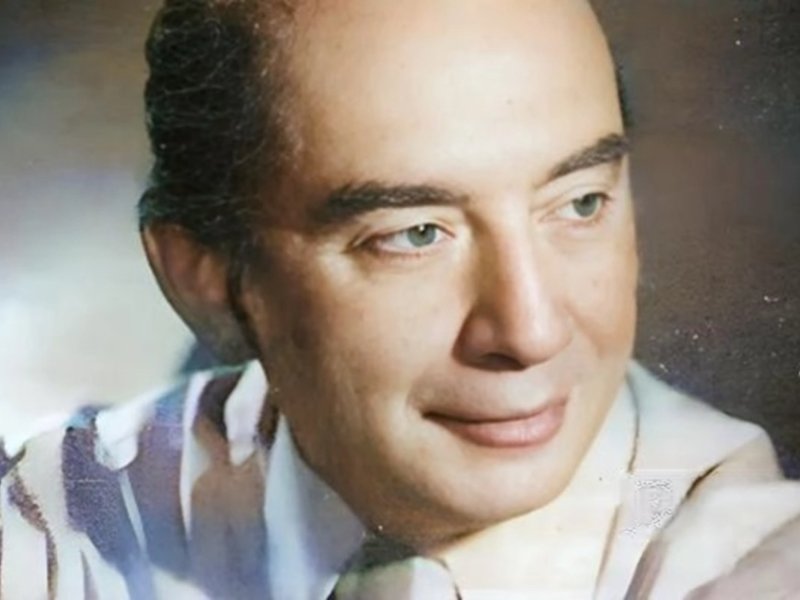
The story of master Edmond Deda, conductor, composer, artist, legend: “Heart, do not be of stone” and do not forget him!
By Bucharest Team
- Articles
On April 23, 1920, in Bucharest, Edmond Deda was born, a name that should be spoken with emotion and respect whenever we talk about the history of Romanian light music. Although today he is less present in the public memory, Edmond Deda was one of the most complex and influential personalities of the Romanian musical scene of the 20th century. Composer, musicologist, pianist, conductor, orchestrator, teacher, and mentor, he was a true architect of musical sensitivity, a creator who knew how to transform emotion into sound and story.
A destiny linked to the stage of the Revue Theatre
Edmond Deda’s artistic activity is closely connected to the “Constantin Tănase” Revue Theatre, an emblematic space of Romanian entertainment. Here he worked for many years as pianist, conductor, and musical director of the orchestra. His presence on stage was constant, and his role essential: he provided live accompaniment and coordinated the musical ensembles in shows that would define an artistic era.
The revue theatre was not only a place of humor and satire, but also a platform for quality music. Edmond Deda understood this and contributed decisively to refining the genre, bringing elegance, harmony, and emotional depth to a field often considered superficial.
The teacher who shaped generations of artists
Alongside his stage activity, Edmond Deda was a teacher at the Popular School of Art in Bucharest. Here he trained artists who would go on to become reference names in Romanian music and entertainment. Trio Grigoriu, Simona Cassian, Aida Moga, and Mara Ianoli are just a few of the personalities who passed through his hands and benefited from his pedagogical rigor and passion.
Deda did not teach only musical technique. He instilled in his students respect for art, professional discipline, and openness to new influences. His modern vision of musical education turned him into an authentic mentor, capable of shaping not only voices and instrumentalists, but artistic characters.
The formation of a complete musician
Edmond Deda’s solid musical education took shape from a young age. In 1938, he graduated from the “Alberto della Pergola” Conservatory in Bucharest, where he was a disciple of renowned masters.
His multifaceted talent manifested itself quickly, and his ambition to create something new led him, in 1941, to found the first Conservatory dedicated to light music and jazz in Romania.
This initiative was visionary, at a time when jazz and light music were viewed with suspicion. Four years later, in 1945, Edmond Deda formed his own musical band, marking the beginning of an extremely prolific activity. Throughout his career, he signed no fewer than 43 scores for musical shows and musicals.
Debut and recognition in musical theatre
His debut as a composer took place in 1938, with the revue show “Poftă bună, la Tănase”, staged at the “Cărăbuș” Theatre, in collaboration with Vasile Vasilache and Gherase Dendrino. It was the beginning of a brilliant career, in which the name Edmond Deda became synonymous with musical refinement and authentic emotion.
In the 1950s and 1960s, Deda signed the music for numerous successful shows that quickly entered the public consciousness. Among them were “Toamna se numără melodiile” (1954), created together with Gelu Solomonescu, as well as “Nunta lui Gică”, “Dansați cu noi”, “Cu dragostea nu-i glumit”, “Do-Re-Mi-Fa-Etcetera”, “Cu concertul în buzunar”, “Estrada noastră vă salută”, “Muzica, bat-o vina!”, and “Aventurile unei umbrele”.
The complete artist: composer, conductor, and performer
Edmond Deda never limited himself to the role of composer. He was a complete musician, capable of orchestrating, conducting, and performing with the same naturalness. In the show “Un cântec pentru dumneavoastră” from 1963, he signed the entire soundtrack, accompanied at the piano, and conducted the orchestra, collaborating with artists such as Nicolae Nițescu and Gigi Marga.
He was also present at the orchestra podium of the “Tănase” Theatre in “Nu aduce ziua ce aduce noaptea!” (1966), a literary-musical cabaret with music signed by Elly Roman. His presence guaranteed artistic coherence and musical quality in every performance.
The musical “Corina” and the maturity of creation
Edmond Deda’s talent manifested itself fully in the area of musical theatre as well. In 1981, he created “Corina”, a musical adaptation of the play “Jocul de-a vacanța” by Mihail Sebastian, staged at the “Tănase” Theatre under the direction of Matei Alexandru.
The cast brought together George Paul Avram, Rodica Popescu-Bitănescu, Vali Niculescu, Victor Moldovan, and Marina Scupra, demonstrating the continuity of his influence over several generations of artists.
The hits that became collective emotion
Edmond Deda was, above all, a poet of music. His romances and hits finely captured the sensitivity of an era and the depth of human feelings. Among his reference creations are “Mă mai gândesc la dumneata”, “Asta-i tot ce-a mai rămas”, “N-am nicio vină”, “Of, inimioară”, “Inimă, nu fi de piatră”, “Ce te uiți așa la mine?”, “Dragostea vine când vrea ea”, “Oglinda”, “Îndrăgostiții n-au nevoie de cuvinte”, “Știu adevărul”, “A fost ca niciodată”, and “Suflet de copil”.
Performed by legendary artists such as Margareta Pâslaru, Luminița Dobrescu, Corina Chiriac, Ștefan Bănică, Aura Urziceanu, Aurelian Andreescu, Doina Spătaru, Dan Spătaru, Horia Moculescu, and Anda Călugăreanu, these songs entered the golden archive of Romanian music.
The legacy of a master forgotten too easily
Despite this impressive contribution, the name Edmond Deda is today rarely invoked. Beyond the stage and composition, his pedagogical influence was overwhelming.
He was a pioneer of applied musical education focused on jazz and light music and collaborated with renowned professionals of the Romanian and international scene.
In the 1970s, he was a special guest in shows such as “Show la Savoy”, where he brought to the Romanian public the music of giants like George Gershwin, Irving Berlin, and Glenn Miller.
Edmond Deda passed away on September 29, 2006, leaving behind an impressive artistic legacy, but one insufficiently valued. Today, 105 years after his birth, it is the right moment to bring him back into the collective memory.
By remembering Edmond Deda, we are reminded of the power of music to make us more sensitive, more human, and closer to one another.
We also recommend: The story of artist George Grigoriu. The star of Trio Grigoriu launched Angela Similea and Stela Enache