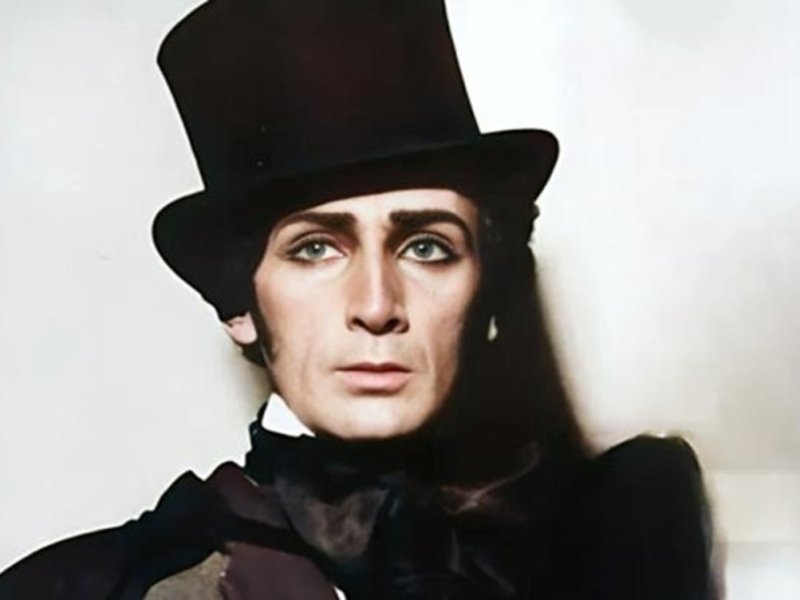
The stars of interwar Bucharest: Oleg Danovski, the Slavic Sphinx who founded the first ballet theatre in Romania
By Bucharest Team
- Articles
The destiny of Oleg Danovski seems to have been written from his very first years of life. Born on February 9, 1917, in the town of Voznesensk, Ukraine, the future great choreographer grew up in an environment deeply marked by art, discipline, and sensitivity. His mother, Juliette, was a ballet master at the Theatre of Chernivtsi, and the Danovski family home was a space where rehearsals, music, and conversations about the stage were part of everyday life. In such a context, ballet was not merely a choice, but a natural continuation of a way of living.
Childhood in a family of artists and the beginnings of a vocation
From early childhood, Oleg understood that dance is not just movement, but expression, emotion, and rigor. The hours spent in rehearsal rooms, watching his mother and her students, shaped not only his technique, but also his critical eye toward choreographic art.
Later on, he would confess that the cultural atmosphere within his family helped him view ballet as a complex form of creation, in which every gesture has meaning and artistic weight.
A rebellious adolescence and the struggle for survival in Bucharest
At only 14 years old, Oleg Danovski made one of the riskiest decisions of his life. Driven by the impulse of adolescent love and a desire for independence, he ran away to Bucharest together with one of his mother’s students, determined to build his own artistic path.
The interwar capital was fascinating, yet merciless to a teenager without money or support. The first months were marked by extreme deprivation, nights spent sleeping on benches in Cișmigiu Park, and days when he survived only on water and bread.
Salvation came with his employment as a dancer at the “Cărăbuș” Theatre, led by the famous Constantin Tănase. The young dancer’s talent quickly stood out, and an unexpected event changed his destiny: forced to replace the principal dancer, who had fallen ill, Danovski stepped onto the stage in a leading role.
The audience and his colleagues were impressed by his expressive strength and scenic confidence, and his rise became rapid and spectacular.
From revue theatre to classical ballet and the birth of the “Slavic Sphinx”
After his experience at “Cărăbuș,” Oleg Danovski continued his activity with the “Alhambra” company, where, between 1932 and 1933, he became a principal dancer. Under the guidance of Nicolae Vlădoianu, he refined his style and began searching for a deeper form of expression, beyond entertainment spectacle.
The grace of his movements, his solemn posture, and his intense gaze earned him the nickname “The Slavic Prince,” while the theatre’s director called him “The Slavic Sphinx,” a name that would define him throughout his life.
At the beginning of the 1940s, Danovski felt that revue theatre could no longer satisfy his artistic aspirations. He chose classical ballet, a field that offered him the possibility of ample choreographic constructions and authentic development.
His collaboration with the Romanian Opera in Bucharest represented a decisive step, allowing him to approach the great scores of the universal repertoire and to define a personal choreographic style based on rigor, expressiveness, and innovation.
The encounter with Floria Capsali and the construction of a Romanian ballet school
An essential role in the evolution of Oleg Danovski was played by Floria Capsali, a personality who had already laid the foundations of modern choreographic education in Romania. Her activity at the Romanian Opera in Bucharest attracted an entire generation of talented dancers, and Danovski quickly integrated into a high-level artistic environment. Floria Capsali’s support offered him not only professional opportunities, but also a model of rigor and artistic vision.
Together, the two shared the goal of developing an authentic Romanian ballet capable of rising to the level of the great European schools. If Floria Capsali consolidated the educational structure, Danovski carried this legacy forward through his stage creations.
At only 17 years old, he became the youngest choreographer in the world, and his productions at the Romanian Opera, such as “Lakmé” by Léo Delibes, already announced an artist with a mature and courageous vision.
International recognition and the great performances of artistic maturity
The year 1949 marked a reference moment in Oleg Danovski’s career, with the premiere of the ballet “Harap Alb.” The performance was received with enthusiasm by both audiences and critics, being considered clear proof of his artistic maturity. The culmination came in 1957, when he staged “Swan Lake” at the Bucharest Opera and Ballet Theatre, in a production that remained in the history of Romanian ballet.
This version of Tchaikovsky’s masterpiece was applauded during international tours and consolidated Danovski’s reputation on the world’s great stages. He was invited to stage performances at prestigious institutions such as the Bolshoi Theatre in Moscow, the Milan Opera, and the Metropolitan Opera in New York.
At the same time, he served as a juror at international competitions and received important distinctions, including the title of Merited Artist of the Arts and the “Cultural Merit” decoration.
The Constanța ballet theatre and the legacy of a visionary
One of Oleg Danovski’s most enduring achievements was the founding of the first ballet theatre in Romania, in Constanța. In 1978, at the invitation of the director of the “Fantasio” Theatre, Aurel Manolache, he created the Classical and Contemporary Ballet Ensemble, bringing together talented young dancers from Bucharest and Cluj.
Here, the master staged the Tchaikovsky trilogy – “Swan Lake,” “The Sleeping Beauty,” and “The Nutcracker” – transforming the institution into an essential center for Romanian ballet.
Even in his final moments, Danovski remained faithful to art. His last performance, “The Snow Queen,” was created while he was gravely ill, a testament to his absolute devotion to dance. He passed away on October 21, 1996, leaving behind an impressive artistic legacy.
Today, the National Opera and Ballet Theatre of Constanța bears his name, and Oleg Danovski remains a legend of dance, the artist who transformed Romanian ballet into an art respected worldwide.
We also recommend: Mia Apostolescu, the diva of interwar Bucharest, the right hand of Constantin Tănase. The story of the stunning cupletist from Cărăbuș