Who was the ruler Alexandru cel Bun and why a street in Bucharest bears his name
- Articles
- 27 JAN 26
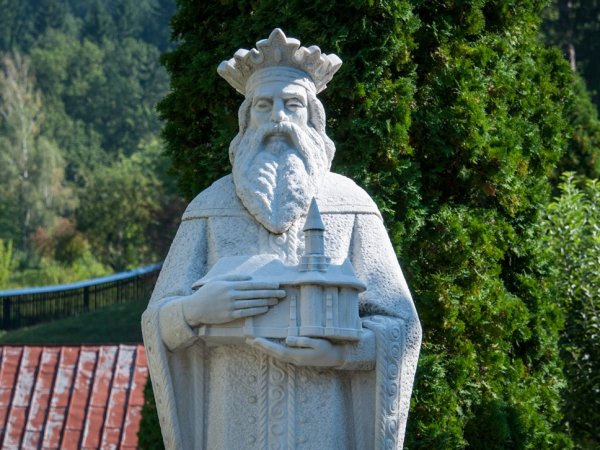
Alexandru cel Bun is one of the fundamental figures of medieval Romanian history, a ruler whose political, diplomatic, and cultural legacy profoundly marked the evolution of Moldavia. Although he ruled for more than three decades, one of the longest reigns in Romanian medieval history, the epithet “the Good” was not attributed to him during his lifetime, but only after his death, as recognition of the balance and stability he offered the country. The fact that an important street in Bucharest bears his name is not accidental, but reflects his importance in Romanian state-building.
Alexandru cel Bun and the beginning of an exemplary reign
Alexandru cel Bun ascended the throne of Moldavia at the beginning of the 15th century and ruled for more than 30 years, a period during which he managed to consolidate the Moldavian state in a complicated geopolitical context. During his lifetime he was known as Alexandru Vodă cel Bătrân, a title that emphasized both his age and his authority. According to the “Letopiseț” of Grigore Ureche, he was the first ruler of the Bogdănești lineage to bear a Greek baptismal name, a detail that reflects the cultural and religious influences of the era.
The epithet “the Good” was attributed to him posthumously, as a historical assessment of his reign. Alexandru was considered a wise leader, especially due to his diplomatic skills. In a period when armed conflicts were frequent, he managed to keep Moldavia away from devastating wars, preferring negotiations and alliances. This balanced foreign policy contributed to internal stability and to the economic development of the country.
Political alliances and strategic marriages
The personal life of Alexandru cel Bun was closely linked to Moldavia’s foreign policy. According to the chronicles of the time, the ruler was married four times, and each marriage had important diplomatic implications. His first wives were of Catholic faith, a fact that reflects the close ties with Poland and other states of Central Europe.
His first wife was Margaret, the daughter of Palatine Stephen of Losontz, from Poland. Alexandru married her before ascending the throne and, as a sign of respect and attachment, he built the church at Baia, near Fălticeni. Margaret died shortly after the marriage and was buried in the very church founded by her husband. The early death of his first wife was followed by a new marriage, to Ana, also known as Neacșa.
Personal tragedies and religious tensions
Ana, the second wife of Alexandru cel Bun, is considered by some historians to have been the daughter of Mircea cel Bătrân. Unfortunately, this marriage was also short-lived. Ana died in 1418 and was buried at Bistrița Monastery, a place that would later become closely linked to the ruler’s destiny.
The third marriage, to Ringala, the widow of the son of the Mazovian prince and a close relative of King Vladislav of Poland, had a major political impact. As historian Constantin Gane notes in the volume “Trecute vieți de doamne și domnițe”, Ringala was of noble lineage and of Catholic faith. The marriage lasted approximately ten years, but ended in divorce, the main reason being the wife’s attempts to convert Alexandru to Catholicism. The ruler categorically refused, remaining faithful to the Orthodox faith.
A diplomatic divorce and relations with Poland
The separation from Ringala was not a conflictual one, but was managed with great diplomatic care. Polish chronicles clearly mention that Ringala separated from Alexandru because he did not wish to change his religion, not because she had been expelled. The ruler ensured her a lifelong pension of 600 gold coins annually, as well as control over the market town of Siret, Volovăț, and the dependent villages.
Moreover, in order to maintain good relations with the King of Poland, Alexandru cel Bun sent in 1422 a contingent of 400 Moldavian horsemen, led by the spătar Coman, to support Poland in the conflict with the Teutonic Knights. This gesture once again demonstrates the ruler’s diplomatic skill and his concern to preserve solid alliances, even after a politically sensitive divorce.
The last marriage and dynastic legacy
In the same year in which he separated from Ringala, Alexandru cel Bun remarried, this time to Marina, a woman of Moldavian boyar origin and of Orthodox faith. This was the ruler’s last and most stable marriage, lasting more than ten years. Marina is considered the first Romanian lady whose authentic likeness has been preserved, thanks to a Byzantine epitaph that depicts her in princely attire, with refined and elegant features.
Marina bore Alexandru four children: Cneaja, Ștefan, Bogdan, and Petru Aron. She outlived the ruler, who died on January 1, 1432, at Bistrița Monastery, following a heart attack. Alexandru cel Bun was buried next to his second wife, Ana, in a place of profound spiritual significance for him.
The ruler’s death and the significance of his name today
After the death of Alexandru cel Bun, Moldavia entered a period of marked political instability. Historian Constantin Cihodaru described this stage as a moment when the entire state edifice began to creak at all its joints, and the ruler’s sons quickly engaged in internal struggles for the throne. The stability and dignity with which Alexandru had governed his country were soon forgotten, and internal conflicts weakened the authority of the principality.
Alexandru cel Bun Street in Bucharest bears this name precisely to recall a ruler who placed diplomacy, balance, and state continuity above personal ambitions. It is a tribute to a leader who knew how to govern with wisdom, avoid unnecessary conflicts, and leave behind a model of governance that continues to inspire even today.
We also recommend: Famous boulevard names: Mihai Bravu, the brave ruler who united Transylvania with Wallachia in 1600