Where the first home with an elevator in Bucharest is located. The history of the Sacha Roman Villa, known as Casa Madrigal
- Articles
- 02 FEB 26
Bucharest is often described as a city of contrasts, an urban space where architectural styles overlap, complement each other or, at times, enter into a tense dialogue. From boyar houses and Brâncovenesc churches to modernist apartment blocks and contemporary interventions, Romania’s capital reflects its fragmented yet extremely rich history. In this context, there are several buildings that cannot be easily placed within a single architectural movement and that become memorable precisely because of this stylistic “indiscipline”.
The urban context and the location on Dealul Mitropoliei
One such building is the Sacha Roman House, known today as Casa Madrigal. More than a simple private residence, the villa represents a cultural manifesto of interwar Bucharest, a synthesis of tradition, modernity and intellectual ambition. Moreover, this house on Dealul Mitropoliei has a detail that makes it unique in the city’s history: it is considered the first private home in Bucharest to have an elevator installed, a clear symbol of luxury and technological progress at the time.
The positioning of the Sacha Roman House is by no means accidental. Located at 11 Aleea Dealul Mitropoliei, in the immediate vicinity of the Romanian Patriarchate complex, the villa stands in one of the most symbolically charged areas of Bucharest. During the interwar period, Dealul Mitropoliei was perceived as a landmark of tradition, spirituality and the city’s profound identity, a place where religious and civic history intersected.
Choosing this location reflects very well the mindset of the urban elite of the 1920s, who sought not only comfort or isolation, but also a certain representativeness. Living on Dealul Mitropoliei meant anchoring oneself symbolically in a space of historical continuity and prestige. The house was not merely a shelter, but an extension of the owner’s social and cultural status, a message addressed to the city and to contemporaries.
Sacha Roman and the ambition of a representative residence
The story of the villa begins in 1924, when Sacha Roman (1885–1967) commissioned the construction of this spectacular home. A jurist, publicist and intellectual actively involved in the cultural life of interwar Bucharest, Roman belonged to that category of affluent individuals who regarded the house not only as a private space, but also as a tool of cultural affirmation. The residence had to speak about taste, education and openness to the new.
At the time, for such an urban elite, the home became a true identity project. The choice of architect, style and technical features was carefully calculated. Sacha Roman did not want just a beautiful house, but one that would express refinement, modernity and a deep connection with Romanian cultural values. Hence the villa’s distinctive character, which avoids standardized solutions and proposes a personal architectural language.
Alfred Popper and the architectural vision
The design of the Sacha Roman House was signed by architect Alfred Popper (1874–1946), an important figure of early 20th-century Bucharest architecture. Popper was known for his openness to stylistic experimentation and for his ability to combine diverse influences into a coherent ensemble. Collaborating with a client like Sacha Roman gave him the opportunity to take this vision to a higher level.
The result is a building that defies rigid labels. The house cannot be strictly classified under a single architectural style, but represents a clear example of controlled eclecticism. It is not a chaotic mixture of influences, but a mature synthesis that demonstrates the high level reached by Romanian architecture during the interwar period.
Eclecticism as a form of architectural maturity
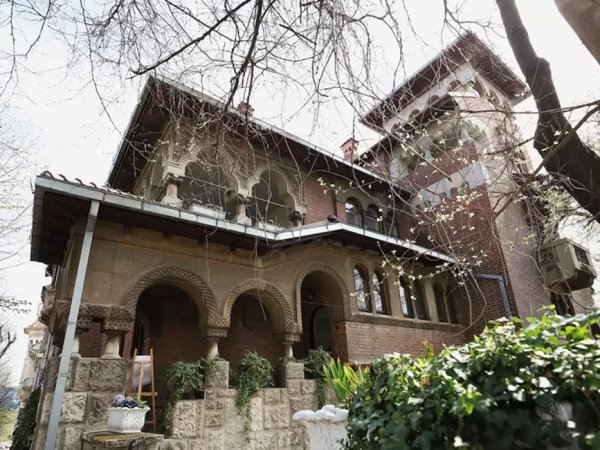
When analyzed in detail, the Sacha Roman House reveals a series of carefully balanced influences. The Neo-Romanian style is present through clear references to Brâncovenesc architecture, visible in certain decorative elements and in the way volumes are articulated. The overall proportions of the building refer to the Byzantine style, suggesting solidity and balance.
The massiveness of the construction and the presence of towers evoke the architecture of Oltenian fortified houses, those residences-fortresses that combined domestic and defensive functions. At the same time, the use of exposed brick directly references the Mogoșoaia Palace, one of the most important landmarks of Brâncovenesc architecture. All these influences are integrated harmoniously, without creating the impression of imitation or pastiche.
A fortress-like residence in the heart of the capital
The volumetry of the Sacha Roman House plays a decisive role in its imposing appearance. The roofs with different slopes and heights, the belvedere tower and the way the building is embedded in the natural slope of the hill create the image of a fortress-like residence, a rare element in Bucharest’s urban landscape. This impression is further enhanced by the relationship between solid and void, the play of volumes and the materials used.
The house appears, at the same time, rooted in tradition and oriented toward the future. It is a construction that inspires stability and permanence, yet incorporates modern solutions for its era. This very combination makes it perceived today as one of the most spectacular and “instagrammable” private residences of interwar Bucharest.
The first elevator in a private Bucharest home
One of the most fascinating details related to the Sacha Roman House is the presence of an elevator, considered to be the first installed in a private residence in Bucharest. In the 1920s, elevators were still a symbol of extreme modernity, usually found in public buildings or luxury hotels. Installing such equipment in a private home says a great deal about the level of comfort and innovation desired by the owner.
This technical detail turns the villa into a landmark of urban progress. The elevator was not merely a practical facility, but also a statement of status. Even by today’s standards, such an amenity remains associated with the idea of luxury. In the context of interwar Bucharest, it underlines the avant-garde character of the residence and Sacha Roman’s desire to live in a space that combined tradition with the latest technological solutions.
Interwar transformations and the systematization of the area
Like any important urban building, the Sacha Roman House did not remain completely unchanged over time. One of the most significant interventions took place in 1931, when the Dealul Mitropoliei area underwent an extensive urban systematization process. This involved excavations, level changes and infrastructure adaptations.
As a result of these works, the access staircase to the villa was created, and the entrance from the street was adapted to the new conditions. These modifications did not alter the general character of the building, but contributed to its better integration into the remodeled urban landscape. The house retained its architectural identity, demonstrating a remarkable capacity to adapt to the city’s transformations.
From private residence to cultural space
The communist period brought, as in the case of many other heritage buildings, changes of ownership and transformations of function. The Sacha Roman House passed through these complicated decades, surviving in a city undergoing continuous restructuring. After 1989, the building entered a new stage of its existence, one that restored its visibility and cultural relevance.
Today, the villa functions as headquarters and cultural space associated with the National Chamber Choir Madrigal – Marin Constantin, one of the most prestigious musical institutions in Romania. Founded by Marin Constantin, the choir has become a cultural ambassador of Romania, and its association with this heritage building is a natural one.
Casa Madrigal and its contemporary cultural role
Under the name Casa Madrigal, the former residence of Sacha Roman has become a space open to the public, dedicated to culture and education. Exhibitions, concerts, cultural and educational events are organized here, and the building is integrated into major initiatives such as the Cantus Mundi program. Thus, the villa is not merely a heritage object, but a living organism of Bucharest’s cultural life.
This new function adds an extra dimension to the building’s history. The house that once reflected the cultural ambitions of an interwar intellectual continues to serve the same purpose, adapted to present-day needs. In this way, Casa Madrigal becomes a successful example of heritage reuse, demonstrating that past and present can coexist harmoniously.
A landmark of interwar Bucharest
The Sacha Roman House remains, beyond its architectural beauty, a living document of an era. It speaks about the aspirations of an urban elite, about the maturity of Romanian interwar architecture and about the desire to integrate tradition into a modern discourse. The fact that it housed the first elevator in a private Bucharest residence is not just a historical curiosity, but a symbol of openness to progress.
Today, Casa Madrigal continues to fascinate and inspire, being a discreet yet powerful presence on Dealul Mitropoliei. In a city in constant change, this villa remains a landmark of elegance, innovation and cultural continuity, proving that quality architecture can transcend eras and political regimes.
We also recommend: Nicolae Minovici Museum of Folk Art, a century of history. From the “Bell Villa” to today’s folkloric treasure