Where Romanians skied during the winters of interwar Bucharest. How the Valea Plângerii garbage dump near Bellu Cemetery was transformed
- Articles
- 14 JAN 26
The winters of interwar Bucharest had a special charm, hard to imagine today. The city, undergoing a period of accelerated development, combined modernity with improvisation, and ingenious solutions often emerged where no one would have expected them. In an era when traveling to the mountains was not accessible to everyone, the Capital managed to offer its residents a surprising alternative for winter sports: a ski slope arranged right on the outskirts of the city.
Valea Plângerii, the forgotten outskirts of the Capital
Few Bucharest residents today know that, in the place of Tineretului Park, inaugurated in 1974, there once existed one of the most unusual ski resorts in Europe. The story of this place is one of extreme contrasts, in which a sinister garbage dump, known as Valea Plângerii, was transformed, for a few years, into a leisure space frequented by thousands of people.
At the beginning of the 20th century, the area located near Bellu Cemetery was far from being a friendly place. Valea Plângerii was a vast garbage dump, an unsanitary swamp where the city’s waste accumulated and where survival had become a daily struggle. Here lived the poorest people of the slums, drawn by the possibility of finding objects that could be sold or reused.
Among the piles of garbage were rotten bones, shards of glass, dead animals, and remnants coming from hospitals, including the books of tuberculosis patients. For those who made a living by rummaging through waste, these things became real treasures.
The landscape was bleak, and the proximity to the cemetery emphasized the image of a marginal area, ignored by the authorities and by the respectable world of Bucharest.
The surprising decision of the authorities in the 1930s
Paradoxically, it was precisely this place of decay that was to become the scene of an ambitious project. In 1933, the authorities of the Capital decided to intervene and transform Valea Plângerii into a space useful to the city. The idea was bold and unprecedented: the creation of a ski resort within Bucharest, on land obtained by leveling the former garbage dump.
The heaps of waste were flattened, the ground was consolidated, and the area began to take on a completely different appearance. The project was conceived seriously, and the result consisted of the arrangement of three distinct slopes. There was a slope for beginners, intended for those taking their first steps on skis, a slope for those in the improvement stage, and a special area for sledding, dedicated especially to children.
A ski resort in the heart of the city
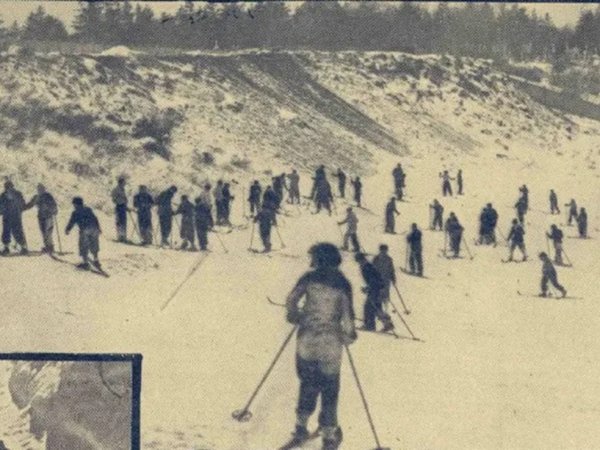
The improvised resort in Valea Plângerii was not a rudimentary one, but met the standards of the time. The slopes were maintained, and the authorities went so far as to install a nighttime lighting system, an extremely modern detail for that period. The floodlights transformed the area into a spectacle of light in the evening, offering Bucharest residents the possibility to ski even after nightfall.
Snow was allowed to settle naturally, and in snowy winters the slopes quickly became points of attraction. Period images capture a landscape difficult to associate with Bucharest: people dressed warmly, skiers descending the slopes, children with sleds, and a city that pulsed with life even in the middle of winter. The resort became a place frequented both by locals and by visitors from other parts of the country.
Sport, competition, and social life in interwar Bucharest
One of the aspects that contributed to the popularity of the slopes in Valea Plângerii was the involvement of sports associations. These organized ski competitions, and participants had the opportunity to measure their skills in an official setting, without leaving the city. The best skiers were rewarded with cups and prizes, and the competitions became real social events.
After the hours spent on the slopes, skiers could retreat to the cabin, where the atmosphere was warm and friendly. A cup of hot plum brandy helped them warm up, and lively conversations completed the experience. For Bucharest residents, this resort was not only a place for sport, but also a space for socializing, relaxation, and escape from everyday routine.
A lost privilege and a definitive transformation
From today’s perspective, it is hard to imagine how lucky the residents of the Capital were in that period. Instead of enduring hours of congested travel to the mountains, a simple tram ticket was enough to reach the slopes. Winter sports had become accessible to a much wider public, and Bucharest proved once again to be a city of contrasts and ingenious solutions.
Over time, however, the resort in Valea Plângerii disappeared, and the area underwent another major transformation. After decades, Tineretului Park was to be arranged here, a green space intended for urban recreation.
From garbage dump, to ski slope, and finally to park, the place went through radically different stages, reflecting the evolution of the city and of mentalities. Today, few remember that once, Bucharest residents skied just a few tram stops from the city center, in a place that had once been a symbol of filth and marginalization.
We also recommend: Interwar Bucharest, a space of contrasts: the latest European fashion on muddy streets