What Bucharest's Interwar Markets Looked Like in Autumn, and What Potatoes Cost
- Articles
- 24 SEP 26
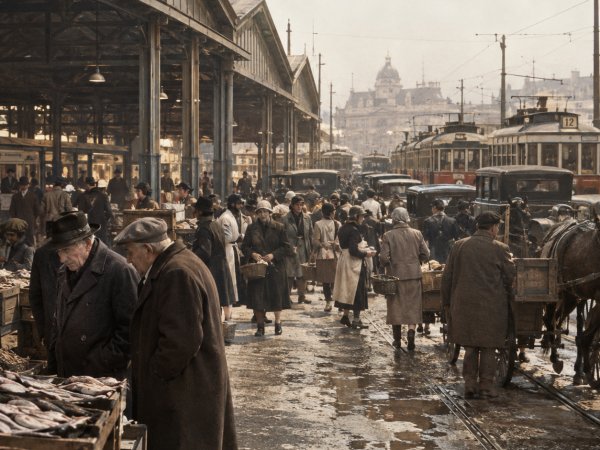
Autumn in the markets of interwar Bucharest meant noise, crowds and produce piled high, and every shopper arrived with the same question in mind: what will it cost me today? The answer, in the numbers of the time, is easier to picture than the crowd itself.
In 1934, a kilogram of potatoes cost 3.10 lei on average in Bucharest, and a kilogram of white bread 7.75. These are year-round averages, not autumn quotations, but they show the world in which shopping was done.
That leaves the question of what people paid with. There is no single average salary for 1934 in the statistics of the day, so the figures have to be pieced together. In the central administration in 1934-1935, average pay by ministry ran from 3,162 lei at the Interior Ministry to 9,257 lei at Foreign Affairs, and more than three quarters of civil servants earned under 5,000 lei a month. For workers, the closest figure comes from 1938: between 1,600 and 2,361 lei a month depending on the branch, with unskilled employees averaging 1,457 lei. The comparison mixes different years, so it remains approximate. A month's unskilled wage, if nothing were left over for rent, firewood and clothes, would have bought about 470 kilograms of potatoes or 188 kilograms of white bread. A pair of shoes at 530 lei would have taken more than a third of the month. An agricultural day laborer paid 36-43 lei a day in 1938 earned the equivalent of 12-14 kilograms of potatoes. A civil servant on 5,000 lei a month was much better off, but just as far from the top: in the 1934-1935 budget scales, a minister drew roughly 30,400 lei.
On September 26, 1929, five years earlier, Ilustrațiunea Română published Ion Tik's report from the Great Market. The reporter had first walked through the live poultry hall, where no one could be heard over the ducks and geese, and came upon a housewife feeling two hens with her fingers, probably to see how fat they were. She found them lean. The seller, covered in feathers from head to toe, explained that a lean hen lays two eggs a day and earns back its price in fifteen days. The customer, still angry over an insult exchanged during the conversation, replied that she wouldn't take them now even if she were paid to.
At the back of the market, the fruit sellers had "thousands of baskets full of grapes, plums and apples." The only calm person in all the din was the duty sergeant, asleep on the corner of a crate of lemons.
The Great Market meant the Central Halls, on the site of today's Piața Unirii. The Great Hall, begun in Cuza's time and finished in 1872 on the model of the Paris halls, was surrounded by the poultry hall and the fish hall. Across the Dâmbovița, at the foot of Metropolitan Hill, lay the Bibescu-Vodă fruit and vegetable market, modernized in 1906. Mircea Damian's monograph, published in 1935, called it "the commercial hub of the capital and its food supply." According to figures attributed to Constantin C. Giurescu, in 1936 Bucharesters consumed between 110,000 and 125,000 kilograms of potatoes and between 300,000 and 400,000 eggs every day.
The fish hall was quieter and rather empty. In 1929, two pensioners looked at a few salted fish and decided this was fish for the rich, not for them. Around the halls, twenty or thirty trams sometimes gathered, stuck between carts, vans and automobiles. A report in Realitatea ilustrată, from December 1936, described the halls being stormed from first light by ladies, cooks and restaurateurs with baskets and hampers.
By the 1930s, the halls had come to be seen as hotbeds of filth, and the city authorities wanted to move them to the edge of town. Engineer I. Săbăreanu, mayor of Sector I Galben (Yellow), decided to close the hall in Piața Amzei. The design for the new building, drawn up in 1935 by architect Nicu Georgescu, kept food shops all around and added two courthouses, a library and a 700-seat cinema. The Art Deco building of the Yellow Sector town hall ended up with a theater hall as well. Under Carol II, both the Bibescu-Vodă market and the smaller halls in Piața Unirii were demolished. The Great Hall remained, until the summer of 1986.
Meanwhile the city was growing, and after 1918 the Filantropia, Domeniilor, Chibrit, Dorobanți and Ghencea markets appeared.
At Obor, the great hall did not yet exist. A market was already operating in the area, successor to the old Târg de Afară (the Outer Fair). Work on the hall began in October 1936, to plans by Octav Doicescu, later by Horia Creangă. The steel frame came from Reșița. In September 1941 the site stopped for lack of money, and the Obor Central Halls were inaugurated only in 1950, more than thirteen years after work began.
In the end, the whole story comes down to arithmetic. At 3.10 lei a kilogram of potatoes, the everyday table was not expensive, but it was always counted, and pay was measured in baskets: what fits in one, and how much of the month is left once it is full. The housewife of 1929 feeling the hens knew that every egg had to earn its keep. The two pensioners in the fish hall learned the same thing by looking at a few salted fish. It is no accident that the figures at the start show most Bucharesters buying small amounts and often, with potatoes at the top of the list.
The city authorities were right about the filth, and they wanted, as we can see, to be rid of it along with the markets. One after another they disappeared: Amzei, Bibescu-Vodă and the smaller halls, then the Great Hall in 1986. Obor survived and became a historic monument, a place where people still buy, still haggle and still shout. And if we are looking for the winner of those years, the only one who didn't seem to worry about prices was the duty sergeant, sleeping peacefully on his crate of lemons.