The tragedy of actor Aristide Demetriade. “The Hamlet” of prewar Bucharest died performing on stage
- Articles
- 20 MAR 26
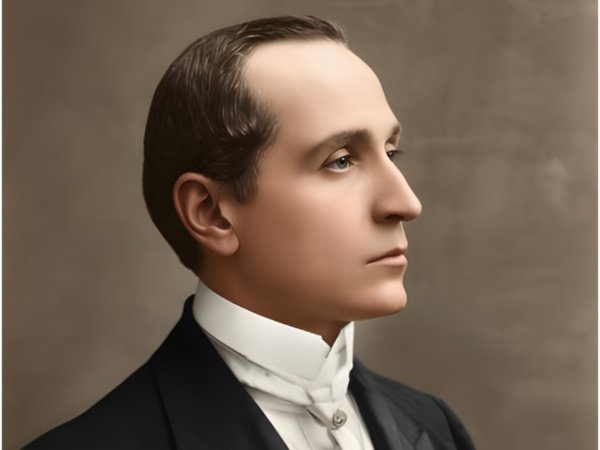
Aristide Demetriade remains one of the greatest Romanian actors of the early 20th century, an artist whose career was defined by the interpretation of tragic heroes. Especially the role of Hamlet, which he played with almost perfect intensity, brought him fame and comparisons with great international actors. Fate, however, had prepared an end for him that seemed taken from a Shakespearean tragedy: the actor died while on stage, giving the audience a lesson in dedication and passion for art.
A career adorned with remarkable partnerships
Born in Valea Ratei, Buzău County, in 1871, Aristide Demetriade appeared on the stage of the National Theatre in Bucharest where he performed a variety of memorable roles. He was Tokeramo in Taifun, Tipătescu in A Lost Letter, Warwick in Saint Joan, or Romeo in Romeo and Juliet.
But Hamlet remains the emblematic role, the one that defined his entire career. None of the Romanian actors of the time, not even Constantin Nottara or Tony Bulandra, could match the expressiveness and intensity with which Aristide brought Hamlet to the stage. In many respects, Aristide Demetriade can be considered a Romanian Lawrence Olivier, a benchmark of acting art in his era.
Throughout his career, Aristide Demetriade shared the stage with some of the greatest actresses of Romanian theatre: Aristița Romanescu, Maria Filotti, Tina Barbu, and Marioara Voiculescu. At the National Theatre in Bucharest, his colleagues included legendary names such as C. Nottara, M. Ciucurescu, Ana Mateescu Giupagea, I. Brezeanu, V. Leonescu, Al. Alexandrescu, T. Bulandra, C. Mărculescu, N. Brancomir, V. Crețoiu, Lili Popovici, and many others. This generation of actors formed the core of a refined Romanian stage, combining impeccable technique with emotional intensity.
Victor Eftimiu, writer and theatre connoisseur, observed with admiration the uniqueness of his performance: “He is the priceless violin on which the immense and musical sadness of our grieving century laments, with murmurs of wind and rebellions of the sea.”
Admiration for Aristide Demetriade was not limited to Eftimiu. Liviu Rebreanu, Tudor Arghezi, and Dem. Demetrescu were also impressed by his flawless acting, recognizing his ability to convey emotion with authenticity and depth. This recognition from writers highlights that his performance was not merely professional but also cultural and artistic, a symbol of theatrical excellence in Romania.
Hamlet – the role that consecrated him
His interpretation of Hamlet made Aristide Demetriade known as “the Hamlet of prewar Bucharest.” Shakespeare’s play was no longer just a dramatic text, but an opportunity for the actor to convey to the audience a full spectrum of emotions, from introspection and melancholy to anger and indignation. His stage presence and his ability to penetrate the character’s psychology made him a benchmark in Romanian theatre, comparable with great international actors. The intensity of his performance and his attention to gestural and vocal details ensured his recognition at the National Theatre, making the audience immediately associate his name with Hamlet.
Aristide Demetriade was not only an interpreter of classical texts; he was an actor who knew how to bring his characters to life authentically. His Hamlet was not merely a representation of Shakespeare’s tragedy, but a symbol of human fragility and complexity in the face of destiny. This depth of the role guaranteed him artistic immortality and made him recognized even by future generations as an exceptional actor.
The last performance and the tragedy on stage
The life of Aristide Demetriade had an end worthy of the tragedies he performed. On February 21, 1930, during the first act of the play The Red Roses, the actor collapsed on stage. The curtain fell, and a few minutes later the audience was informed that the actor, known to be ill and who had announced that this would be his final stage appearance, could no longer continue the role due to health reasons. In reality, the soul of the great artist had already ascended, leaving behind an empty stage and a shocked audience.
This event transformed the moment into a legend of Romanian theatre. The young actor Vasile Crețoiu took over Aristide’s role, completing the performance as a posthumous tribute to the great actor. Thus, the Hamlet of prewar Bucharest died performing on stage, remaining a symbol of total dedication and passion for the dramatic arts.
The legacy of a perfect artist
Aristide Demetriade’s death on stage consolidated his myth in Romanian theatre. The audience and his colleagues never forgot his dedication and professionalism. For future generations, his example remains a lesson on what it means to live and die for art. Every role played by Aristide, whether Hamlet, Romeo, or Tipătescu, bore the mark of an artist who lived every word and gesture with sincerity and passion.
Aristide Demetriade demonstrated that theatre is not only a place of entertainment but also a space where emotions, suffering, and beauty meet, and the artist becomes a witness to the human experience. His personal tragedy, dying while performing, made life and art merge in a unique moment, transforming him into a symbol of absolute dedication to the stage.
The admiration of contemporaries and recognition by posterity
Writers and contemporaries contributed to building the myth of Aristide Demetriade. Victor Eftimiu, Liviu Rebreanu, Tudor Arghezi, and Dem. Demetrescu highlighted the uniqueness and talent of the actor. Admired for emotional intensity, gestural and vocal control, Aristide was more than an interpreter: he was an inspiration for the entire generation of prewar Romanian theatre.
Even today, his name evokes the image of an actor who took dramatic art to the heights of perfection, an example of professionalism and passion that transcends time. His Hamlet remains, in the memory of critics and the public, one of the most authentic and powerful roles in Romanian theatre.
The story of Aristide Demetriade confirms the saying that “all the world’s a stage, and all the men and women merely players.” The artist lived his entire existence in the spotlight, dedicating himself completely to every role. His final tragedy, collapsing on stage and having his role continued by his colleagues, turned the event into an emblem of Romanian theatre. “To be or not to be” was no longer just a line from Hamlet but an expression of his own life and death, forever imprinted in the memory of Romanian culture.
Aristide Demetriade thus remains not only a name but a symbol of stage excellence and absolute dedication, a “Hamlet” of prewar Bucharest who died performing on stage, whose spirit continues to inspire future generations of artists.
We also recommend: Constantin I. Nottara, the theatre and the drama of love. The wife of Romania’s greatest actor fell into the arms of I.L. Caragiale