The statue of Constantin Brâncoveanu in Bucharest, the story of a monument that breathes history
- Articles
- 08 JAN 26
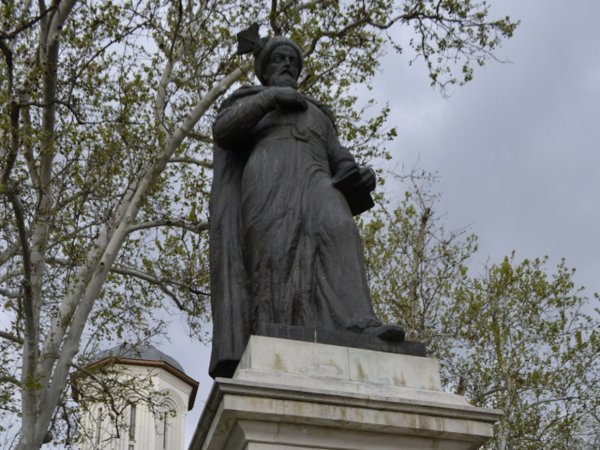
In the courtyard of Saint George the New Church in Bucharest, one of the most symbolically charged places in the Capital, stands the statue of Constantin Brâncoveanu, a monument that is not only a work of art, but also a living history lesson. Made of bronze in 1939 by the sculptor Oscar Han, the statue represents the great ruler near the very place where he rests in eternal peace.
A monument raised on the place of the ruler’s eternal rest
The choice of location was not accidental, but deeply symbolic: this is where the tomb of Brâncoveanu is located, the martyr ruler who refused to renounce his faith even at the cost of his life.
Saint George the New Church, one of his most beloved foundations, thus became the space where history, faith, and memory meet. The statue completes this spiritual ensemble, offering passers-by the image of a leader who profoundly shaped the destiny of Wallachia.
The initiative to erect the statue and the historical context
The erection of the monument was initiated in 1938, at the proposal of the then general mayor of Bucharest, Iulian Peter. The purpose of this endeavor was to honor the faith, sacrifice, and martyrdom of Constantin Brâncoveanu, an emblematic figure of Romanian history. It was a time when interwar Romania was reaffirming its national values, and the recovery of symbols of the past had become a cultural and identity priority.
Although the statue was completed in 1939, it was never “unveiled” according to tradition. A superstition of King Carol II of Romania led to the avoidance of the classic unveiling ceremony, considered to bring bad luck. Thus, the statue was only “inaugurated,” in an official setting, without the solemn moment of its actual unveiling. The event coincided with the inauguration of 1848 Boulevard, today I. C. Brătianu Boulevard, during the mandate of Mayor Victor Dombrovski.
Oscar Han and the artistic vision of the ruler
The sculptor Oscar Han, one of the most important Romanian artists of the 20th century, conceived the statue of Constantin Brâncoveanu in a manner that combines historical rigor with artistic expressiveness. The monument, made of bronze, has a height greater than that of the ruler himself, thus emphasizing his moral stature and historical importance.
Brâncoveanu is depicted as young, wearing a long tunic fastened at the chest, under which the princely garment can be seen. This choice of clothing suggests both political authority and the sobriety of a ruler aware of his responsibilities. His head is covered with a fur işlic, specific to the era, adorned with a surguci, a detail that gives historical authenticity and nobility to the image.
The ruler’s gaze, firm and focused, seems directed toward the future, as if he were still watching over the city and the country he once led. On the upper part of the pedestal there is a simple but powerful inscription: “CONSTANTIN BRÂNCOVEANU.”
The statue as a protected historical monument
The artistic and historical importance of the statue was officially recognized by its inclusion in the 2010 List of Historical Monuments, at position 2280, with the code LMI B-III-m-A-19965. This classification confirms the monument’s heritage value and the need to protect it for future generations.
The statue is not merely a representation of a historical personality, but an identity landmark of Bucharest. Placed in a sacred space, it invites reflection on the past and on the values that have defined Romanian history: faith, dignity, and sacrifice.
The reign of Constantin Brâncoveanu and the golden age of Wallachia
The reign of Constantin Brâncoveanu, which lasted from 1688 to 1714, was one of the most prosperous periods in the history of Wallachia. Under his leadership, the state experienced rare internal stability, despite the complex geopolitical context of the time, under Ottoman suzerainty.
Economically, the country recorded significant progress, and culturally and artistically the famous Brâncovenesc style in architecture took shape. This style, characterized by elegance, balance, and the synthesis of Eastern and Western influences, left behind numerous churches, monasteries, and palaces that endure to this day.
Brâncoveanu was a great founder, supporting the construction and restoration of many places of worship. He also laid the foundations of the Princely Academy and supported printing, contributing decisively to the development of education and culture in the Romanian space.
The tragic downfall and martyrdom of the ruler
In April 1714, the destiny of Constantin Brâncoveanu took a dramatic turn. Because of the intrigues of political adversaries and suspicions related to the considerable wealth he had accumulated, he was deposed by the Ottoman Empire together with his family. He was taken to Istanbul, where he was tortured in order to reveal where he had hidden his riches.
The climax of the tragedy occurred on August 15, 1714, when Constantin Brâncoveanu was executed by beheading, together with his four sons. Before the execution, he was offered the chance to save his life by renouncing Christianity and converting to Islam. The ruler categorically refused, choosing to die for his faith. His gesture has remained one of the most impressive examples of sacrifice and dignity in Romanian history.
Canonization and the spiritual significance of the monument
In 1992, the Romanian Orthodox Church canonized Constantin Brâncoveanu together with his sons, who are commemorated annually on August 16 under the name “The Holy Brâncoveanu Martyrs.” This official recognition of their sanctity further strengthened the significance of the statue in the courtyard of Saint George the New Church.
Today, the monument is not only a historical symbol, but also a spiritual one. It recalls the power of faith and the supreme sacrifice made to preserve religious and national identity. The statue of Constantin Brâncoveanu breathes history, but also spirituality, remaining an essential reference point in the cultural landscape of Bucharest and in the collective memory of the Romanian people.
We also recommend: The statue of the genius “The Lion”, the monument of the Romanian heroes from the First World War: “Tell future generations that we made the supreme sacrifice!”