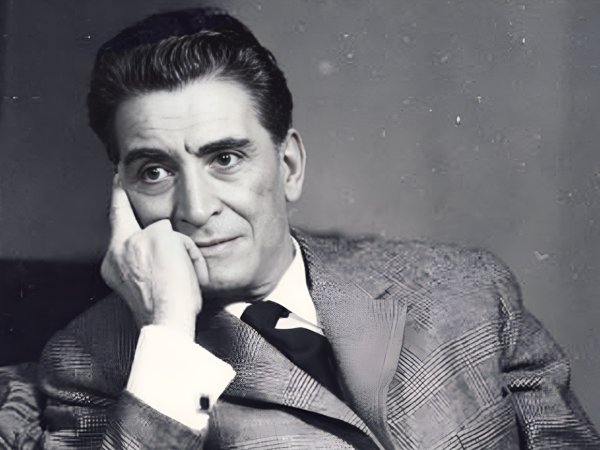
The stars of interwar Bucharest: The great actor George Vraca was sung to by George Enescu on his hospital bed
- Articles
- 12 JAN 26
The cultural history of interwar Bucharest is filled with spectacular destinies, and the life of George Vraca is among those that seem taken straight from a novel or a film script. Starting out on a path completely different from that of the stage, passing through the terrible trials of war, and being discovered by chance by the great artists of his time, George Vraca was to become one of the most important and respected actors Romania has ever had. His story is one of chance, a vocation discovered late, and a career built with passion, talent, and a great deal of hard work.
Aromanian origins and a destiny shaped toward agriculture
George Vraca was born in 1896 into a family of farmers of Aromanian origin, with roots in the Pindus Mountains of Macedonia. The environment in which he grew up naturally guided him toward his parents’ profession, and nothing seemed to foreshadow his artistic future. In his adolescence, Vraca attended a school of agronomy and dreamed of continuing his studies in Paris, where he wished to become an agricultural engineer.
Before the outbreak of the First World War, the young man was already employed as a clerk within the Ministry of Agriculture, a stable job that seemed to guarantee him a predictable future. His life appeared to be set on a secure path, built on work, discipline, and clear professional aspirations, but history was about to radically change his trajectory.
War, wounds, and the meeting that changed his life
With Romania’s entry into the First World War, George Vraca was mobilized and sent to the front. During this period, he obtained the rank of second lieutenant and took part in heavy fighting, being wounded several times in the battles of Cașin, Oituz, and Târgu Ocna. The experience of war marked him deeply, both physically and psychologically.
Stricken with epidemic typhus, Vraca was hospitalized in Iași, an episode that was to prove decisive for his destiny. It was here that the providential encounter took place that changed his life forever. One day, the hospital was visited by Maria Ventura and Constantin Nottara, accompanied by the great Romanian composer George Enescu. The three went from ward to ward, hoping to ease, even slightly, the suffering of the soldiers through music and recitations.
George Enescu played the violin, while the two great actors recited verses for those lying in their hospital beds. After the artistic moment, they spoke with the wounded, and the young Vraca drew attention through his voice and the way he told stories. Asked what his occupation was and invited to say a few words, he was surprised by the unexpected question of Maria Ventura, who asked him whether he had ever thought of becoming an actor.
From amazement to the revelation of a vocation
George Vraca’s reaction was one of genuine astonishment. He had been to the theatre only a few times and had never thought of an artistic career. His reply, that becoming an actor also requires talent, made Constantin Nottara laugh, but was met with the calm and confidence of Maria Ventura, who simply answered that this was precisely the point.
That short conversation, held in a hospital ward, was the spark that ignited in Vraca an idea that would not leave him alone. After leaving the hospital, Maria Ventura’s words continued to echo in his mind. He decided to seek out the master Constantin Nottara and ask for his guidance, a step that would place him on the path of acting.
The conservatory and the debut on the Bucharest stage
Following the advice he had received, George Vraca enrolled at the Conservatory of Dramatic Art, where he began to study acting seriously. His talent, doubled by an impressive voice and a powerful stage presence, was quickly noticed. In 1920, he made his debut on the stage of the Comedia Theatre, temporarily joining the Bulandra company.
The first play in which he appeared was called The Black Rooster, and his role was that of the Old Watchman. Although the character was 80 years old, the young actor strove to render him authentically, wearing a beard and imposing moustache, constructing a specific walk and gestures suited to old age. The emotions of the debut were overwhelming, and Vraca would later confess that the momentum of the verses made him forget the age of the character and surrender to the joy of being on stage for the first time in his life before an audience.
Consecration and decisive encounters in his career
After his debut, George Vraca began acting alongside important names of Romanian theatre, such as Maria Filotti, Ion Sârbu, and Maria Giurgea. A crucial moment in his artistic evolution was the year 1924, when he had the opportunity to perform alongside the great Agatha Bârsescu. His meeting and collaboration with her remained, as the actor himself confessed, one of the most precious experiences of his professional life.
Agatha Bârsescu had just returned from a triumphant tour in Western Europe and America and was at the peak of her artistic maturity. The performances held at the Eforie Hall remained unforgettable for Bucharest audiences, and Vraca, together with his friend Calboreanu, had the honor of “seconding” her in plays such as Prometheus by Victor Eftimiu and Ghosts by Henrik Ibsen. Her overwhelming presence was so powerful that, as he modestly admitted, those around her almost ceased to exist in the eyes of the audience.
Artistic maturity and the war years
The reunion with Maria Ventura, the woman who had set him on the path of acting, was also of particular importance in his career. George Vraca continued to perform steadily, consolidating his status as a great actor of the Romanian stage. He passed through the period of the Second World War without interruption, remaining active on stage in a difficult historical context.
Immediately after the end of the war, he took over the leadership of the Nottara Theatre, a recognition of his prestige and artistic authority. This position came as a crowning achievement of his theatrical career, confirming his central place in the cultural life of Bucharest.
The final years, cinema, and artistic legacy
The communist period did not drive him away from the stage or the screen either. George Vraca accepted roles in several propaganda films, such as Life Triumphs (1951), The Bugler’s Grandchildren (1953), and The Sun Rises (1954), whether by his own choice or compelled by the political circumstances of the time. His last film was Tudor, made in 1963.
George Vraca passed away one year later, leaving behind an impressive career and a name that remains closely linked to the golden age of Romanian theatre. From a clerk at the Ministry of Agriculture and a second lieutenant on the front, to a legendary actor of the Bucharest stage, his destiny remains one of the most spectacular in the cultural history of Romania.
We also recommend: The stars of interwar Bucharest: Oleg Danovski, the Slavic Sphinx who founded the first ballet theatre in Romania