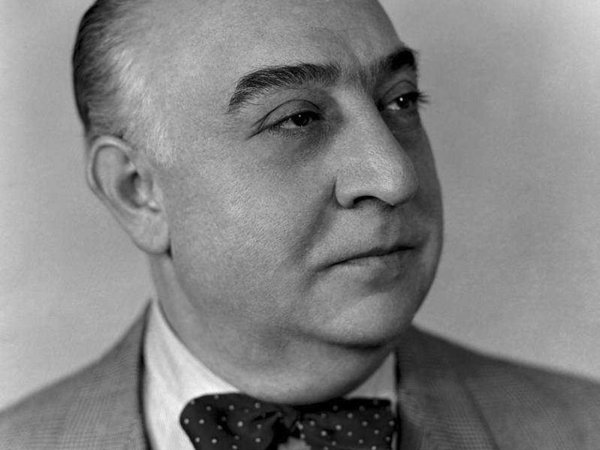
The stars of interwar Bucharest: Ion Talianu, from the arrogant Nae Cațavencu to the most beloved Romanian actor
- Articles
- 27 JAN 26
In the history of Romanian interwar theatre, few names managed to impose themselves with the same strength and longevity as Ion Talianu. An actor of rare finesse, with an imposing stage presence and a profound understanding of human nature, Talianu was one of the artists who defined the golden age of the Bucharest stage. For the general public, his name remains inseparably linked to the memorable interpretation of Nae Cațavencu in A Lost Letter by Ion Luca Caragiale, a role that definitively consecrated him and turned him into a benchmark of Romanian acting art.
The beginnings of a theatrical destiny
Ion Talianu was born on March 3, 1898, in the town of Târgu Ocna, into a family related to the Cozoni family. From childhood, he was drawn to the world of stories, characters, and the stage, and his first encounters with theatre took place during his years of study in his hometown. This early fascination with dramatic art was to shape a solid and consistent professional path, built through work and perseverance.
After completing his primary studies, Talianu moved to Ploiești, a city with a vibrant cultural life at that time. Here he took his first serious steps in his acting career, appearing on the stage of the Ploiești Theatre. The experience gained in this dynamic artistic environment provided him with the necessary foundation to develop his interpretative technique and refine his style.
The ascent onto Bucharest’s great stages
His talent did not go unnoticed, and Ion Talianu quickly came to perform on the stages of the most important theatres in Bucharest. The National Theatre, the Bulandra Theatre, and the Revue Theatre were just some of the institutions where the actor left his artistic mark. He was part of an exceptional generation of artists who contributed decisively to the development of Romanian interwar theatre.
Collaborations with the great directors and actors of the time allowed him to tackle a wide range of roles, from comedy to drama, demonstrating remarkable versatility. His performances were appreciated for the balance between expressive force and psychological subtlety, qualities that established him as one of the most respected actors of the era.
Nae Cațavencu, the role that turned him into a legend
Undoubtedly, the most important achievement of his career remains the interpretation of Nae Cațavencu in A Lost Letter. An emblematic character of Caragiale’s dramaturgy, Cațavencu is a mixture of vanity, opportunism, and speculative intelligence, a human type deeply anchored in the political realities of the time.
Ion Talianu managed to capture the essence of this character beyond the appearance of an “arrogant and opportunistic banker.” His performance revealed the moral complexity of Cațavencu, making him credible, human, and, paradoxically, close to the audience. The public and theatre critics quickly recognized the value of this interpretation, considered a reference point in the history of the Romanian stage.
Theatre as a mirror of interwar society
Talianu performed the role of Nae Cațavencu during a period of major social and political tensions. Interwar theatre was not only a space for entertainment, but also a place of reflection on the realities of a society in full transition. Through his acting, the actor succeeded in conveying the subtle messages of Caragiale’s text, using irony and humor to expose hypocrisy and corruption.
Thus, Ion Talianu was not only a talented performer, but also a culturally engaged artist, aware of the role of theatre in educating and sensitizing the public. Through his work, he contributed to raising the artistic standards of the Romanian stage.
Other memorable roles and artistic versatility
Throughout his career, Talianu interpreted numerous other characters that highlighted his talent. The role of the banker Gogulean in the play Răsună valea allowed him to explore a cold and calculating human type, specific to a society undergoing industrialization. The actor built this character with finesse, gradually revealing vulnerabilities hidden beneath an appearance of hardness.
Another important moment was his interpretation of Lieutenant Colonel Palade in the play Mitrea Cocor, directed by Alexandru Finți. Here, Talianu demonstrated a deeply dramatic side of his talent, subtly approaching the inner conflicts of a character caught between duty and the harsh realities of the time.
Presence on the big screen
Ion Talianu also extended his artistic activity into cinema, appearing in films such as Regele petrece (The King Revels) and Om de afaceri (Businessman). Although the stage remained his preferred medium, the actor proved that he could easily adapt to the language of film. Even in secondary roles, his presence was powerful, turning brief appearances into memorable moments.
This ability to give weight to every role, regardless of its size, distinguished him from many of his contemporaries and consolidated his reputation as a complete actor.
The man behind the stage
Beyond his professional success, Ion Talianu was known for his modesty and exemplary discipline. He did not seek glory and avoided conflicts, preferring to devote himself entirely to his work. He was appreciated by his colleagues for his fairness, generosity, and spirit of camaraderie.
The magazine Cinema wrote in February 1981 about him as an exceptional man, full of humor and surprisingly modest, despite his appearance of an arrogant banker. As an artist, he was described as talented, conscientious, and disciplined, always arriving with his role prepared down to the smallest detail, for whom every nuance mattered.
Official recognition and cultural legacy
His merits were officially recognized as well. In 1953, Ion Talianu was awarded the title of Emeritus Artist of the Romanian People’s Republic, and in 1952 he received the Order of Labor, Second Class, on the occasion of the “Caragiale Centennial.” These distinctions reflect the immense respect he enjoyed among his contemporaries.
The legacy left by Ion Talianu is solid and enduring. Through his talent, rigor, and passion, he influenced generations of actors and contributed decisively to the consolidation of modern Romanian theatre. Even though time has passed, his name remains synonymous with artistic excellence and devotion to the stage.
We also recommend: The stars of interwar Bucharest: Nae Roman, “baptized” by the great Constantin Tănase, refused to join the Communist Party