The Sociology of Heatwaves. What Bucharest and Its People Look Like Above 40 Degrees Celsius
- Articles
- 29 JUN 26
A heatwave doesn't just change Bucharest's temperature. It changes the way people inhabit the city. They walk slower, talk less, instinctively seek shade, and seem to burn through their patience faster than at any other time of year. After a few days of nearly 40 degrees, the same intersection, the same bus, the same supermarket queue feel like completely different places. Not because the streets have changed, but because the people moving through them have.
The City That Smells Different
Extreme summer heat has a specific smell that Bucharest residents recognize without ever having named it: the scorched asphalt on Calea Victoriei at noon, the garbage that can't wait until Wednesday, the warm metal of buses, and somewhere in the background, linden trees in the parks trying to compensate for everything else on their own.
Smell matters more than it seems. Research in environmental psychology shows that unpleasant olfactory stimuli activate the same stress circuits as visual or auditory ones — the body doesn't distinguish between a real threat and the smell of a sewer drain at 39 degrees. It catalogues both as environmental aggression and responds the same way: adrenaline, tension, the threshold of tolerance dropping a few notches.
The Light That Flattens Everything
There's a quality to heatwave light that makes Bucharest look different from the rest of the year. Gone is the golden morning light or the soft blue of a May afternoon. In its place: white, vertical, shadowless light — the kind that exposes everything worn, faded, overexposed. The yellowed façades of apartment blocks in Drumul Taberei, the bleached lettering on old shop signs, the dust on parked cars. The city looks more tired under this light, and so do the people in it.
It's not just aesthetics. Exposure to intense light and shadowless spaces produces a diffuse form of sensory exhaustion. The eyes work constantly, the body thermoregulates constantly, attention fragments. By evening, without having done anything particularly demanding, you're drained.
The Invisible Redistribution
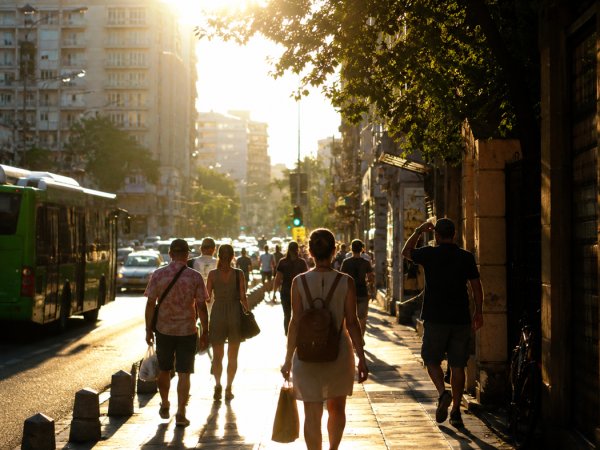
Without any administrative decision, the heatwave redistributes people across the city. Sunny terraces stay empty, shaded ones fill up. Parks with old trees draw a population they don't see the rest of the year — Cișmigiu at seven in the morning is full of people who would normally be stuck in traffic at that hour. Shopping malls become democratic refuges: free air conditioning, benches, open access — a social function nobody claims, but everyone quietly uses.
The city's schedule compresses toward the extremes. Early morning and late evening are the only windows when Bucharest operates at anything close to normal capacity. By midday, the city centre empties, Lipscani terraces run half-full, delivery cyclists move less frequently. It's not a collective decision — it's the same adaptation that produced the siesta in Mediterranean cultures, now imposed informally, without asking anyone's permission.
What Heat Does to Patience
Psychologist Kimberly Meidenbauer at Washington State University describes the mechanism plainly: extreme heat directly impairs self-control. The capacity to pause before reacting, to think before speaking, declines in proportion to temperature. The person leaning on their horn at a traffic light in August isn't necessarily a bad person — they're someone with an overtaxed prefrontal cortex and three nights of poor sleep behind them.
A study published in Science calculated that each heatwave brings a 4% increase in interpersonal violence. In practice, that means more arguments in traffic, more tension in elevators, fewer compromises at checkout queues. Bucharest amplifies the effect through its thermal infrastructure: concrete, asphalt, few mature trees on main roads, many cars. The phenomenon is called the urban heat island effect, and it makes the temperature in the city centre 4 to 6 degrees higher than in the green peripheral areas. That's not a metaphor. It's a concrete disadvantage compared to any city that made different choices.
The Night — The Unspoken Problem
There's one effect of the heatwave that people consistently underestimate: nighttime temperature. When the mercury doesn't drop below 25 degrees, the body can't enter deep sleep — it needs a drop in its own internal temperature, which the environment no longer provides. Sleep becomes shallow, fragmented, and after several nights it shows in everything: poor concentration, emotions harder to manage, ordinary problems that suddenly feel overwhelming.
At night, Bucharest has its own heatwave soundtrack: fans running in every open window, dogs barking more often, cars passing less frequently with windows down. The city doesn't sleep well, and in the morning it wakes with a low, collective irritability that nobody names but everyone recognises.
Who Suffers Differently
Not everyone lives the same Bucharest in August. The difference isn't just biological — it's economic and geographic. A flat without air conditioning on the sixth floor of a block with a bitumen roof in Berceni has nothing in common with an air-conditioned villa with a garden in Floreasca. Elderly people living alone, with no resources to cool down beyond a fan, are the most exposed and the most invisible in the public conversation about heatwaves — a conversation that tends to focus on hydration tips and forget about the social infrastructure that should exist for them.
Delivery cyclists, construction workers on Pipera building sites, vendors at market stalls — none of them can reorganise their schedule around temperatures. They live the heatwave directly, for hours on end. The conversation about how heat changes urban behaviour is, at its core, a conversation about people who have enough control over their time and space to make choices. Many don't.
What Summer Reveals About a City
A heatwave is an urban planning test with no appeal. A city with mature trees on every street, with buildings that don't accumulate heat, with public spaces that offer shade and water, produces a different kind of summer. Bucharest has large, beautiful parks — and entire neighbourhoods where natural shade is a rare luxury, where the pavement radiates heat back into your face and the iron of balcony railings is untouchable after eleven in the morning.
Extreme summer heat isn't a temporary meteorological emergency. It's an x-ray of the city — one that shows, more clearly than any urban planning report, what was built for people and what was built for something else.