The Saint John the Great Inn, the Monastery, the Cemetery and the Emergence of the House of Deposits and Consignments
- Articles
- 22 SEP 26
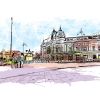
Today, the CEC Palace seems to sit on Calea Victoriei with the certainty of a French pastry that has found the right display window. The glass-and-metal dome, the elegant façades and the monumental staircase make the building one of the most recognizable landmarks in Bucharest. Before this image became emblematic of the capital, however, the same plot of land had a completely different appearance. Here stood an old religious complex, made up of the Saint John the Great Church and monastery, a cemetery and an inn built around the religious establishment. The history of the site connects, within a relatively small space, medieval and pre-modern Bucharest with the spectacular transformations of the city during the second half of the 19th century. Eventually, the inn, the church and the monastery buildings disappeared, and the headquarters of a modern financial institution was built in their place. It is one of those urban overlaps that explain very well how Bucharest changed its appearance: beneath a building constructed for the finances of modern Romania lies the memory of an old religious establishment, merchants, monks and even a cemetery.
From the old church to the Saint John the Great Monastery
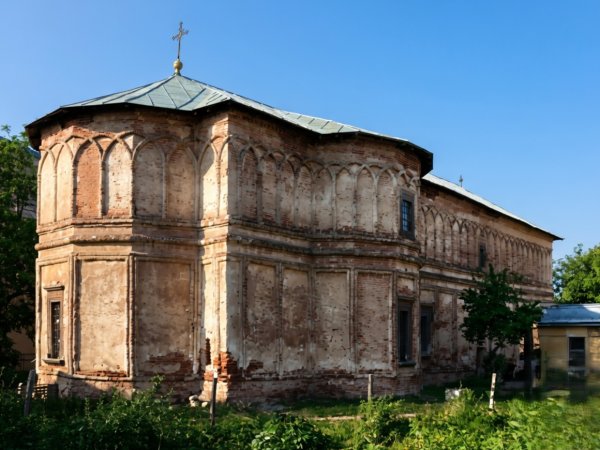
The origins of the establishment go back to the 16th century. Historical and documentary sources place the appearance of the Saint John the Great Church during the reign of Mihnea II Turcitul, attributing it to the great treasurer Andrei Golescu. The Museum of the Municipality of Bucharest mentions that the church was built in the 16th century and that, later, the complex was also endowed with an inn.
The religious establishment went through several transformations and periods of prosperity or decline. Over time, the monastery accumulated properties and revenues, while auxiliary buildings developed around it. As in the case of other monastic establishments in Bucharest, economic activity was not separated from religious activity. Shops, rooms and inns represented important sources of income for maintaining the monastery.
At the beginning of the 18th century, the complex was in poor condition. Constantin Brâncoveanu intervened in the establishment, and during 1702–1703 the church was rebuilt and the monastic complex restored. Brâncoveanu’s intervention gave the site a new lease of life and definitively connected its history with one of the most important cultural and architectural periods in Bucharest.
Around the church and monastery, the inn that would bear the same name was subsequently established. The exact date of its construction is presented differently in historical sources, being placed in the first half of the 18th century. The National Archaeological Record notes that the inn was probably already operating in the 18th century, using some of the monastery’s auxiliary buildings as well.
The inn should be viewed in the context of the city of that time. Bucharest was a commercial centre where important roads brought merchants, goods and travellers, while inns provided not only accommodation but also places for trade. In the case of monastic inns, economic activity had a very concrete purpose: financially supporting the religious establishment.
Thus, within the same courtyard, the church, cells, administrative and commercial spaces could coexist. Faith and commerce were not two separate worlds, but parts of the same urban mechanism.
The inn, the merchants and the cemetery in the heart of the city
The Saint John the Great Inn must be imagined as part of a Bucharest very different from the one known today. Calea Victoriei was not yet the monumental boulevard known to modern generations, and the city centre consisted of a dense mixture of churches, boyar estates, shops, inns and homes.
There was also a small cemetery around the monastery. One of the figures associated with this place is Ienăchiță Văcărescu, poet, scholar and author of an important work on the grammar of the Romanian language. According to historical sources dedicated to the old complex, Văcărescu died in 1797 and was buried in the cemetery of the Saint John the Great Monastery.
The presence of a cemetery next to the church was natural for Bucharest before the sanitary and urban reforms of the 19th century. Inside the city there were numerous small burial grounds associated with churches and monasteries. This very model would later be called into question during the modernization of the capital, when authorities began moving cemeteries outside densely inhabited areas.
The Saint John the Great complex was affected over time by earthquakes and by the lack of sufficient maintenance work. The National Archaeological Record mentions repairs to the inn and the complex at the beginning of the 19th century, but the deterioration continued.
By the middle of the 19th century, Bucharest was entering a period of radical transformation. The secularization of monastic properties, the reorganization of the administration and the emergence of modern institutions changed the relationship between old religious properties and the city.
It is in this context that the gradual disappearance of the Saint John the Great complex must also be understood.
From the Saint John Inn to the House of Deposits and Consignments
The House of Deposits and Consignments was established by a law sanctioned by Alexandru Ioan Cuza on November 24, 1864, and the institution was due to begin its activity on January 1, 1865. Its creation was part of the efforts to modernize Romania’s public finances and to establish institutions capable of managing deposits and other financial operations.
At first, the House of Deposits did not have its own palace. The institution initially operated in the building of the Ministry of Finance and then moved to the Șerban Vodă Inn. Archaeological research confirms that the Șerban Vodă Inn, located on the site of the present-day Palace of the National Bank of Romania, housed the House of Deposits and Consignments for a short period.
Meanwhile, a new stage was beginning on the grounds of the Saint John the Great Monastery. The inn was demolished in 1873–1874, according to some historical sources, while the former abbot’s residence was repaired and adapted to accommodate the House of Deposits and Consignments, an institution that had previously operated in the Șerban Vodă Inn.
There are, however, differences in chronology among secondary sources regarding the demolition of the various components of the complex. Research by the Museum of the Municipality of Bucharest and the National Heritage Institute indicates the demolition of the old complex and the disappearance of its buildings during the 1870s, with the church and auxiliary buildings being removed to make way for the new financial headquarters.
What is important is that the transformation did not take place in a single day. First the inn disappeared, then the old monastic buildings were transformed or demolished, while the former abbot’s residence had a temporary existence as the headquarters of the financial institution. In 1896, according to sources documenting this sequence, the abbot’s residence itself was demolished.
In place of a complex built around a church, one of the most important administrative and financial buildings of modern Romania was about to appear.
The foundation stone of the CEC Palace
On June 8, 1897, the foundation stone of the new Palace of the House of Deposits, Consignments and Savings was laid, in the presence of King Carol I and Queen Elisabeth. The moment marked the beginning of the construction of the building that would definitively change the appearance of this section of Calea Victoriei.
The project belonged to French architect Paul Gottereau, one of the foreign architects who contributed decisively to the architectural transformation of Bucharest at the end of the 19th century. Construction was coordinated by Romanian architect Ion Socolescu. The palace was designed in the spirit of late 19th-century eclectic architecture, with a strong French influence.
Construction was completed at the beginning of the new century, and the CEC Palace was inaugurated in 1900. Its glass-and-metal dome became its most spectacular visual element, while the main façade, columns and pediment give it the monumentality that makes it impossible to confuse with an ordinary building.
With the new construction, the site completely changed its function. From a religious complex with a church, cells, an inn and a cemetery, the plot became the headquarters of a financial institution representative of modern Romania.
What remains beneath the memory of the CEC Palace
The story of the site is, ultimately, the story of Bucharest’s radical transformation. Over several centuries, the same plot of land went from the church built in the 16th century to the monastery rebuilt by Constantin Brâncoveanu, from the inn that generated income for the establishment to the former abbot’s residence transformed into a financial headquarters and, finally, to the CEC Palace.
From an urban point of view, the change is spectacular. From a historical point of view, it is even more interesting: the present building did not appear on empty land, but on successive layers of the city.
The walls of the inn disappeared, as did the rooms where merchants displayed their goods, the monastery cells, the church and the small cemetery where Ienăchiță Văcărescu had been buried. In their place, modern Bucharest erected a building intended for money, deposits and financial administration.
The CEC Palace has remained, however, as a visible landmark of this transformation. Its dome can be photographed every day, but what can no longer be seen is the city beneath it: the church, the monastery, the inn and the cemetery that once occupied the same place.
And this is perhaps one of the most fascinating lessons of old Bucharest: sometimes, in order to understand a famous building, one must look not only at what can be seen, but also at what was removed so that it could exist. Beneath one of the capital’s most photographed domes lies, symbolically, the memory of an entire fragment of the city.
We also recommend: