The Perfume Museum in Bucharest, the charming place where aromas reign over the senses
- Articles
- 13 JAN 26
In a hurried city, dominated by concrete, traffic, and noise, there is a discreet space where time seems to stand still and the senses are invited on a delicate journey through history. The Perfume Museum in Bucharest does not impress through its size, but through the density of the stories it gathers within its walls. Like a precious bottle, small and seemingly simple, this museum hides rare essences, memories, and fragments of a world in which perfume was not just a cosmetic product, but a symbol of elegance, identity, and memory.
A small museum, but full of aromatic stories
The Perfume Museum is not a vast space, yet it perfectly respects the classic recipe of perfumery: complex essences preserved in small containers. In the world there are probably tens of thousands of perfumes, each sealed in its own bottle, like fascinating potions. Each one carries a story, whether it speaks about a famous figure, a historical era, or an intimate moment from someone’s life.
Some aromas manage to touch personal memory directly, awakening childhood recollections: a grandmother’s perfume, a bottle secretly “borrowed,” or a precious powder accidentally spilled on the carpet. The Perfume Museum in Bucharest is a place where such memories take shape, and scents become bridges between generations.
Val Iacob and the passion for the history of perfume
Behind this museum stands Val Iacob, the owner of a luxury perfumery that also hosts the collection. In the exhibition space, several hundred bottles are displayed, but the true scale of his passion is hidden at home, where more than 20,000 objects related to the history and evolution of perfume are kept.
“I started from the idea that no one escapes encountering the smells around them,” explains Val Iacob. Perfume, he says, is a constant of human existence, present in rituals, daily life, and special moments. His collection is not just a gathering of rare objects, but an attempt to preserve an olfactory history that risks being lost.
Perfumes that have crossed centuries
Among the museum’s most valuable pieces is a Lubin eau de toilette from 1825, preserved in its original large pharmacy bottle. From the moment this perfume was created until today, the world has changed dramatically: Romania gained its independence, two world wars took place, vaccines were invented, the first airplanes flew. And yet, this perfume has remained intact.
Val Iacob recounts with humor that the person from whom he acquired the bottle was never able to open it, which probably contributed to preserving the liquid. The perfume is so rare that even Gilles Lubin, the current head of the French brand, had never seen it before a visit to Romania.
Romania, a force in European perfumery
Few people know that about a hundred years ago, Romania was the second perfume-producing market in Europe, after France. It was the interwar period, when Bucharest was nicknamed Little Paris, and major French perfume houses had factories between the Carpathians and the Black Sea. Famous names such as Coty, Guerlain, and Lubin produced perfumes here for the European market.
This close connection with French perfumery also explains the presence of exceptional pieces in the museum. For example, the perfume “Mon Boudoir,” the favorite of the queen, was withdrawn from production in 1938, upon her death, as a sign of mourning respect for “the most beautiful queen of Europe.”
Legendary perfumes brought back to life
In September 2019, Val Iacob managed to convince the Houbigant house to reproduce the perfume “Mon Boudoir,” 100 years after its official launch. This gesture represented not only a historical recovery, but also a reaffirmation of Romania’s importance in the history of European perfumery.
Another celebrated product present in the museum is Caron powder, which marked a century of existence. The exhibition includes boxes that trace the history of this beloved product, from its launch in 1917 to 2017, illustrating changes in design and taste over time.
Romanian brands and the nostalgia of scents from the past
A generous space in the Perfume Museum is dedicated to Romanian products. Although their aromas can no longer be sensed, the visual impact is strong, especially for those who remember brands such as Bob, Eva, Adam, and Miraj. These names evoke a period when Romanian perfumes and cosmetics were constant presences in bathrooms and on dressing tables during the 1970s and 1980s.
Bottles decorated with beads or containers for bath salts tell the story of a local industry that shaped the everyday life of several generations.
Perfumes worn by historical figures
The museum also houses creations associated with famous historical figures. The Rancé house, a dynasty that has reached its eighth uninterrupted generation of perfumers, boasts “Le Vainqueur,” the perfume worn by Napoleon Bonaparte himself. The recipe of “The Conqueror” is still produced today, without deviations, following the original formula.
Likewise, Gin Fizz, a perfume created in 1955 for Grace Kelly, is still made according to the original recipe. As its name suggests, it smells exactly like a gin and tonic, demonstrating the refinement and precision of classic perfumery.
A collection in continuous growth
Val Iacob admits that he would like a larger exhibition space for the thousands of objects that did not fit within the museum’s current walls. “On any vacation we go on, we visit flea markets. It’s impossible for someone not to have perfume bottles, powder boxes, or cosmetics on their stall,” he says. Sometimes he pays just a few euros for an item that leaves him breathless.
He found a Fleur d’Amour from 1907, also exhibited here, at someone’s home in Galați, the place where the brand later had its representation in Romania. He also wishes to recover old pharmaceutical laboratories, many of which were removed from the country at some point.
The evolution of the bottle, from pharmacy to art object
In the olfactory chronology assembled at the museum, one can observe the fascinating transition from the first perfume bottles, which, because they were made in pharmacies, looked like pharmaceutical containers with little ornamentation, to the moment when importance began to be placed on bottle design.
Over time, the perfume bottle became an art object meant to reflect the personality of the fragrance inside.
A museum temporarily closed, but alive in memory
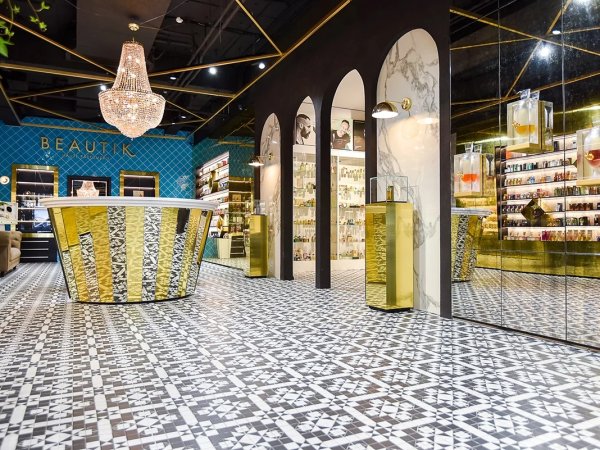
The Perfume Museum is located inside the Beautik store in Mario Plaza, on Calea Dorobanților no. 172. Although the exhibition is currently closed to the public, its spirit remains alive.
It is a place that proves perfume is not just a pleasant smell, but a form of cultural heritage, capable of telling stories, stirring emotions, and connecting past and present through the subtle power of aromas.
We also recommend: The History of the Filipescu-Cesianu House, the Most Beautiful Building in Belle Epoque Bucharest. Which Museum It Hosts Today