The oldest songs about Bucharest: from “Calea Victoriei” to “În Târgul Moșilor” and “La margine de București”
- Articles
- 04 FEB 26
Bucharest has not only been sung about in poetry and literature but also in music, starting from the early decades of the 20th century. The capital of Romania inspired composers, lyricists, and performers who captured the charm of the city, the contrast between the neighborhoods and the elegant boulevards, the nostalgia of old fairs, and the vibrancy of a constantly changing metropolis. Songs dedicated to Bucharest became true sound documents, preserving the emotions, images, and mentalities of vanished eras. From revue songs and urban romances to hits that crossed generations, these creations tell the story of a lively, contradictory, and deeply beloved city.
Bucharest in interwar music and the charm of the sung city
The interwar period was a golden era for Romanian urban music. Bucharest was a cosmopolitan city, with revue theaters, summer gardens, elegant restaurants, and picturesque neighborhoods. The music reflected this diversity, and the city often became the main character in songs that combined romance, irony, and melancholy.
During those years, composers such as Ion Vasilescu, Gherase Dendrino, or Elly Roman, alongside inspired lyricists, turned Bucharest into an inexhaustible source of musical subjects. The songs did not just talk about concrete places but also about people, customs, and moods. In this way, a true urban musical heritage was born, which continues to define the cultural identity of the capital.
“Fetițe dulci ca-n București,” a tribute to urban femininity
The song “Fetițe dulci ca-n București” is one of the most well-known pieces that capture the charm of the city through its people. The song was composed by Ion Vasilescu, one of the most important Romanian composers of the 20th century, famous for his revue hits.
The lyrics, in their established version, belong to an author from the circle close to the revue theater, reflecting the language and spirit of the era.
The piece appeared in the 1930s and was performed by several famous artists of the time, being especially associated with female voices from revue performances. The song praises the beauty, grace, and playful spirit of the young women of Bucharest, presented as symbols of the city itself.
Beyond its seemingly light tone, the song captures the atmosphere of interwar Bucharest, where elegance intertwined with natural charm. “Fetițe dulci ca-n București” quickly became a hit, sung in cafés, on the streets, and in summer gardens, contributing to the mythology of a cheerful and seductive city.
“București, București,” the song of longing for the city
“București, București” is one of the songs that best expresses the deep attachment to the capital. The song was also composed by Ion Vasilescu, a true musical chronicler of the city, and appeared during the interwar period, when Bucharest was perceived as a space of opportunities but also of nostalgia.
Performed by emblematic artists of the era, the song speaks about longing for the city, its streets, its intense life, and the memories it leaves in the hearts of those who leave it. The lyrics have a melancholic but affectionate tone, transforming Bucharest into an almost mythical place.
The story of the song is closely linked to internal migration and the experience of those who arrived or left the capital. For many, “București, București” became a personal anthem of longing, a song that evokes the emotional bond between the city and its inhabitants.
“La margine de București,” life at the city’s edge
The song “La margine de București” is one of the most suggestive creations about the contrast between the elegant city center and its outskirts. The song was composed by Ion Vasilescu and appeared in the 1930s, performed by light music and revue artists who knew how to authentically convey the atmosphere of Bucharest’s neighborhoods.
The lyrics describe life at the edge of the city, with its joys and hardships, with simple but intense loves, and with a rhythm of life different from that of the central boulevards. The song has the note of an urban romance, blending nostalgia with realism.
“La margine de București” tells the story of ordinary people, of the small daily dramas and joys, offering a sincere image of the city beyond its official splendor. It is precisely this authenticity that has made the song remain relevant and appreciated even today.
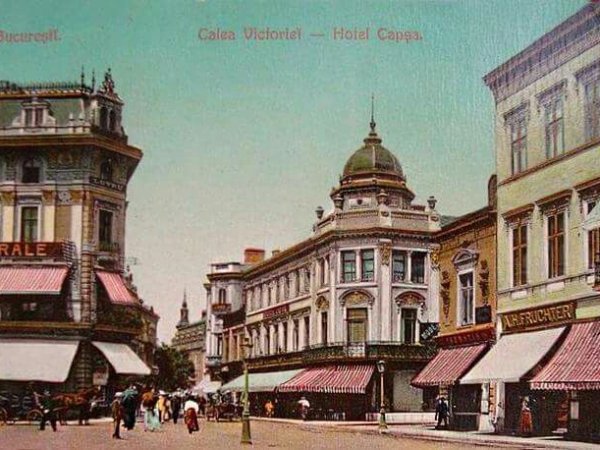
“Calea Victoriei,” the symbol of Bucharest’s elegance
“Calea Victoriei” is one of the most representative songs dedicated to an emblematic avenue of the capital. The composition belongs to Ion Vasilescu, and the song was released during the interwar period, when Calea Victoriei was the center of Bucharest’s social, cultural, and political life.
Performed by renowned revue theater artists, the song captures the boulevard’s charm, with its lights, elegant walks, and cosmopolitan atmosphere. The lyrics evoke the image of a modern Bucharest, connected to major European capitals but maintaining its local specificity.
The story of the song is closely related to the image of Calea Victoriei as a place of meetings, loves, and urban dreams. Over time, “Calea Victoriei” became not only a song but a sonic symbol of an era when Bucharest lived one of its most dazzling periods.
“În Târgul Moșilor,” the echo of a popular tradition
“În Târgul Moșilor” is a song that connects urban music with Bucharest’s popular traditions. The song evokes the famous Târgul Moșilor, an annual event with deep roots, where Bucharest residents gathered for trade, entertainment, and socializing.
The song was composed in the first half of the 20th century and performed by urban folk and revue artists. The lyrics describe the fair’s atmosphere, with stalls, music, good cheer, and people coming from all corners of the city and its surroundings.
“În Târgul Moșilor” is more than a cheerful song; it is a musical chronicle of a Bucharest tradition that shaped city life for generations. Through this melody, the collective memory of the capital remains alive, and the connection between past and present becomes tangible.
The musical legacy of old Bucharest
These old songs about Bucharest are not just artistic creations; they are true cultural documents. They capture the city’s transformations, social differences, aspirations, and emotions of its inhabitants. Each song tells a story, whether about the elegance of Calea Victoriei, life at the city’s edge, or the charm of traditional fairs.
The legacy left by these songs continues to influence how Bucharest is perceived and loved. They help us better understand the city’s identity and keep alive the memory of a capital that, although changed, preserves its unmistakable spirit.
We also recommend: Everything You Didn’t Know About Maria Tănase, the “Magic Bird of Romanian Music.” Untold Stories About the Great Artis t