The most famous legends of the Mărțișor: The Dragon Who Kidnapped the Sun, Baba Dochia and the Fierce Battle Between Spring and Winter
- Articles
- 27 FEB 26
Every year, on March 1, Romanians celebrate Mărțișor, one of the most beloved holidays dedicated to spring. This custom is considered by many researchers to be a deeply Romanian tradition, although there are also opinions according to which neighboring peoples later adopted the symbol because of its beauty. Mărțișor marks the beginning of a new cycle of nature and represents the rebirth of life after the cold months of winter. In the old Roman calendar, March 1 was the first day of the year. During this period the feast of Matronalia was celebrated, dedicated to the god Mars, protector of war, but also of agriculture and spring. Thus, since Antiquity, the beginning of March was associated with the forces of nature and with the idea of regeneration.
The origin and meaning of the Mărțișor
The tradition of the Mărțișor is extremely old. Archaeological evidence discovered at Schela Cladovei, in Mehedinți County, indicates the existence of necklaces made of pebbles colored in white and red, dated to approximately eight thousand years ago. These objects suggest that the symbolism of the two colors was known since prehistoric times.
At its beginnings, the Mărțișor had the form of a perforated coin, made of gold, silver or ordinary metal, attached to a string braided from two colors. Sometimes the string was white and black, other times white and red. The coin reflected the social status of the wearer, while the colors symbolized the cycles of nature.
White was associated with light, purity and the rebirth of nature, while black or red suggested winter, respectively life and energy. Over time, the black string was almost completely replaced by red, and the white-red combination became the best-known form of the Mărțișor.
Our ancestors wore these talismans on the wrist or on the chest in order to protect themselves from evil and to attract luck. Especially young girls considered the Mărțișor a magical object that brought them beauty and health. In the Dacian period, these symbols were considered solar amulets meant to bring fertility and prosperity.
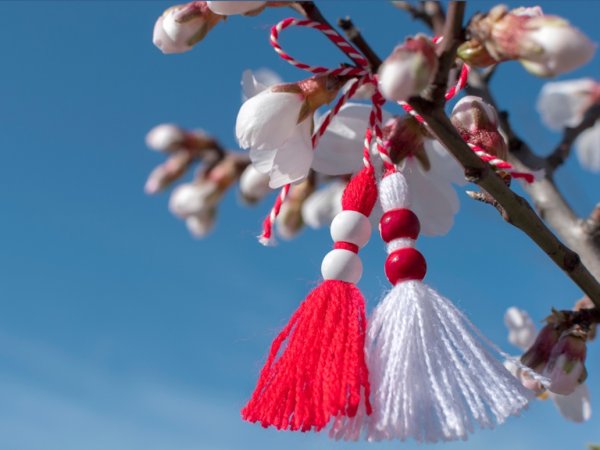
After nature began to bloom, the Mărțișors were hung on the branches of trees. It was believed that in this way luck was transmitted to the tree and, implicitly, to the household.
Over the centuries, the meaning of the Mărțișor has changed. From a protective talisman, it became a symbol of affection and love. Today it is offered to loved ones as a sign of appreciation.
The two-colored string is also interpreted as a symbol of the balance between the contrasts of the universe: day and night, life and death, health and illness or winter and spring.
The legend of the dragon who kidnapped the Sun
One of the most beautiful stories related to the Mărțișor speaks about the struggle of a brave young man for the salvation of the Sun.
The legend says that the Sun had descended to Earth in the form of a beautiful boy. Fascinated by his brightness, a dragon kidnapped him and locked him in a dark fortress. With the disappearance of the Sun, the world was seized by sadness: the birds no longer sang, the springs no longer flowed, and people no longer had the strength to rejoice.
A brave young man, called Mărțișor, decided to set out in search of the Sun. People offered him their symbolic help, giving him strength and encouragement. His journey lasted three seasons – summer, autumn and winter – until he reached the dragon’s castle.
The fight between the two was long and difficult. After many days of struggle, the young man managed to defeat the dragon and to free the Sun. It rose again into the sky, bringing back light and warmth.
Although the world rejoiced at the return of spring, the hero did not live to see nature blooming. The wounds suffered in the fight proved fatal, and his blood flowed onto the snow. As it melted, snowdrops appeared, the first flowers of spring.
Since then, people have braided red and white strings in memory of the brave young man. Red symbolizes blood and sacrifice, while white represents the purity of the snowdrop.
The story of Baba Dochia and the days of the Babas
Another famous legend is that of Baba Dochia, a mythological character who symbolizes the struggle between winter and spring.
It is said that Baba Dochia was a harsh woman who subjected her daughters-in-law to difficult trials. One day she ordered them to wash black wool until it would become white. The girls tried in vain, and despair made them burst into tears.
A traveler named Mărțișor met them and offered them some snowdrops, advising them to take them home. Baba Dochia, seeing the flowers, believed that spring had already arrived and hurried to leave with the sheep to the mountain.
Because the weather was still cold, she took nine sheepskin coats with her. As she climbed, the weather seemed to grow warmer, and Dochia began to throw off her coats one by one. Soon, however, the cold suddenly returned, and the blizzard covered everything.
Baba Dochia and her flock froze and turned into rocks. Tradition says that the rock formations in the Ceahlău Mountains are actually “Baba Dochia’s sheep”.
The first nine days of March are known as the Days of the Babas and symbolize Dochia’s ascent on the mountain. Every woman chooses a day, and the weather on that day shows how her year will be.
The symbolic battle between Spring and Winter
Another popular story explains the symbolism of the Mărțișor string through the confrontation between Spring and Winter.
The legend says that Spring was walking through a meadow when she noticed a snowdrop trying to emerge from the snow. Wanting to help it, she pushed aside the layer of snow so that the flower could grow.
Winter, furious that it was losing its power over the earth, sent a wave of cold. The snowdrop froze, and Spring tried to protect it with her hands. While covering it, she injured one finger, and her blood fell over the flower.
The warmth of the blood brought the snowdrop back to life, and Spring won. Thus the combination of white and red colors is explained, symbols of purity and life.
Traditions and customs related to the Mărțișor
The Mărțișor is worn differently depending on the region. In some areas of the country, people wear it for several days or weeks, until the first signs of spring appear.
In Transylvania, Mărțișors are often hung on windows, doors or even on the horns of animals in order to drive away evil spirits. In Banat, girls wash with water from melted snow in order to be loved, and in Dobrogea the Mărțișors are thrown toward the sky after the arrival of cranes.
In Moldova there is the tradition that girls offer Mărțișors to boys on March 1, and on March 8 the boys respond with similar gifts.
Teenage girls sometimes wore the Mărțișor for twelve days, then attached it to their hair until the appearance of migratory birds. Afterwards, the string was tied to a tree, and the coin was used to buy fresh cheese and red wine, symbols of beauty and health.
At the end of the cycle that begins on March 1 is March 9, when the Forty Holy Martyrs are celebrated. In some regions there is the custom of drinking forty glasses of wine.
The Mărțișor in Balkan traditions
The custom of the Mărțișor is not limited to the Romanian space, but appears in different forms in the Balkan area.
In the Republic of Moldova, as well as in Romania, the Mărțișor is offered especially to women, while in some Moldavian regions men also receive such symbols.
In Bulgaria there is the tradition of the Martenitsa, the white-red string worn until the appearance of the first storks or budding trees. Afterwards it is tied to a tree in order to transmit luck to nature.
In Albania and Macedonia, similar symbols are worn especially by children and are hung in trees after the appearance of swallows.
The meaning of the colors is generally the same in all these traditions: white is associated with longevity and masculine power, and red symbolizes feminine fertility and energy.
An eternal symbol of rebirth
Although the exact moment of its appearance is not known, the tradition of the Mărțișor is certainly one of the oldest in Europe. From prehistoric pebbles and Dacian coins to modern figurines, the Mărțișor has remained a symbol of hope.
The legends about the brave young man who freed the Sun, about Baba Dochia or about the struggle between Spring and Winter convey the same idea: nature is always reborn, and life defeats cold and darkness.
Today, the Mărțișor continues to be a sign of joy and new beginnings. The white-red string remains a symbolic bridge between past and present, between tradition and modernity, reminding us every spring of the deep connection between people and nature.
We also recommend: The most unique “Mărțișor” in Bucharest. The Tudor Arghezi Memorial House, in whose courtyard the poet’s entire family is buried