The Monument of the Heroes of the Air and the history of the majestic statue built in honor of Romanian aviators
- Articles
- 05 FEB 26
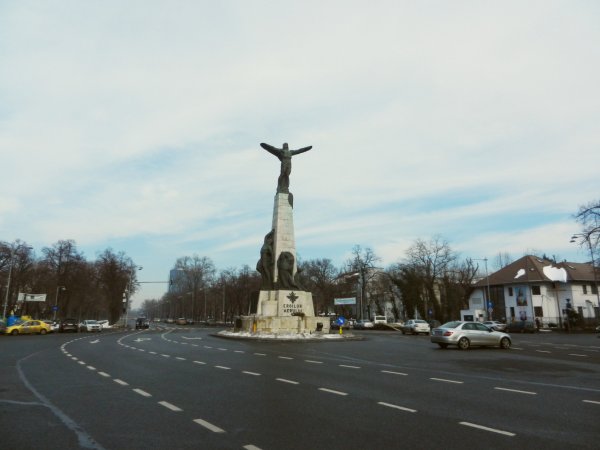
In the heart of Bucharest, in one of the Capital’s best-known and busiest urban spaces, rises the Monument of the Heroes of the Air, a monumental work of art that brings together historical memory, the symbolism of sacrifice, and the artistic ambition of interwar Romania. Built in honor of Romanian aviators, both military and civilian, who dedicated their lives to the development of national aviation, the monument is not only an architectural landmark but also a testimony to an era in which flight became synonymous with courage, progress, and supreme sacrifice. Its history is complex, marked by controversies, artistic competitions, financial efforts, and a profound symbolic vision.
The historical and symbolic context of the Monument of the Heroes of the Air
At the beginning of the 20th century, Romanian aviation was experiencing a period of rapid affirmation, driven both by technical progress and by the geopolitical context of the time. The First World War had demonstrated the strategic importance of air forces, and Romania, which had recently consolidated its status as a unified national state, needed symbols that would honor the sacrifices of those who had fallen for aeronautical progress.
The Monument of the Heroes of the Air was conceived as a tribute to all Romanian aviators, military and civilian, who contributed to the development of aviation and who, in many cases, lost their lives during missions or accidents. Its placement in the center of Aviators’ Square, a circular intersection with maximum visibility, was chosen precisely to give the monument a dominant and permanent presence in the urban landscape of the Capital.
The artists and the artistic conception of the monument
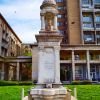
The realization of the monument took place over several years, between 1928 and 1935, and bears the signature of sculptors Lidia Kotzebue and Iosif Fekete. The monument has a total height of 20 meters and consists of an imposing obelisk and four bronze statues, three of which are placed at the base of the pedestal and are collectively called “The Sacrifice of the Heroes of the Air.”
Viewed from the front, the statues reveal a powerful visual narrative. The figure on the left leans against the obelisk, with the left arm lowered, highlighting the musculature of the body, while the right arm is raised toward the sky, revealing the wing of Icarus. This posture suggests the aspiration toward flight and the aviator’s supreme ideal. The central figure, with its contorted body and tensed muscles, evokes the suffering of the fallen aviator and is often compared to a modern Laocoön, a symbol of struggle and pain. The figure on the right is depicted fallen, with the head resting on the shoulder, suggesting exhaustion and ultimate sacrifice.
The Victory of Aviation and the symbol of Icarus
The focal point of the sculptural ensemble is the figure placed at the top of the obelisk, known as “The Victory of Aviation.” It represents Icarus in a modern interpretation, with wings spread wide, ready to take flight. The statue has a height of approximately 5 meters and visually dominates the entire monument.
The symbolism of Icarus is profound: he embodies humanity’s aspiration to surpass limits, the courage to defy the unknown, and the risk assumed in the name of progress. In the context of aviation, Icarus becomes the symbol of the aviator who accepts the ultimate danger in order to conquer the sky. Although the statues are idealized, their bodies have a real inspiration: it is believed that the model for the aviators’ anatomy was the famous American boxer Joe Louis, who was present in Bucharest at that time, a fact that gives the sculptures authentic physical strength.
Artistic style and aesthetic influences
From a stylistic point of view, the Monument of the Heroes of the Air represents a synthesis of several artistic currents. The pedestal, with its ziggurat-like shape, clearly fits into the Art Deco language, a style associated with modernity, geometry, and dynamism. The undulating drapery of the statues, executed in a motif of three, is also characteristic of this style.
At the same time, the expressiveness of the figures, the muscular tension, and the dramatic nature of the postures recall Russian expressionism, with which Lidia Kotzebue had been in contact. The monumentality of the ensemble anticipates the later works created in Bucharest by Ivan Meštrović, demonstrating the innovative character of this project for interwar Romanian art.
The first initiatives and competitions for the realization of the monument
The idea of building a monument dedicated to Romanian aviators appeared as early as 1923, when a special committee was formed. Its members included prominent figures of public and military life: Prince Carol II, Professor Dr. Ion Cantacuzino, General Vasile Rudeanu, Colonel Doctor Aviator Victor Atanasiu, aviators Cornel Olănescu and Mihai Oromolu.
Initially, the committee requested, for a fee, projects from well-known sculptors such as Ion Jalea, Alexandru Severin, Cornel Medrea, and Ion C. Dimitriu-Bârlad. Considering, however, that these proposals did not sufficiently reflect the spirit of the aviators’ sacrifice, it was decided to organize a public competition, with total prizes amounting to 40,000 lei.
The selection of Lidia Kotzebue’s project
Fourteen sculptors participated in the competition, and their models were exhibited at the Romanian Athenaeum on 2 July 1925, allowing the public to vote secretly for the preferred project. Although three works were awarded prizes—those created by Spiridon Georgescu, Lidia Kotzebue, and Ion Schmidt-Faur—the committee did not consider any of them convincing enough for immediate execution.
After the failure of attempts to commission a foreign artist, the committee returned, after two years, to Lidia Kotzebue’s project, accepting the idea of her collaboration with other sculptors or architects. In July 1927, for final approval, she was asked to create a model at a scale of 1:4, but the lack of time made this impossible. Thus, for the actual execution of the statues, Kotzebue turned to sculptor Ion Jalea, who declined but recommended the young sculptor Iosif Fekete instead. On 27 October 1927, the project was definitively approved.
Casting the statues and completing the monument
Between 1928 and 1929, Iosif Fekete created the four sculptures in clay, later cast in plaster at full scale. For the figure of Icarus, the image of boxer Joe Louis was used, while for the head a photograph from an album featuring famous pilots was employed.
Although in 1930 the work was ready to be cast in bronze, financial difficulties and delays in deciding the location postponed the completion of the project. Eventually, the statues were cast in bronze at the V.V. Rășcanu Foundry in Bucharest, and the work was completed only in June 1935.
The solemn inauguration of 20 July 1935
The inauguration of the Monument of the Heroes of the Air took place on 20 July 1935, in a solemn setting. King Carol II, Prince Nicolae, and the Grand Voivode of Alba Iulia, Mihai, arrived at Mogoșoaia Railway Station at 10:25, where they were greeted by high-ranking officials. The royal convoy reached General Gheorghe Buzdugan Square, today Aviators’ Square, shortly after 10:30.
Members of the government led by Gheorghe Tătărescu, two aviation regiments, ministers, artists, representatives of the local administration, and numerous Bucharest residents were present. The King reviewed the troops and then ascended to the official tribune.
King Carol II’s speech and the significance of the monument
Before pulling the tricolor cord, King Carol II delivered an emotional speech, emphasizing the importance of the aviators’ sacrifice and the role of the monument as an eternal symbol of devotion and faith. He spoke about the progress of Romanian aeronautics, about the courage of those who contributed to its development, and about the blood shed for every step forward.
The Monument of the Heroes of the Air thus became not only a tribute to the past but also a symbol of interwar Romania’s modernization, a work of art of great aesthetic value and a landmark of collective memory. Today, it continues to stand guard over the Capital, reminding present and future generations of the courage, sacrifice, and ideals of those who chose the sky as their destiny.
We also recommend: “The ‘Potato on a Spike,’ the Most Famous Statue in Bucharest: The Story of the Rebirth Monument in Revolution Square”