The legends of the abandoned manor in Tineretului Park in Bucharest: from the parish house of a priest to Maria Tănase’s villa
- Articles
- 04 FEB 26
Tineretului Park is, without a doubt, one of the most frequented green spaces in Bucharest. Wide alleys, playgrounds, the quiet lake, and the proximity to the “Children’s World” Park make it an ideal place for relaxation. However, beyond its modern and friendly image, the park hides a strange presence that strongly contrasts with the surrounding cheerfulness: an abandoned manor, in an advanced state of decay, located on the plateau above the lake. This building, ignored by many and viewed with fear or curiosity by others, has become over time a true magnet for urban legends and unverified theories.
A ruined manor, between light and darkness
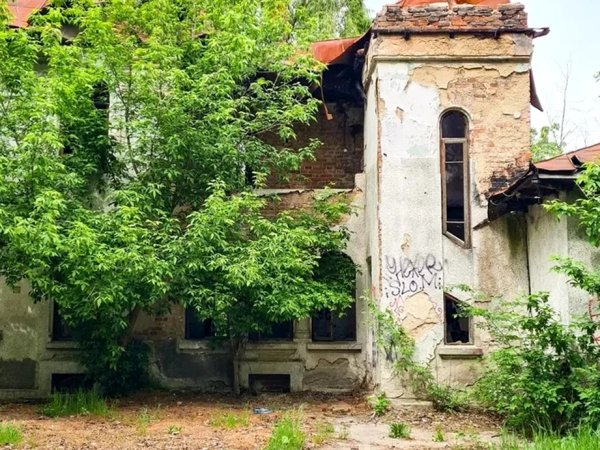
The construction, today a silent ruin, seems detached from another era. Broken windows, walls blackened by fires, traces of old furniture, and fallen plaster fragments tell the story of a building that once knew better days. Although it is fenced off and declared private property, the mystery surrounding it has never been kept at a distance. On the contrary, the lack of clear information about the origin and purpose of the manor has fueled, over the decades, numerous fascinating stories.
Seen during the day, the manor in Tineretului Park appears to be just an abandoned building, a collection of tired walls that no longer say much to hurried passersby. At night, however, the atmosphere changes radically.
The silhouette of the building becomes threatening, and the small towers of the roof, visible among the tree branches, take on a Gothic air. The shards of glass still left in the metal frames reflect the light of the streetlamps, and the oppressive silence around it intensifies the feeling of a place abandoned, forgotten by time and by people.
The advanced state of decay is the result of years of neglect, repeated fires, and the absence of any serious conservation intervention. The ceiling has collapsed in places, the metal structure is rusted, and the interior is full of debris and traces of those who used the building as a temporary shelter. All these elements shape the image of a lost architectural jewel, which inevitably raises the question: what was this place before it became a ruin?
Unclear origins and the Charlea family hypothesis
One of the first theories regarding the appearance of the manor claims that it was built by a wealthy family known as Charlea. At the time the building was erected, the area looked completely different from what we see today.
It was a suburb of Bucharest, with marshes, narrow streets, and poorly urbanized spaces. The manor would have been placed in a secluded location, far from the bustle of the city, which made it suitable for an elegant private residence.
Over time, as the city expanded, the area was systematized, and the old neighborhood was transformed into a park. The building, however, remained in place, forcibly integrated into a completely different urban landscape.
Nevertheless, the Charlea family hypothesis is not supported by clear documents. Historical evidence is vague, and the lack of solid archives makes this theory remain rather a story passed on by word of mouth.
The parish house of the priest from Cărămidarii de Jos
Another version circulated over the years is that the building was the parish house of the priest who served at the Cărămidarii de Jos church, located on Piscului Street. The church, built in 1711, is one of the oldest in the area, and the relative proximity between the two constructions has fueled this hypothesis.
However, upon closer analysis, the theory raises numerous question marks. The distance between the church and the manor is quite large to justify such a direct connection, and the architectural style of the building does not necessarily correspond to a parish house. Moreover, known historical documents do not mention the existence of such a residence in that location. Thus, although the idea is interesting and contributes to the mysterious aura of the manor, it remains difficult to support from a historical point of view.
The manor and the mystery of the “Mihail Sadoveanu” Library
One of the most discussed theories is the one according to which the building once housed the “Mihail Sadoveanu” Library. This hypothesis is based on discoveries made inside the manor over time. Wooden shelves, catalog cards, and pieces of furniture specific to libraries were observed among the ruins, suggesting a possible cultural function of the space.
It is known that, in the 1960s, the “Mihail Sadoveanu” Library was moved to 16 Slătineanu Street. It is possible that, before this definitive relocation, the institution had a temporary headquarters, and the manor in Tineretului Park could have played this role.
However, there is no official evidence to confirm this use. Many specialists believe that the furniture could have come from other sources, having been brought here later, perhaps even after the building was abandoned. In the absence of clear documents, this theory also remains at the stage of speculation.
The Maria Tănase myth and the fascination of an urban legend
Perhaps the most well-known and romantic story connected to this manor is the one involving Maria Tănase. Over the years, it has been said that the famous performer of Romanian folk music lived in this building, turning it into a place with a strong cultural and emotional charge. The story quickly caught on with the public, especially due to the almost mythical status of the artist in Romanian culture.
The reality, however, is different. Maria Tănase never lived in this manor. She had a house nearby, on the former Livada cu Duzi Street, an area that was demolished in the 1980s, during the major urban transformations that led to the development of Tineretului Park and the “Children’s World” Park. The artist’s house was destroyed following nationalization and demolitions, and that location is now occupied by swings and playground areas for children.
Even so, the legend persists. Associating Maria Tănase’s name with this ruin says a lot about people’s need to connect abandoned places with emblematic figures, in order to give them meaning and a story that saves them from oblivion.
From elegance to decay
Regardless of the truth behind these theories, one thing is certain: at its beginnings, the manor was a remarkable building. Its architecture, decorative details, and dimensions suggest a respectable space, intended for an important purpose. The interior was most likely furnished with quality furniture, and the atmosphere was elegant, specific to a prestigious residence or institution.
The passage of time and social changes, however, have radically transformed this place. After losing its initial function, the building was used for various purposes, including as a temporary shelter for needy families or homeless people. The lack of investment, vandalism, and fires accelerated the degradation, until the manor reached an almost irreversible state.
A symbol of forgotten heritage
Today, the abandoned manor in Tineretului Park is more than a ruin. It represents a symbol of the way in which Bucharest’s cultural heritage has often been neglected or left to be forgotten. Although there have been discussions and initiatives related to saving it, the lack of a concrete restoration plan has caused them to remain mere intentions.
The building continues to deteriorate, and its future is uncertain. The chances of restoration in the near future seem minimal, especially in the context of high costs and legal issues related to ownership. Even so, in the collective memory of Bucharest residents, the manor will remain a landmark of a bygone era, a place of legends and untold stories.
Perhaps it will never again be returned to the public in its original form, but its mystery continues to fascinate. In its silence, hidden among the trees of Tineretului Park, the abandoned manor preserves its role as a witness to history and as a symbol of a story that still awaits to be fully deciphered.
We also recommend: Tineretului Park, between legend and reality: the Cocioc swamp, the Valley of Weeping, and the garden that rose from a garbage dump