The history of AFI Cotroceni, from the Bucharest Electric Motors Factory to the largest and most popular shopping mall in the country
- Articles
- 25 SEP 26
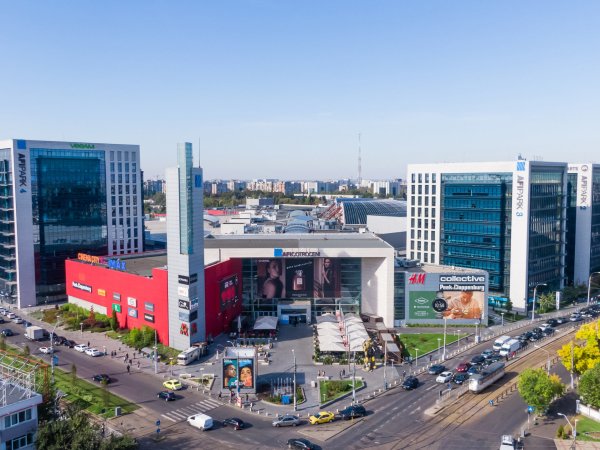
Today, AFI Cotroceni is one of the best-known places in Bucharest. Every day, tens of thousands of people pass through its doors for shopping, restaurants, cinema, entertainment or simply to spend a few hours in one of the largest shopping centers in Romania. The enormous building near Timișoara Boulevard and General Vasile Milea Street seems to have always been part of the landscape of the modern capital. The history of the place is, however, much older and surprisingly different. Before there were shops, restaurants, cinemas and leisure spaces here, the land was occupied by the Bucharest Electric Machines Factory, known by the acronym UMEB. Electric motors and generators were manufactured on this industrial platform, and during the communist period the factory was one of the important units of the Romanian electrotechnical industry. The transformation from factory to shopping mall is, in fact, a very suggestive image of the changes Bucharest went through after 1990.
From the old industrial site to the AFI project
The story of UMEB is connected to the tradition of Bucharest's electrotechnical industry. According to the company's historical documents, an industrial and military unit associated with the Army Arsenal previously operated on the respective site, and in 1948 the Dinamo Electric Machines Factory was established. In 1961, it received the name Bucharest Electric Machines Factory, becoming known throughout the country by the initials UMEB.
The factory produced electric motors, generators and generating sets, while its manufacturing range diversified over the decades. Ziarul Financiar reported that, before the Revolution, several thousand people worked at UMEB and more than one thousand types of electric motors were produced. An important part of the production was destined for export, including to markets such as Italy, Germany, Finland and Spain.
For the industrial Bucharest of the 1960s, 1970s and 1980s, UMEB was not simply another factory. It was one of the city's major production units, with halls, machinery and a large community of workers. Inside the platform, an activity completely different from what we see today was taking place: the noise of industrial installations and machinery was part of the area's everyday life.
After 1989, however, Romanian industry entered a broad process of restructuring. UMEB went through changes of ownership and reorganizations, and the land on which it operated gradually became much more valuable for real estate developments than for industrial production. In 2005, AFI Europe purchased the land of the former factory for approximately 78.8 million euros, preparing one of the most important urban transformations in this part of Bucharest.
How the idea of a huge mall in Cotroceni appeared
In the middle of the 2000s, the shopping center market in Bucharest was undergoing a period of rapid expansion. Shopping malls had already become an urban phenomenon, and real estate developers were looking for large plots of land, well connected to the city's infrastructure. The former UMEB platform had exactly the advantages needed for a project of such dimensions: a large surface, access to important roads and a location between the center of the capital and the densely populated neighborhoods in the west.
AFI Europe proposed a large-scale project here, which would initially bear the name Cotroceni Park. The idea was not that of a simple shopping center, but of a complex capable of combining shopping with entertainment and services. The investment announced for the project amounted to approximately 300 million euros, a considerable sum for the Romanian market of that period.
The works progressed at a spectacular pace. In the summer of 2009, when the press visited the construction site, the project was already at an advanced stage, and the developer was aiming for an opening before the end of the year. The shopping center had been designed as a large-scale construction, with retail spaces, restaurants and numerous entertainment areas.
One of the elements that attracted attention from the construction period was the architectural scale of the interior. The project included a spectacular dome in the food court area, while the general concept aimed to transform the shopping center into a leisure destination, not merely a place for shopping.
In this way, the project also changed the image of the area. Instead of a closed industrial platform dominated by halls and production activities, an urban space open to the public appeared, connected to the neighborhood's main roads and very close to public transportation.
October 29, 2009, the day AFI Palace Cotroceni opened
AFI Palace Cotroceni, the name under which the shopping center became known in its early years, was inaugurated on October 29, 2009. At the time of its opening, it was presented as the largest shopping mall in Romania, and the inauguration attracted an impressive number of Bucharest residents. Ziarul Financiar later recorded that, during the first weekend, the shopping center reached approximately 100,000 visitors per day.
On the day of its inauguration, the mall had a leasable area of approximately 76,000 square meters. Approximately 95% of the spaces were already leased, and among the tenants were important names in international retail. Inditex, for example, brought brands such as Zara, Pull&Bear, Stradivarius, Bershka, Oysho and Massimo Dutti to the shopping center.
AFI Palace Cotroceni stood out from the very beginning through the size and diversity of its offer. It was not merely a place where people went to buy clothes or household products. Restaurants, cinemas and numerous attractions for leisure time had been included in the project. Sources from the period of the inauguration also mentioned a go-karting track, an ice rink, a climbing wall and a cinema complex with 20 screens, as well as the first IMAX 3D cinema in Romania.
This combination would become one of the main explanations for the mall's popularity. AFI Cotroceni did not compete only through the number of stores, but also through the idea of an urban destination where shopping could be combined with dining, movies, sports or entertainment.
The 2017 expansion and transformation into a major shopping hub
The success of the project prompted the developer to continue investing. Almost eight years after its inauguration, AFI Cotroceni went through another important stage of expansion. In 2017, the leasable area of the shopping center was increased by approximately 6,500 square meters, reaching around 90,000 square meters.
The expansion allowed the arrival of several very large stores. Among them were the 5,200-square-meter Peek & Cloppenburg store and a 4,000-square-meter Zara store, presented at the time as the largest Zara in the Central and Eastern European region.
The impact of the expansion was also visible in commercial indicators. In 2017, retailers' sales at AFI Cotroceni reached approximately 1.1 billion lei, an increase of 5% compared with the previous year, while the average number of visitors rose to approximately 51,000 per day.
During the same period, AFI Cotroceni became part of a larger urban project. AFI Park office buildings were also developed on the land of the former industrial platform. Thus, the old industrial space was transformed into a mixed-use complex, with commercial and office functions. AFI Europe described the development in Cotroceni as one of its most important investments in Romania.
What remains of the old UMEB
Perhaps the most interesting aspect of AFI Cotroceni's history is the contrast between the site's past and present. A few decades ago, electrical equipment was manufactured here and thousands of people worked here. Today, the same space is crossed daily by tens of thousands of visitors.
The transformation did not, however, mean the complete disappearance of UMEB as a company. In 2008, the factory was moved to a new location on Timișoara Boulevard, and production continued. The investment for the new factory was estimated at 11.5 million euros, allowing the company to preserve its industrial profile even after the Cotroceni site was vacated.
In this sense, the history of AFI Cotroceni is not only the story of the disappearance of a factory and the emergence of a shopping mall. It is also the story of an industrial relocation, the change in the function of a piece of land and the way Bucharest moved from the major production platforms of the communist era to an economy based on services, retail and office buildings.
AFI Cotroceni today
Today, AFI Cotroceni continues to be presented by the developer as the largest and most important shopping center in Bucharest and one of the most important shopping centers in Romania. Current official data indicate a leasable area of approximately 86,500 square meters and almost 50,000 visitors per day. The shopping center is located at 4 General Paul Teodorescu Boulevard and is approximately a ten-minute walk from a metro station.
Its current size is the result of almost two decades of development. From the Cotroceni Park project announced in the 2000s to the mall opened in 2009 and subsequently expanded, AFI Cotroceni has become a landmark of contemporary Bucharest. Its economic value has also increased considerably: in 2017, after the expansion, the shopping center was valued at approximately 501 million euros, while a valuation published in 2023 indicated a value of 543.8 million euros.
Seen from the present, it is difficult to imagine that, in the place of the shopping galleries, restaurants and entertainment spaces, one of Bucharest's major industrial platforms once stretched out. Yet it is precisely this transformation that makes the history of AFI Cotroceni so representative of the city.
We also recommend: The History of Sun Plaza, the Most Popular Shopping Complex in Southern Bucharest