The First Vegetarian Restaurant in Bucharest Opened in 1908. What Romanians Ate at “Natura”
- Articles
- 20 FEB 26
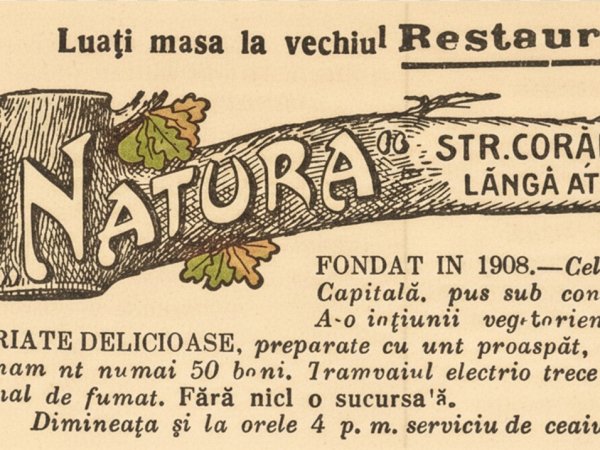
At a time when terms such as “bio,” “sustainable,” or “plant-based” did not exist in everyday language, Bucharest was already becoming acquainted with a concept that today seems modern: the vegetarian restaurant. On November 23, 1908, “Natura,” the first establishment in Romania dedicated exclusively to meat-free dishes, opened its doors in the Capital. The event represented more than a simple gastronomic inauguration – it was the expression of a social and cultural movement seeking alternatives to the traditional diet rich in animal-based products.
The Context of the Opening of the “Natura” Restaurant
Far from being an isolated eccentricity, vegetarianism already had roots in Romanian society. Although at first glance it may seem hard to believe, at the beginning of the 20th century there were influential circles promoting a diet based on vegetables, fruits, and cereals. “Natura” became the symbol of this orientation and a meeting point for Bucharest residents interested in a healthy and balanced lifestyle.
The opening of the “Natura” restaurant was not a random gesture, but the result of an initiative undertaken by the Asociația Vegetarienilor din România. This organization advocated for the promotion of vegetarian food and for popularizing its benefits among the general public. Its members came especially from the urban elite – doctors, intellectuals, professors – people concerned with hygiene, health, and social reforms.
The establishment was opened near Biserica Albă, on what is now George Enescu Street, in a central and accessible area. The location was not chosen by chance: it was intended that the restaurant be visible, easy to find, and associated with a respectable setting. Very quickly, “Natura” became a landmark for those interested in healthy eating and, at the same time, in a lifestyle considered modern and responsible.
The inauguration ceremony had a festive character and attracted remarkable personalities of the time. Among those present was Dr. I. Cantacuzino, and the main speech was delivered by Dr. C. Parhon, the president of the association. In his address, he highlighted the advantages of the vegetarian diet and advocated for its adoption as an alternative to the dominant culinary habits. The message was clear: food could become an instrument of moral and physical reform of society.
Vegetarianism Between Conviction and Tradition
Although some contemporaries viewed this initiative with skepticism, vegetarianism was by no means an absolute novelty in the Romanian space. The satirical publication Furnica ironically mentioned that “the vegetarian regime has long been practiced by the immense majority of the Romanian people.” The allusion was obvious: the fasting periods imposed by the Orthodox Church already required the elimination of meat and animal-based products from the diet.
Thus, in a certain sense, meatless meals were part of local tradition. The difference was that, in the case of the “Natura” restaurant, vegetarianism became a conscious, permanent choice associated with the idea of progress. It was no longer only about observing religious prescriptions, but about embracing a lifestyle considered superior from a hygienic and moral point of view.
It is interesting that the restaurant’s target audience was not represented by disadvantaged categories. On the contrary, customers came especially from among those with generous financial means. For them, dining at “Natura” was a statement of belonging to a modern, European current in which health and dietary self-control became signs of refinement.
What Romanians Ate at “Natura”
The inaugural menu of the “Natura” restaurant demonstrates how varied and sophisticated vegetarian cuisine could be in 1908. The opening banquet included a succession of dishes meant to show that the absence of meat did not mean the absence of taste or diversity.
The meal began with vegetable soup, a natural and comforting choice. It was followed by appetizers such as butter, radishes, and olives – simple yet appreciated combinations. A dish with Western influence was salsify à la Polonaise, a sign that Romanian vegetarian cuisine was open to European recipes. Peas with mushroom patties and mixed salad completed the range of main courses.
A highlight was the cauliflower roast, a plant-based reinterpretation of traditional meat dishes. Desserts were numerous and tempting: millet with milk, compote of various fruits, vanilla cream, and apple pie. Various cheeses were added, along with a rich selection of fruits – grapes, apples, pears, mandarins – together with almonds, hazelnuts, and walnuts.
Beverages were not missing either. Guests could enjoy “Natura” cereal coffee, whole-grain bread, and must from Drăgășani, a sign that Romanian winemaking tradition found its place even within a vegetarian menu. Overall, the offer demonstrated that a meat-free meal could be not only nourishing, but also festive.
The Impact on Bucharest Society
The “Natura” restaurant had a considerable echo in early 20th-century Bucharest. For some, it was a curiosity; for others, a sign of progress. In a society undergoing a process of modernization, the idea of eating in an organized, balanced, and moderate way was becoming increasingly attractive.
The establishment functioned as a space for debate and meeting for supporters of dietary reforms. Here, medical theories, hygienist principles, and ideas about the regeneration of society through personal discipline were discussed. Food was seen as a pillar of public health, and the restaurant offered a concrete example of applying these concepts.
In 1911, “Natura” moved to 3 Corabia Street, a sign that its activity was prosperous enough to allow relocation. The move also indicated the desire to expand and consolidate the business. However, the outbreak of the First World War was to put an end to the restaurant’s existence.
The Decline and the Legacy Left Behind
Romania’s entry into the war radically changed society’s priorities. Food crises, economic instability, and logistical difficulties made it impossible for the “Natura” restaurant to continue operating. The establishment disappeared, yet the idea behind it was not abandoned.
The Asociația Vegetarienilor din România continued its activity during the interwar period, keeping alive the debate about vegetarian nutrition. Even though the restaurant did not survive the turbulent times, it remained a symbol of an era in which Bucharest was experimenting and seeking new directions of development.
Looking back, “Natura” can be considered a precursor of today’s vegetarian and vegan restaurants. At a time when meat was associated with prosperity and social status, proposing an exclusively plant-based menu was a courageous gesture. The initiators of the project demonstrated that gastronomy can reflect values, convictions, and ideals.
Today, when vegetarian food is once again in the spotlight, the history of the restaurant opened in 1908 shows us that many current trends have deep roots. Bucharest did not recently discover meat-free cuisine – it experimented with it as early as the beginning of the last century, in an establishment that bore a simple and suggestive name: “Natura.”
We also recommend: The history of the Cireșica Restaurant, the favorite place of interwar Bucharest, where you went “to eat batoc fish and listen to Zavaidoc”