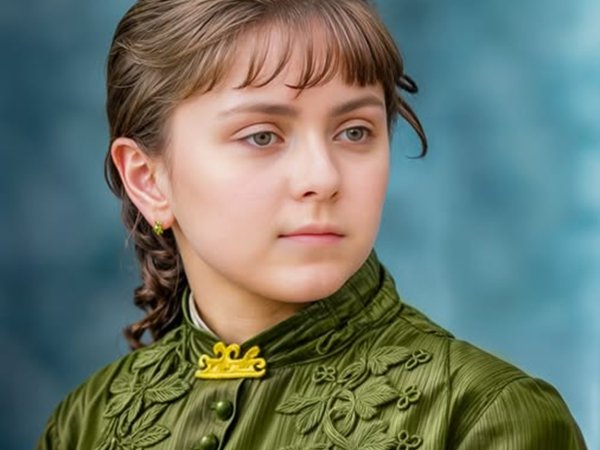
The First Romanian Woman Student at the Sorbonne Spoke French Fluently at the Age of 2. The Brilliant Iulia Hașdeu Was Struck Down by Illness at the Age of Majority
- Articles
- 17 FEB 26
In the history of Romanian culture, few destinies have shone so intensely and faded so quickly as that of Iulia Hașdeu. A genius child, a precocious spirit, a complex artist and an intellectual of rare depth, she managed, in only 18 years, to leave behind a body of work and a legend that continue to fascinate.
A child prodigy born into an exceptional family
The first Romanian woman enrolled at the Sorbonne, a poet of French expression, a pianist, a singer, and a young researcher in philosophy, Iulia was a phenomenon of her time. Her destiny, however, was broken by illness right at the threshold of adulthood.
As a result of galloping tuberculosis, her life ended in 1888, leaving behind an impossible grief for her parents and an aura of mystery that would deepen with the raising of the famous castle in Câmpina.
An unconventional childhood
Iulia Hașdeu was born on November 14, 1869, in Bucharest, on Carol I Street no. 14, being the daughter of the scholar Bogdan Petriceicu Hașdeu and of Iulia Faliciu. She received the same name as her mother, a symbolic gesture through which her father wished to emphasize the profound bond between the two beings who illuminated his life.
From her very first years, the little girl—nicknamed “Lilica”—showed signs of genius. At only two years old she spoke the French language fluently, and at four she had already begun to write. At five she was composing short stories, and at seven she was drafting historical narratives such as “Mihai Vodă the Brave” and poems dedicated to the reign of Prince Țepeș. She was a brilliant mind, capable of assimilating information with astonishing speed.
An essential role in her formation was played by her mother, who dedicated all her energy to her daughter’s education. Iulia Faliciu invested time, discipline, and tireless attention in cultivating the child’s talent, shaping her character and her will to accomplish great things.
The amazement of the intellectuals of the time
The Hașdeu family home was frequented by prominent personalities of Romanian culture. One of the famous anecdotes places the poet Alexandru Macedonski at its center. While visiting, he allegedly asked the little girl whether she knew any poem. Iulia responded provocatively: “And you?” After Macedonski recited a poem to her, the child reproduced it entirely, word for word, only a few minutes later. Her memory and intelligence left those present speechless.
At eight years old, in 1877, she took the cumulative examination for grades I–IV at Primary School for Boys No. 2, under the guidance of Dem. Demetrescu, obtaining the certificate of completion. In the same year, she gathered her stories—written in Romanian and French—into the cycle “Stories for My Friends and for All Girls from 10 to 20 Years Old.”
At 11, she was already composing plays: the three-act tragedy “The Circus Lady,” the comedy “Love Is a Spark,” as well as one-act works in French such as “Adieu et Bonne Arrivée” and “Les enfants ne jugeant pas.” She wrote short stories, poems, and dramatic sketches with a surprising artistic maturity.
Chosen education and artistic vocation
Iulia was enrolled as a private student at the “Saint Sava” High School, where she took examinations alongside the official students. She graduated in 1881 with remarkable results. Her parents ensured that she had private tutors for humanities, foreign languages, Latin, Greek, and the arts.
Her father wished that his daughter benefit from everything that had been inaccessible to him in childhood: music, painting, and vast culture. Iulia attended the Conservatory, in the singing and piano section, possessing an exceptional voice and a special artistic sensitivity. She was attracted to painting and demonstrated promising visual talent.
Although part of the public opinion viewed her successes with suspicion—attributing them to her father’s influence—her performances were confirmed through concrete results and the appreciation of her professors.
The first Romanian woman at the Sorbonne
At only 16 years old, in 1886, Iulia Hașdeu became the first Romanian woman admitted to the prestigious Sorbonne University, where she attended the Faculty of Letters, preparing for a degree in Philosophy. At the same time, she attended courses at the École des Hautes Études in Paris.
She was energetic, enthusiastic, eager for knowledge. She took painting and singing lessons with renowned professors, studied tirelessly, and impressed through her seriousness. She delivered two lectures at the Sorbonne: “The Logic of the Hypothesis” and “The Second Book of Herodotus,” proving exceptional oratorical talent.
In love with French culture, she admired personalities such as Napoleon I, Ferdinand de Lesseps, and Victor Hugo. Hugo’s death, in 1885, affected her deeply.
The struggle with illness
While preparing her doctoral thesis, entitled “Popular Philosophy among Romanians: Logic, Psychology, Metaphysics, Ethics and Theodicy,” Iulia fell gravely ill. Ignoring the first symptoms, she continued to study with determination. The doctors’ diagnosis was merciless: tuberculosis.
She was taken for treatment to Montreux, in Switzerland, then to Agapia and to Bucharest. Her condition visibly worsened. In March 1888, sensing the approach of the end, she wrote the poem “Death,” a disturbing reflection on passing beyond:
“I do not hate life, nor am I afraid of death,
For it is a strong and warm light…”
The verses reveal rare spiritual maturity, a serene acceptance of destiny. On September 29, 1888, Iulia Hașdeu passed away and was buried at Bellu Cemetery.
A father’s grief and the birth of a legend
After his daughter’s death, Bogdan Petriceicu Hașdeu discovered impressive manuscripts: poems, dramatic sketches, materials for the doctoral thesis. He published them in “Revista Nouă” and later in three volumes issued in 1889, at the publishing houses Hachette and Socec, under the title “Œuvres posthumes.” The first volume, “Bourgeons d’Avril,” was received with admiration in Paris.
But the father’s grief did not subside. Convinced that he had received a message written by his daughter’s hand from the world beyond, Hașdeu devoted himself to spiritism. He recorded his experiences in the volume “Sic Cogito,” the first work of spiritism in Romanian literature.
The Castle of Câmpina – the temple of the “world beyond”
Between 1893 and 1896, Hașdeu built in Câmpina the Iulia Hașdeu Castle, an edifice with the appearance of a medieval fortress, conceived—according to his statements—after plans transmitted by his daughter from the other world.
At the entrance there are two stone armchairs, placed on seven steps each, symbolizing the seven customs of the air. The castle became a place of spiritist séances, where the scholar attempted to communicate with Iulia.
Numerous legends were woven around the castle: piano sounds in quiet nights, mysterious apparitions on the terrace, daisies appearing suddenly in the garden.
A living cultural legacy
Every year, on July 2, at the Iulia Hașdeu Castle, the “Celebration of the Two Iulias” takes place, in memory of the scholar’s daughter and wife. The castle and the library were donated to the Romanian Academy, according to the family’s wish.
Although Iulia Hașdeu’s life was short, its intensity was overwhelming. She demonstrated that genius is not bound to age and that the spirit can transcend biological limits. Through her work, through the legend that surrounds her, and through her father’s boundless love, Iulia remains one of the most moving figures of Romanian culture.
We also recommend: Who was the chronicler Mihail Moxa and why a street in central Bucharest bears his name