“The fall of the Bastille, more than just a street in Bucharest. The French Revolution, a defining moment in European history”
- Articles
- 20 FEB 26
Few events in European history had the symbolic power and political impact of the fall of the Bastille. The date of July 14, 1789, does not only mark the conquest of a medieval fortress in the heart of Paris, but also the moment when an entire world began to shake. The French Revolution thus became, from that point on, an irreversible process, and its echo would resonate far beyond France’s borders, influencing political ideas, state structures, and European mentalities for the centuries that followed. For Romanians, the expression “Fall of the Bastille” is not only a historical reference but also the name of a street in Bucharest. Yet beyond this urban designation lies a universal symbol of the struggle against absolutism and of asserting the sovereignty of the people. Just as Piața Palatului in Bucharest would become, two hundred years later, the scene of the collapse of another regime, the Bastille represented for the French the concentrated image of the Old Regime.
The Bastille, a symbol of absolutism
The Bastille fortress had been built in the Middle Ages as a defensive element of Paris, but in the following centuries, it became a state prison. Although on July 14, 1789, there were only seven prisoners inside, the Bastille was perceived as a place of royal arbitrariness. People could be sent here by simple orders signed by the king, considered inconvenient to the authorities.
More than a detention space, the Bastille symbolized the absolute authority of the monarchy. In the collective mindset, its massive walls represented oppression, lack of freedom, and the vast distance between the people and the ruler. In the context of the economic and social crisis affecting France at the end of the 18th century, this symbol became the perfect target of popular anger.
Furthermore, the fortress had a strategic role: it was an important arsenal of Paris. Inside it were tens of thousands of rifles and 12 cannons. For the Parisian revolutionaries, capturing the Bastille meant not only a moral victory but also a military one.
July 14, 1789, the day that changed France
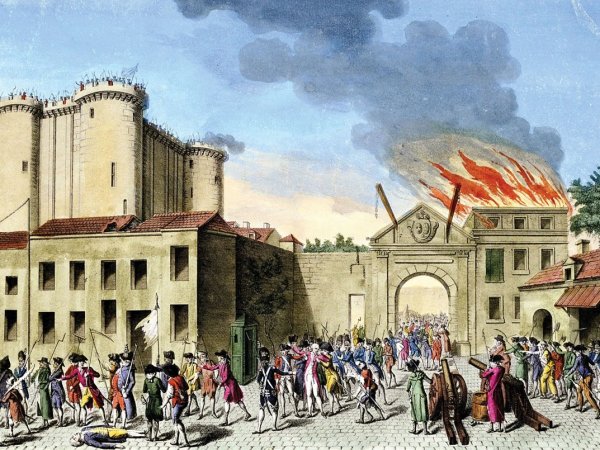
On the morning of July 14, 1789, tensions in Paris were at their peak. Crowds sought weapons to defend themselves and support their claims. After seizing arms from other depots, the revolutionaries marched on the Bastille, where the gunpowder necessary for their efforts was stored.
Initially, a negotiation was attempted between representatives of the crowd and the fortress governor, Bernard-René de Launay. The discussions failed, and the situation quickly escalated into an armed assault. After hours of fighting, the Bastille was captured. The governor was taken prisoner and killed, and his head was paraded through the city, a gesture demonstrating that the rupture between the people and authority had become total.
The fall of the Bastille was immediately perceived as a victory of the revolution. Although militarily the fortress was not decisive, the symbolism of the moment was enormous. The absolute monarchy had received a blow from which it would never recover.
The demolition of the fortress and the birth of a national symbol
Just two days after the assault, on July 16, 1789, the demolition of the Bastille began. Stones from its walls were sold as souvenirs, and pieces of the fortress reached various corners of France and even abroad. The act had a strong symbolic value: the physical destruction of the fortress meant the destruction of the old regime.
A large portion of the materials from the demolition were used to build a bridge over the Seine, the famous Pont de la Concorde. Thus, the stone of a symbol of oppression became part of a construction associated with the new revolutionary order.
History would repeat this pattern two centuries later when pieces of the Berlin Wall were transformed into souvenirs after its collapse. The act of keeping fragments from a destroyed symbol of oppression is a way of fixing in memory the victory over a system considered unjust.
In 1880, the date of July 14 was officially declared France’s National Day, consecrating the fall of the Bastille as a founding moment of French republican identity.
The king and the belated attempt at reconciliation
The events of July 14 took King Louis XVI by surprise. Confronted with the reality of a large-scale popular revolt, the monarch realized that the situation could no longer be managed by traditional methods.
A new mayor of Paris was appointed, and the city was organized into a new administrative structure called the “Commune.” At the same time, the National Guard was created, a form of popular army meant to defend the revolution and public order.
In a symbolic gesture, the king agreed to wear the tricolor cockade—blue, white, and red—and entered the Paris City Hall with it. It was a desperate attempt to reconcile with the masses and demonstrate that he understood the new reality. However, the gesture came too late. The forces unleashed in 1789 could no longer be stopped.
The revolution spread rapidly throughout France. In cities and regions, the population organized to self-govern, challenging central authority and noble privileges. The path toward the abolition of the monarchy had become inevitable.
From the fall of the Bastille to the execution of the king
The fall of the Bastille initiated a process that would culminate in the abolition of the monarchy and the proclamation of the republic. In 1793, King Louis XVI was tried and sentenced to death by the republican government.
His execution by decapitation took place in the location now known as Place de la Concorde. The irony of history is that the space where the king’s statue once stood became the place where the French monarchy met its end.
The moment had a huge impact across Europe. For the first time, a monarch was executed in the name of popular sovereignty. The idea that power belongs to the nation, not the king, became a principle that would shape the political evolution of the continent.
Where the street Căderea Bastiliei is located in Bucharest
In Bucharest, Căderea Bastiliei Street is located in Sector 1, near Victory Square (Piața Victoriei), one of the capital’s most important administrative and political areas. The street connects Lascăr Catargiu Boulevard with Calea Victoriei and is near major landmarks such as the George Enescu National Museum – Cantacuzino Palace – and other historic buildings representative of early 20th-century architecture.
The area is central, characterized by elegant buildings, cultural institutions, and office headquarters. The street’s name discreetly recalls the events of July 14, 1789, bringing a fragment of European history into Bucharest’s urban landscape. It is an example of how great historical moments are integrated into city identities, becoming everyday reference points for residents.
A defining moment in European history
The fall of the Bastille was not only a spectacular episode of the French Revolution but also the beginning of a profound transformation. The ideas of liberty, equality, and fraternity spread beyond France’s borders and influenced political movements across Europe.
The French Revolution questioned the feudal order, aristocratic privileges, and the legitimacy of absolute monarchy. It generated conflicts, excesses, and periods of violence, but it also opened the path toward modernity, the rule of law, and the affirmation of the citizen as a political actor.
Today, when we say “the fall of the Bastille,” we may think of a distant historical event or a street in Bucharest. In reality, it is a symbol of collective courage and society’s capacity to reclaim its rights. July 14, 1789, remains one of those dates that changed the course of history, marking the birth of a new era for France and for all of Europe.
We also recommend: Who was Smaranda Brăescu and why a street in Bucharest bears her name. The tragic story of Romania’s first female parachutist