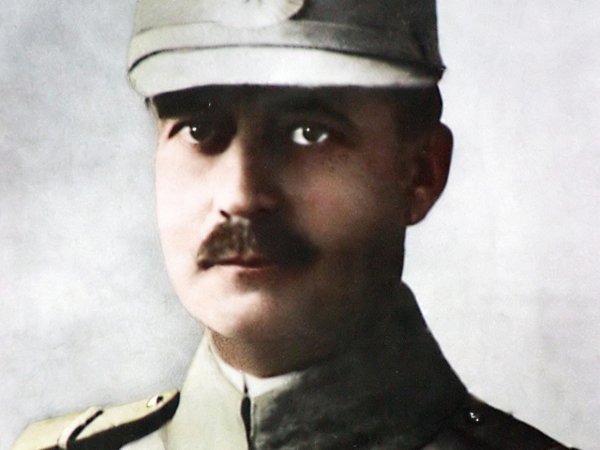
The cruel fate of the Romanian general Henri Cihoski. Hero of the First World War, thrown into a mass grave as an “enemy of the people”
- Articles
- 15 JAN 26
The modern history of Romania is full of military figures who decisively contributed to the survival and unification of the national state, yet not all of them received the recognition they deserved. Among all the generals who made Greater Romania possible, the destiny of Henri Cihoski stands out through its drama and injustice. While names such as Eremia Grigorescu or Alexandru Averescu are frequently mentioned in textbooks and official speeches, Cihoski was condemned to oblivion, despite having played a crucial role in the defining moments of Romanian history. His tragic fate perfectly illustrates the ingratitude and brutality of the communist regime toward the military elites who loyally served the Romanian state.
An exceptional strategist and an architect of national defense
Henri Cihoski was not merely a career officer, but a soldier with solid training, remarkable strategic thinking, and a deep understanding of the art of war. An engineer of genius by education, he understood the importance of fortifications, defensive positions, and the thorough organization of troops.
For Cihoski, the defense of the country was not just a matter of orders and discipline, but a carefully conceived construction in which every soldier became part of a solid defensive system. This modern vision of warfare transformed him into one of the most effective commanders of the Romanian army during the First World War.
At a time when the Romanian state was facing material shortages, demoralization, and enormous external pressure, Cihoski managed to inspire confidence and determination, proving that discipline and military intelligence could compensate for logistical disadvantages.
Mărășești 1917, the moment of glory of General Cihoski
The peak of his military career was reached in the summer of 1917, during the Battle of Mărășești, one of the most dramatic episodes of the First World War for Romania. Commanding the 10th Infantry Division, Henri Cihoski received the extremely difficult mission of defending one of the most vulnerable sectors of the front.
There, the German troops led by Field Marshal August von Mackensen were attacking with devastating force, using heavy artillery and aggressive tactics.
In the midst of this inferno, Cihoski refused to retreat. He remained in the trenches alongside his soldiers, sharing the same risks and the same suffering. Under continuous bombardment, he personally coordinated the defense and ordered bayonet counterattacks that became legendary.
These desperate yet extremely well-calculated actions succeeded in stopping the enemy advance at a moment when the entire Moldavia region was at risk of being lost.
His courage and determination were recognized directly on the battlefield, when he was decorated with the Order of “Mihai Viteazul,” the highest Romanian military distinction. In those dramatic days, Henri Cihoski was rightfully called the “Defender of Mărășești,” a title that reflected not only his deeds, but also his decisive role in saving the Romanian state.
The military shield of the Union of Bessarabia with Romania
Henri Cihoski’s contribution to Romanian history did not end on the battlefield in 1917. The following year, 1918, the situation in Bessarabia was extremely unstable. The collapse of the Russian Empire and the chaotic retreat of Russian troops created a power vacuum, exploited by Bolshevik bands that terrorized the population and threatened public order. In this dangerous context, King Ferdinand turned to Cihoski’s experience and firmness.
Sent to Chișinău with a clear mission, the general was tasked with restoring order and protecting the Sfatul Țării, the representative body that was to decide the fate of Bessarabia. The exemplary organization of the Romanian troops and his authoritative presence quickly created a climate of security. This stable framework made possible the historic vote of March 27, 1918, through which Bessarabia united with Romania.
Indirectly, yet essentially, Henri Cihoski was the military guarantor of the Union. Without the protection provided by the Romanian troops under his command, the act of union would have been far more difficult, if not impossible. Nevertheless, his contribution was often overlooked in later historical accounts.
Activity during the interwar period and ignored warnings
After the war, Henri Cihoski continued to serve the Romanian state during the interwar period. Between 1928 and 1930, he held the position of Minister of War, from which he sought to modernize the Romanian army. He supported equipping the army with modern equipment, professionalizing the officer corps, and adapting military strategy to the new geopolitical realities.
Repeatedly, Cihoski warned about the danger posed by the Soviet Union, a hostile neighbor that had not abandoned its territorial ambitions. Unfortunately, many of these warnings were ignored or minimized, and rapid political changes limited his ability to implement lasting reforms.
“The Night of the Generals” and the collapse of a destiny
The reward for a life dedicated to the Romanian flag came in the form of one of the cruelest injustices. After the establishment of the communist regime, Romania’s military elites were considered a threat to the new order.
On the night of May 5 to 6, 1950, known as “The Night of the Generals,” Henri Cihoski, who had reached the venerable age of 78, was taken from his own home by agents of the Securitate.
There was no trial, no clear accusations, and no right to defense. For the new regime, the hero of Mărășești had become a simple “enemy of the people.” He was imprisoned at Sighet Prison, a place intended for the slow extermination of former dignitaries and military leaders of interwar Romania. Weakened by age and illness, Cihoski could not withstand the inhuman detention regime.
After only 12 days, on May 18, 1950, his heart gave out. His death passed almost unnoticed, and his body was buried at night in an anonymous mass grave in the Cemetery of the Poor. His identity was erased, and the man who had defended Moldavia and Bessarabia was not granted even a cross.
A memory that demands justice
The destiny of General Henri Cihoski remains one of the most painful pages in Romanian history. It is the story of a man who served the state with devotion, who contributed decisively to the salvation and unification of Romania, but who was symbolically and physically destroyed by a totalitarian regime.
Rediscovering and acknowledging his memory represents not only an act of historical justice, but also a lesson about the fragility of national gratitude and about the price paid by those who defended the authentic values of Romania.
We also recommend: „No one shall pass here!” General Eremia Grigorescu, the hero of World War I, rests in the Mausoleum at Mărășești