The capital's oldest park was, in truth, a courtship plan disguised as a garden
- Articles
- 29 JUL 26
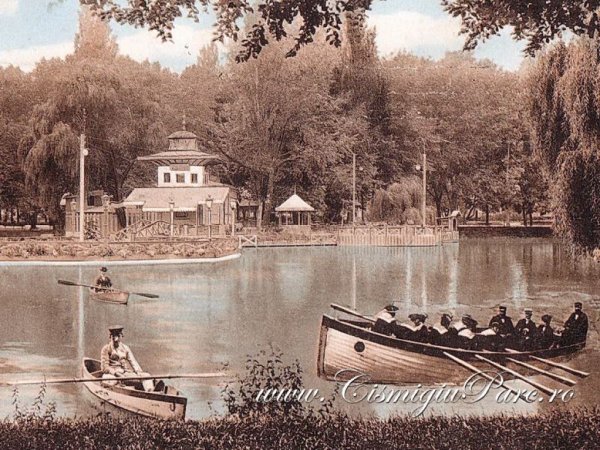
Few people know that before it was a park, Cișmigiu was just an abandoned pond, sitting at the edge of a city that hadn't yet thought about public green spaces. It was called "Dura the merchant's lake," after a property owner from the seventeenth century, and that's how it stayed for a long time: stagnant water, purposeless, in a Bucharest where gardens belonged to boyars or to some pleasure house, not to the city itself.
The name it carries today comes from that same era, from a Turkish word that roughly means "the one who looks after the fountains." The official who held that job lived right on the lake's shore, and his title stuck to the place and stayed there long after the job itself had disappeared and no one remembered it.
The order to develop the site didn't come until 1830, from Pavel Kiseleff, under the rule of Gheorghe Bibescu. That was a year before the Revolution of 1848, and Bucharest had around 70,000 residents at the time. It sounds like a lot for the period. It was, in fact, the second-largest urban center in southeastern Europe, after Constantinople. And yet this large city didn't have a single real public park.
Lighting, designed specifically for the evening
What sets Cișmigiu apart isn't necessarily its age. It's more the way it was designed from its very first years of operation. The garden was given evening lighting with oil-fed candles, placed along the lake's edge, and not by accident: the idea was to encourage walks after dark. The candles lasted a while, then were replaced with oil lamps, and by around 1890 electricity arrived too, with the wooden poles and overhead wires typical of the era.
A park lit up at night, in the nineteenth century, wasn't some minor technical detail. It was, in practice, an invitation. Few other public places in the city allowed a couple to walk together after sunset back then.
"The garden of the Bucharest soul"
That's what interwar tourist guides called it. And around it, one by one, rose the buildings that cemented its status as a landmark: Gheorghe Lazăr High School, City Hall, the Grand Hotel du Boulevard. The terrace at the center of the park became, for generation after generation, the meeting spot above all others, sought out equally by the young and by the wistful, as the memoirs of the time describe it.
Winter brought a different kind of gathering. In December 1882, an unusually harsh frost froze the lake solid and turned it into a natural ice rink. That's how Bucharest residents discovered one of the city's first forms of public skating, with military music playing on the sidelines while people huddled there, in the cold, just to be together.
What's left of all this
The park today covers 16 hectares, stretching between Regina Elisabeta and Schitu Măgureanu boulevards, still in the English style it was given at the start, with its original layout kept nearly intact. It's a listed historic monument and a protected dendrological park, home to trees over 150 years old. The island at the center of the lake, the bridges, the winding paths: all of them still sit exactly where the nineteenth-century plan put them.
What hasn't changed at all is its social function. Cișmigiu remains the place where people in Bucharest take someone on a first walk, or where marriage proposals happen without much staging, just a bench, a bridge, and now and then an accordion player passing through. Not because the city has any particular need for romantic scenery, but because the place was built for exactly this, nearly two centuries ago, an idea that has held up untouched ever since.