The Bucharest District Once Called the Forbidden Quarter, Which Still Has No Church Today
- Articles
- 23 SEP 26
At nine in the morning, a guard checks a small screen inside a gray-painted booth, while a gardener trims a hedge with a motor that breaks the silence for a few minutes, then stops. No one walks by. A Land Cruiser with tinted windows slows at an automatic gate, waits three seconds, and drives in. The air smells of cut grass and sun-warmed stone, and beyond the fences you can just make out tiled roofs and the tips of fir trees, though nothing on the street tells you whose house belongs to whom. Here, you can walk for twenty minutes without meeting anyone but a guard or a courier.
The district is called Primăverii. In the press and in a few recent books, it also circulates under the name Forbidden Quarter, a nickname inherited from the communist era, when access here really was restricted. It sits next to Herăstrău Park and is today one of the areas with the highest concentration of diplomatic residences in the city, alongside Dorobanți.
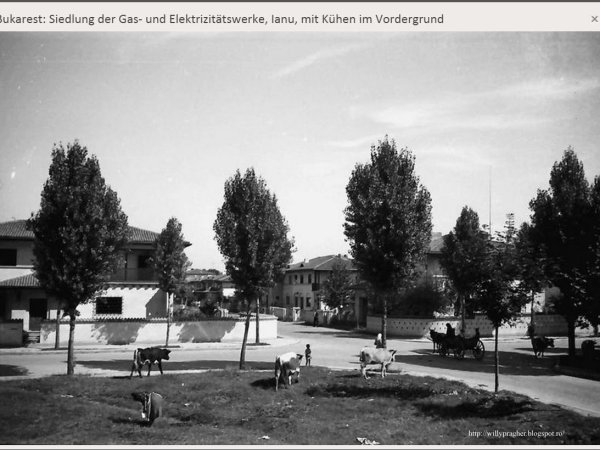
Its story begins differently than one might expect. It was called Jianu during the interwar period, and engineer Nicolae Caranfil, director of the Bucharest Communal Gas and Electricity Company, bought a 500,000-square-meter plot from the former Bordei Garden and subdivided it for the company's employees. Architect Octav Doicescu designed an ensemble of 80 white villas, with a modernist feel, on lots of 300 to 400 square meters. The surrounding area later developed in different styles, Neo-Romanian, eclectic Mediterranean, Moorish, Tuscan-Florentine, as interwar Bucharest found its architectural language. Photographer Willy Prager captured the area in the 1940s, with some houses already built and others still empty.
After the communist regime took hold, the population changed completely, and the name Primăverii appeared later, during this new phase. Party nomenclature moved into the villas built for gas company employees, and the nickname Forbidden Quarter was no figure of speech: at the entrances stood militiamen in guard booths who let through only the cars of residents, while pedestrians were advised to avoid the area altogether. Inside, residents had no church, no shops, no market, and supplies were handled by a representative appointed from each building, who drew up a weekly shopping list. There were no pubs, so social life in the district was, according to accounts from that era, almost nonexistent.
In 1962, Gheorghiu-Dej laid the foundations for Villas Lac 1, 2, and 3, on the shore of Lake Herăstrău, and Primăverii Palace, built between 1964 and 1965, was originally meant for him, but became the residence of Nicolae and Elena Ceaușescu. Today it's a museum, with an entrance ticket and a guide.
The church is still missing today, and it remains the only Bucharest district with no place of worship of its own.
The difference from the communist era lies in who lives here now. A real estate consultancy firm specializing in official residences has brokered, in recent years, transactions for the embassies of the United Arab Emirates, Qatar, Egypt, Kuwait, Jordan, the United States, Canada, the United Kingdom, Germany, and Finland. The Embassy of Saudi Arabia moved in 2022 into a 3,500-square-meter building on Dorobanți Boulevard, with a panoramic terrace overlooking Charles de Gaulle Square. The residence of the Qatari embassy is located at Strada Venezuela 10A, in a 4,000-square-meter property with an indoor pool and a private garden of nearly 2,800 square meters, according to an official statement from 2017. The US Embassy has operated since 1964, and since September 2011 has been based at its current location on Bulevardul Doctor Liviu Librescu 4-6, right at the heart of the district.
Restaurants have appeared too. The Primăverii-Mircea Eliade area has drawn a dense cluster of eateries with diverse cuisines and quiet cafés, where the smell of fresh coffee and warm morning bread has, in places, replaced the guarded silence of before.
Prices confirm the exclusivity. In the second quarter of 2026, Herăstrău reached 4,427 euros per square meter, Șoseaua Nordului 4,245, and Dorobanți 4,158, well above the average for new apartments across all of Bucharest, which stood at 2,549 euros per square meter in August 2026.
What links the district's two eras, the one of militiamen at the gate and the one of ambassadors with private gardens, is a silence that was never accidental here. The church that's still missing remains, perhaps, the clearest sign of how hard some things are to change in a district that was planned from the start.