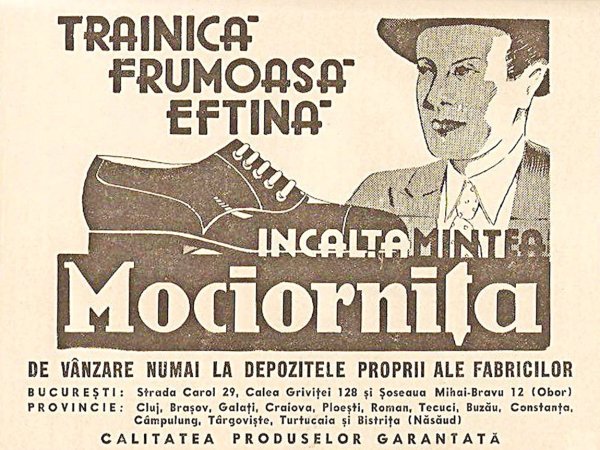
Symbols of Bucharest: Mociornița Shoe Factory, the empire built by the greatest Romanian industrialist
- Articles
- 19 MAR 26
Bucharest has been, throughout its modern history, a place where ambition, intelligence, and entrepreneurial spirit gave birth to impressive stories. In a time when Romania was searching for its economic and industrial identity, a few visionary people managed to transform bold ideas into true empires. Among them is Dumitru Mociorniță, one of the most important Romanian industrialists, the creator of a shoe factory that would become a symbol of performance and modernity. Alongside other remarkable figures of the era, such as Nicolae Malaxa, Mociorniță contributed decisively to the development of the Romanian economy during the interwar period. His story is one of work, perseverance, and success, but also of a dramatic collapse, caused by the radical political changes that followed the Second World War.
An era of great industrialists and opportunities
In the first decades of the 20th century, Romania was going through a period of major transformations. After the consolidation of the national state, the economy began to develop rapidly, and entrepreneurial initiatives were supported by the authorities. Professionalism, seriousness, and the desire for progress were valued and encouraged.
The interwar period represented the moment of maximum economic effervescence. The Romanian state supported domestic companies, and local industrialists had the opportunity to build solid businesses, capable of competing on the European market. In this favorable context appeared great entrepreneurs, who laid the foundations of essential industries.
This era was defined by a rare combination of individual ambition and institutional support. People who had vision and courage were encouraged to develop their businesses, and the results did not take long to appear. The Mociorniță factory is one of the best examples of this fertile economic climate.
From modest origins to elite education
Dumitru Mociorniță was born into a modest family of peasants from Prahova. His origin did not necessarily foreshadow the spectacular destiny he would have, but ambition and the desire to assert himself pushed him toward education and performance.
He attended the “Saints Peter and Paul” High School in Ploiești, and later the Kretzulescu Economic High School in Bucharest. His intelligence and seriousness were noticed from his school years. A decisive moment was the meeting with Ion I. C. Brătianu, who, impressed by his results at the baccalaureate exam, offered him a scholarship.
This opportunity allowed him to study at the Higher School of Commerce in Bucharest and later at the Higher School of Industry in Paris. The experience gained in these institutions, completed by a period of work in Hamburg, gave him a modern perspective on industry and business.
Although he had the chance to leave for the United States, Mociorniță chose to return to Romania, convinced that he could build his own path here. This decision would change not only his destiny, but also that of Romanian industry.
The beginnings of the career and the rise in industry
Returning to the country, Dumitru Mociorniță began to work for the industrialist Grigore Alexandrescu, an important name in the economic environment of the time. The professional relationship between the two quickly turned into a personal one, Mociorniță marrying his daughter.
This closeness gave him access to an extensive network of contacts: industrialists, suppliers, and traders. With the support of his father-in-law, but especially through his own qualities – seriousness, punctuality, and professional competence – he managed to impose himself quickly in the business environment.
In a short time, he became an example for those around him, including for Alexandrescu’s family. His involvement was not limited only to economic activity, but also included social responsibilities, a sign of the trust he enjoyed. This stage represents the foundation on which he would later build his own industrial empire.
The birth of the Mociorniță factory and accelerated development
The year 1923 marks a crucial moment: the establishment of the Mociorniță shoe factory. The project was carried out on the basis of a loan of 30 million lei, and the equipment was brought on lease from Germany and Great Britain, a sign of orientation toward modern technology.
In 1925, Mociorniță purchased important lands on Apele Minerale Street, where he would develop the industrial complex. Although part of them were initially mortgaged, he continued to invest and expand the factory, including by renting and later buying other lands.
The development of the factory was continuous and carefully planned. Even during construction, production activity was not interrupted. Mociorniță was directly involved in all stages, from design to the implementation of new technologies.
Inside the factory, modern production methods were tested, and workers were constantly trained. This concern for innovation and quality turned the factory into a leader of the shoe industry in interwar Romania.
The products made here quickly became known for their quality, and the factory came to be the most important producer in the field in the country.
A family dream and international ambitions
Dumitru Mociorniță never saw his business only as a source of profit. For him, the factory represented a life project, an ideal that he wanted to pass on to future generations.
The enterprise was organized as a joint-stock company, most of the shares being owned by family members. The industrialist actively involved his children in the business, preparing them to take over the leadership.
A lesser-known but extremely ambitious dream was the creation of a powerful concern, capable of conquering the Eastern European market. In this project, Mociorniță intended to collaborate with Grigore Alexandrescu and with his brother, the industrialist Gheorghe Mociorniță.
This vision shows the real dimension of his ambitions. It was not just about a local business, but about building an industrial empire with regional impact.
The war, the decline and the dismantling of an empire
The Second World War brought dramatic changes. Romania was preparing for conflict, and industry was increasingly oriented toward the needs of the army. The Mociorniță factory had an important role in the production of equipment.
At the same time, Dumitru Mociorniță was affected by health problems, caused by the intense effort he had made over the years. Aware of this, he began to transfer responsibilities to his sons.
In 1942, he established the joint-stock company “Pielăria și Confecțiunea Românească D. Mociorniță” and appointed his eldest son, Dumitru Ioan Petre, as general director of the enterprise. The other sons, in turn, received shares and positions within the company.
Everything seemed prepared for continuity. Unfortunately, political reality was to destroy this plan. After the war, with the installation of the communist regime and Soviet influence, a systematic process of confiscation of properties began. The houses, cars, and the factory’s production were taken over by the state.
In June 1948, nationalization definitively ended the business. The equipment became “property of the people”, and the industrialist’s sons were subjected to repression, including imprisonment and “re-education” processes.
The legacy of Dumitru Mociorniță
Dumitru Mociorniță died on September 17, 1953, in a period when everything he had built had already been destroyed. His dream of leaving a lasting legacy to his family had been shattered.
For decades, his descendants were stigmatized, being considered “descendants of exploiters”, a label that reflected the ideology of the time and that deeply affected the fate of the family.
However, the memory of Dumitru Mociorniță survived. His factory remains a symbol of an era in which private initiative and entrepreneurial spirit could transform Romania into an industrial power.
His story is one of success and collapse, of ambition and sacrifice, but above all of the strength of a man who believed in his own dream. In the history of Bucharest, the name Mociorniță remains linked to the idea of industrial excellence and to a model of development that, for a time, seemed capable of changing the destiny of a country.
We also recommend: Bucur Maternity Hospital, a brief history. Few Romanians know it was built from the donation of industrialist Dumitru Mociorniță