Symbols of Bucharest: How the Green Inn disappeared from the capital
- Articles
- 05 OCT 26
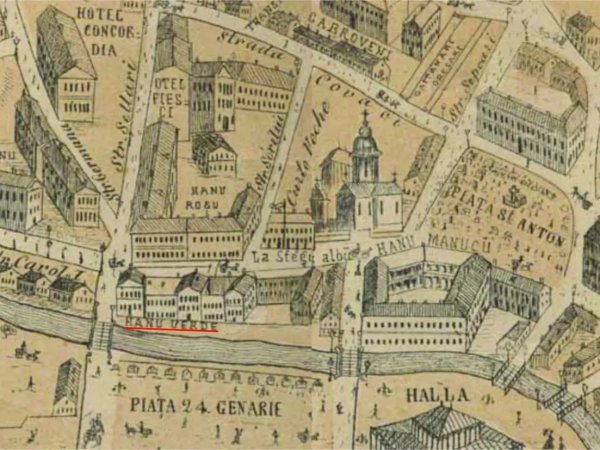
In the historic center of Bucharest, where tourists today walk among restaurants, terraces and buildings erected in different periods, there were once dozens of inns. Some have survived to the present day, such as Manuc’s Inn, while others have almost completely disappeared, remaining known only from old photographs, plans and documents. Among them is the Green Inn, one of the important commercial buildings in the area of the Old Princely Court. Built at the beginning of the 19th century, near the Red Inn and at the intersection of what are today French Street and Șelari Street, the Green Inn was part of Bucharest’s commercial landscape for more than a century. The building housed shops, living spaces, cellars used for storing goods and drinking establishments, and at one point it became the workshop of one of Romania’s most important artists and photographers, Carol Popp de Szathmari. Today, the inn no longer exists. Its site was occupied by a modern building for the interwar period, while the remains of the old building remained hidden beneath the constructions and streets of today’s historic center. Archaeological research carried out in 2011 and 2012 nevertheless recovered part of its story and demonstrated that beneath today’s Bucharest there are still traces of the city of two centuries ago.
An inn built near the Old Princely Court
The history of the Green Inn must be understood in connection with the transformation of the Old Princely Court area. At the end of the 18th century, the old Princely Court had gradually lost its function as a princely residence, and its lands began to be divided into plots and commercially developed. In this context, new commercial buildings and inns developed, radically changing the appearance of the area.
Sources from the Bucharest Municipality Museum indicate the Green Inn at the intersection of what are today Șelari and French streets and date it to the beginning of the 19th century, with documentary evidence from 1804. Like other buildings in the area, it appeared after the lands belonging to the former Princely Court were put up for auction.
The name “Green” seems to have had a simple explanation: the color of the walls. The Bucharest Municipality Museum points out that some Bucharest inns received colloquial names according to the exterior appearance of the buildings, with the Red Inn and Green Inn being relevant examples. Thus, it was not necessarily the name of the owner or of a religious institution, but rather a visual landmark that was easy for city residents to recognize.
On Borroczyn’s 1852 plan, the inn can be identified as a building with an inner courtyard, around which commercial and residential spaces were organized. Photographs taken in the second half of the 19th century also provide an image of the building and its relationship with the surrounding streets.
The inn should not be imagined merely as a place where merchants and travelers stayed. In 19th-century Bucharest, such complexes had a much more complex economic function. Cellars were used for storing goods, the ground floor for trade, while the upper floors could contain living quarters. Inner courtyards allowed access and movement between the different areas of the complex.
What the Green Inn looked like in the 19th century
Documents preserved from the end of the 19th century describe the Green Inn as an old building, with a ground floor and a single upper floor. At the upper level there were 24 rooms intended for residential use, demonstrating that the inn was both a commercial and residential space.
Several shops operated on the ground floor. Four of them opened onto French Street, two onto Șelari Street, while on the side facing the Dâmbovița River there was a tavern with an eating house. In period photographs, the establishment appears under the name “La Podul de Piatră” (“At the Stone Bridge”). Later, during the interwar period, it was replaced by the “Cina Românească” restaurant, managed by Constantin Nistor.
Under the building were vaulted cellars, essential in a commercial district such as the one around the Old Princely Court. Modern archaeological research has confirmed this function. Four of the rooms identified in the western part of the inn had basements covered with flattened vaults, which archaeologists believe were most likely used to store the goods of merchants who had shops on the ground floor.
Thus, the image of the Green Inn becomes much clearer: it was not simply an accommodation building, but a small commercial center, where goods arrived, were stored in cellars, displayed in shops and sold to customers who moved through one of the busiest areas of Bucharest.
Carol Szathmari’s workshop and Dr. Spech’s medical office
One of the reasons the Green Inn holds a special place in Bucharest’s history is its connection with Carol Popp de Szathmari, the painter and photographer who would become one of the important figures of 19th-century Romanian art.
Szathmari established his photographic studio here, and documentary sources indicate his presence at the Green Inn in the 1860s. The National Library of Romania’s journal, based on Bucharest address guides, shows that Szathmari was still listed at the Green Inn in the 1866 edition, providing a more precise picture of the period when his studio operated here.
The photographer’s presence in such a place says a great deal about the character of the area. At that time, central Bucharest was a space where trade, housing, inns, workshops and small services coexisted. The Green Inn was not isolated from city life, but was part of an extremely active neighborhood.
The office of physician Eduard Spech also operated in the same building, beginning in 1852. Therefore, the inn housed commercial, professional and residential activities at the same time, becoming a true microcosm of 19th-century Bucharest.
From inn to the Dattelkremer building
At the beginning of the 20th century, the Green Inn had already entered a different stage of its existence. The old building was beginning to be overtaken by the transformations of the city, while commercial functions were becoming increasingly important.
A significant part of the building was rented by Marco Dattelkremer, who opened the “La Centrală” furniture store here. The “La Cizma Regală” store also operated on the ground floor. In 1890, the building had been purchased by rentier Theodor Eftimiu, and ownership later passed to his heirs.
After 1911, Dattelkremer increasingly linked his name to the building. The “La Centrală” store was renamed after its owner, while the façades of the building were covered with advertisements. The old inn, once identified by its green walls and commercial function, had thus come to be known rather as the “Dattelkremer building”.
The change reflected the transformation of Bucharest. The city was entering an era in which old inns were gradually being replaced by taller buildings, modern shops and commercial spaces adapted to new requirements.
How the Green Inn disappeared
The end of the Green Inn came in the 1930s. In 1932, the demolition of the old building was decided as part of the broader process of urban modernization and planning. A six-story residential building with commercial spaces on the ground floor was to be erected on the site of the inn. Other sources from the Bucharest Municipality Museum indicate 1934 as the year when the “Potcoava” building was constructed, suggesting that the demolition and construction of the new building took place in stages.
The disappearance of the inn did not, however, mean the disappearance of all traces of it. Dattelkremer’s furniture store continued to operate for some time in the new building erected on the site of the former inn. In practice, part of the old commercial activity of the place survived in a completely different building.
This transformation is characteristic of interwar Bucharest, when numerous old buildings were demolished to make way for modern properties. From the perspective of today’s city, the disappearance of the Green Inn may seem like just one episode in a long list of demolitions, but for the history of the historic center it represents the loss of a complex that had been present in the urban landscape for more than a century.
What archaeologists discovered beneath today’s streets
The Green Inn returned to the attention of researchers in 2011 and 2012, when archaeologists from the Bucharest Municipality Museum investigated the area on the southern side of Șelari Street. The research identified several wall structures belonging to the western body of the inn and made it possible to reconstruct aspects of the building.
One of the most important conclusions was that the inn went through at least two building phases. During a later stage, part of the building was rebuilt from the foundations, and the new frontage was slightly set back from the previous alignment. The change may be connected to urban developments and to the alignment rules that began transforming Bucharest during the 19th century.
Archaeologists also identified eight rooms belonging to the western wing. Four of these had cellars, while the preserved vaults and walls provide information about the organization of the commercial space. The cellars were connected to one another through openings made in the dividing walls, and in one of the areas access to the upper level was also identified.
The most spectacular discovery, however, was older than the Green Inn itself. In one of the rooms, a segment measuring approximately 4.5 meters was found from the enclosure wall of the Princely Court, dated to the reign of Constantin Brâncoveanu. The wall was built from bricks bonded with lime mortar and had been reinforced with wooden elements. The discovery demonstrates just how deep the historical layers of the Old Princely Court area are.
An inn that disappeared, but was not forgotten
Most of the Green Inn could not be archaeologically investigated because its remains are overlapped by the current building on the site of the former inn. Nevertheless, the discovered walls, historical plans, photographs and archival documents make it possible to reconstruct an important part of its story.
The Green Inn is therefore an example of how Bucharest changed, sometimes through irreversible disappearances. The building that once housed merchants, residents, shops, a tavern and Carol Szathmari’s studio can no longer be visited today. In its place stands a modern building, while passers-by crossing the area can see only some of the traces that history has left underground.
Nevertheless, the Green Inn has not disappeared completely. It continues to exist in photographs of old Bucharest, in cartographic plans, in archival documents and, above all, in the remains brought to light by archaeologists. Its story reminds us that today’s historic center is not merely a tourist setting, but a space built over successive layers of the city.
And beneath the streets on which Bucharest residents and tourists walk today, there are still fragments of the city of merchants, inns and the Princely Court. The Green Inn is one of these vanished symbols, recovered through research: a building that can no longer be seen, but whose story can still be reconstructed from the traces that time has failed to erase.
We also recommend: The story of “The inn without a name”, the temple of lost souls. Here the poor and the unlucky sought refuge