Stories of Bucharest: The poor man’s bathing place, Ciurel Lake, and summer-time leisure
- Articles
- 01 APR 26
In the 19th century and the beginning of the 20th century, the Dâmbovița was not just a simple watercourse crossing the capital, but a living presence full of contrasts. On the one hand, its banks were adorned with rich vegetation, with greenery that waved in the wind and gave the city a picturesque note. For the viewer’s eye, the image was delightful, almost idyllic, especially in a Bucharest still undergoing urban transformation.
The Dâmbovița of the past: beauty, smells, and the contrast of a city in formation
On the other hand, however, this beauty was overshadowed by a less pleasant reality. In that period, modern sewage systems did not exist, and household waste was discharged directly into the river. The smell was hard to endure, and the water, especially in the central area of the city, became murky, then grayish, and finally almost black.
A suggestive example is that of the tributary called Bucureștioara, which sprang from Icoanei Park. Because of severe pollution, it had come to be known by locals under a far from elegant name, reflecting its deplorable condition. Such realities were not unusual for European cities of the time, but in Bucharest the contrast between nature and neglect was particularly visible.
Under these conditions, bathing within the city became almost impossible, at least for those who cared about their health. Nevertheless, Bucharest residents did not give up the pleasure of water, especially during the scorching summers, when the heat became oppressive. The solution was simple: they headed toward the outskirts of the city, where the river was still clear and welcoming.
Ciurel Mill and the “poor man’s bathing place”
One of the most popular places for bathing was the area near Ciurel Mill, located at the entrance of the Dâmbovița into the city. Here the water was much cleaner, cold, and clear, offering ideal conditions for a refreshing swim on hot summer days.
As early as the beginning of the 19th century, this area had become a true attraction point for the inhabitants of the suburbs. People came in large numbers to enjoy the water, to escape the heat, and to socialize. It was a lively, animated place, where people from all social categories met, from workers and merchants to children and women who came with household chores.
As time passed, this place was nicknamed the “poor man’s bathing place,” especially during the interwar period. The name reflected the fact that, unlike the modern bathing places in the city, access here was free, and the conditions were rudimentary. Nevertheless, for many Bucharest residents, the place had a special charm, offering a freedom that other spaces could not match.
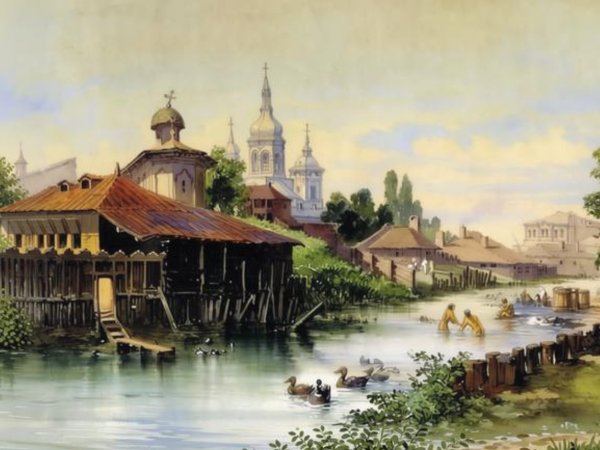
The crowd was often impressive. The riverbanks were full of people, and activities took place simultaneously: some bathed, others washed clothes, while the water carriers filled their containers with water to sell it further in the city. It was a mixture of useful and pleasant, typical of an era when daily life unfolded at a different pace.
Life on the riverbank: people, customs, and freedom
The atmosphere at Ciurel was a unique one, dominated by a freedom difficult to imagine today. In those times, bathing suits were not yet widespread or accessible to everyone. Thus, bathing was often done without clothes, both by men and by women.
This lack of modesty was not perceived as something scandalous, but rather as a normal aspect of everyday life. Women who came to wash clothes took advantage of the opportunity to bathe, while men threw themselves into the water without hesitation. The spectacle was a natural one for contemporaries, but would seem surprising to modern viewers.
Merchants who arrived in the area had the opportunity to observe this effervescent world. In the absence of strict rules or clearly delimited spaces, the riverbanks became a place of direct interaction, where social differences seemed to fade.
This scene of life was immortalized in 1868 by the painter Amedeo Preziosi, whose works faithfully capture the atmosphere of old Bucharest. In his images, we can see people bathing, water carriers working, and an entire world unfolding around the water.
Water carriers and the role of water in daily life
An essential element of life at that time was represented by the water carriers, a profession that has disappeared today. They were merchants who transported drinking water using special containers and sold it to the inhabitants of the city.
Their presence at the Dâmbovița, in the Ciurel area, was natural, since the water here was cleaner than in other parts of the city. The water carriers entered directly into the river to fill their containers, then set off toward different neighborhoods, where water was a precious resource.
This activity illustrates how important water was in daily life and how different the conditions were compared to today. The lack of modern infrastructure turned simple gestures, such as obtaining water, into true commercial activities.
At the same time, the presence of the water carriers contributed to the dynamics of the place, adding an economic element to a space already animated by recreational and domestic activities.
The interwar period and the beginning of organized leisure space
With the advent of the interwar period, Bucharest began to modernize, and this was also reflected in the way leisure spaces were organized. At Ciurel, about one hundred cabins were installed, offering the possibility to change clothes and store belongings for a fee.
This change marked a step toward civilization and organization, bringing the “poor man’s bathing place” closer to the modern concept of an urban beach. However, most people, especially children and young people, preferred to keep the old habits.
Bushes continued to be used as improvised changing cabins, and bathing without clothes remained a common practice. Freedom and lack of constraints were, for many, more important than the comfort offered by the new facilities.
During this period, a certain separation between men and women also took shape. The riverbed was informally divided into two distinct areas, and crossing from one side to the other was generally respected. This division reflected an attempt to preserve decency, without imposing strict rules.
Adolescence, curiosity, and small breaches of the rules
Even under these conditions, the separation between the sexes was not always strictly respected. Curiosity, especially among young people, sometimes led to small breaches of unwritten rules.
Boys, driven by the desire to explore and observe, tried to approach the area reserved for women, either physically or only with their gaze. These episodes, described in accounts of the time, add a note of authenticity and humor to the atmosphere at Ciurel.
They also reflect a society in transition, in which moral norms coexisted with a certain freedom of behavior. It was a world where rules existed, but were applied with flexibility, and life unfolded at a more relaxed pace.
The dam cascade and the charm of urban nature
Another attraction point of the area was the dam near Ciurel, where the waters of the Dâmbovița fell in a cascade, forming an impressive natural spectacle. The water crashed against the stone steps, creating foam and whirlpools that attracted the bravest swimmers.
Children, in particular, were fascinated by this place. Fearless and carefree, they threw themselves into the water and let themselves be carried by the currents, turning each summer day into an adventure. For them, the dam was a place of total freedom, where rules seemed not to exist.
This combination of nature and human intervention created a unique landscape, in which the city and the river coexisted in a spectacular way. It was a simple but intense form of entertainment, which required nothing more than courage and the desire to enjoy the moment.
The legacy of a vanished place
Today, the Ciurel area and Ciurel Lake are profoundly transformed, and the image of the “poor man’s bathing place” belongs to the past. The modernization of the city, the canalization of the river, and the change in lifestyle have led to the disappearance of this type of space.
Nevertheless, the stories about Ciurel remain an important part of Bucharest’s memory. They offer us a perspective on a simpler, yet lively world, in which people knew how to enjoy the small things.
The “poor man’s bathing place” was not just a place for bathing, but a space of community, freedom, and human interaction. It was a place where social differences faded, and the joy of summer was shared by all.
Through these memories, we can better understand the evolution of Bucharest and the transformations it has undergone. And the image of people bathing in the clear waters of the Dâmbovița, at Ciurel, remains one of the most picturesque and authentic stories of the city of the past.
We also recommend: Ștrandul Kiseleff, locul preferat al bucureștenilor interbelici: aici se organizau competiții sportive și concursuri de Miss