Stars of interwar Bucharest: Gheorghe Timică, from the operetta chorister to the legendary actor of the Capital
- Articles
- 17 AUG 26
Interwar Bucharest was one of the most vibrant periods in the cultural history of the capital. The theaters, summer gardens, halls and musical revues had become places where audiences discovered actors, singers and comedians who would remain in the city’s memory. Among the personalities who contributed to this atmosphere was Gheorghe Timică, one of the most appreciated Romanian theater and film actors of the first half of the 20th century. His real name was Dumitru Georgescu, and his artistic career began modestly, as a simple chorister in an operetta company. From there, however, a spectacular journey was to begin, taking him through numerous theatrical companies and Bucharest theaters and bringing him alongside great names of the Romanian stage, such as Nicolae Leonard, Velimir Maximilian and Constantin Tănase. The Museum of the National Theatre Bucharest remembers him as one of the institution’s important actors, while the testimonies of his contemporaries speak of his naturalness and stage charm. Today, the memory of Gheorghe Timică is preserved even through a street in Bucharest that bears his name. A decision of the General Council of Bucharest Municipality changed the name of George Timică Street in 2015 to Gheorghe Timică Street, explicitly mentioning the period 1886–1954 and his profession as an actor.
Childhood in Brăila and his first encounters with theater
Gheorghe Timică was born in 1886, being known in biographical sources under the name Dumitru or Dimitrie Georgescu. Some secondary sources indicate Bucharest as his birthplace, while the traditional biography transmitted about the actor places it in Rășinari. It is, however, well documented that he spent his childhood in Brăila, where he attended primary school.
For the child who would become one of the great comedians of the Romanian stage, his encounter with theater represented a decisive moment. The first performances he saw were “Păunașul codrilor”, performed by the Bobescu troupe, and “Meșterul Manole”, presented by the Al. P. Marinescu troupe. The performances impressed him so much that he began dreaming of an artistic career.
Timică was, however, from childhood, an energetic and difficult-to-control character. His parents considered that such a temperament could be disciplined through military education and sent him to the School for Troop Children at Dealu Monastery in Târgoviște. The experience did not change his nature, however, and later he was transferred to the 7th Hunter Battalion.
The strict discipline there led him to request another transfer, and he arrived at the 6th Mihai Viteazul Regiment. Paradoxically, it was precisely the army that would provide him with one of his first opportunities to discover his musical talent. He joined the regiment’s orchestra and learned to play several instruments, from the clarinet to the small drum.
Captain Damian, the orchestra leader, noticed that the young man had musical abilities and encouraged him to attend the Conservatory. It was advice that would bring him even closer to the world of the stage.
From the Conservatory to the chorus of an operetta company
In 1920, Timică took the entrance examination for the Conservatory of Music and Dramatic Art, where he chose for his audition the monologue of Despot from “Despot Vodă”. Among the members of the examination committee was the great actor Constantin Nottara. From the very first verses, Nottara stopped him and suggested that he should turn toward comedy, considering that his temperament was not suited to drama.
The advice would prove prophetic. Timică did not remain at the Conservatory for long, however. For first-year students, the program included, among other things, exercises and fables, and the young man quickly became bored. He left the institution and managed to enter as a simple chorister in the operetta company led by Constantin Grigoriu.
This period represented the true beginning of his career. Grigoriu noticed that the young man was in love with theater and gave him an opportunity. In the play “Vagabonzii”, Timică received the role of an 80-year-old man. It was an important opportunity for an actor at the beginning of his career, and the experience would prove to him that the stage was the place where he felt most comfortable.
During this period, his path began to move definitively away from music and toward comedy and theater. His talent for observation, facial expression and the interpretation of characters increasingly recommended him for comic roles.
The Associated Artists Company and his first successes
In 1907, Nicolae Niculescu-Buzău left the Grigoriu Company and founded, at the Ambasadori Summer Garden, the Associated Artists Company. The new troupe was led by Niculescu-Buzău and Constantin Nottara, and Timică joined this team.
At first, the actor was given small roles, especially servant characters. For an artist who would become famous, the beginning was a modest one, but these appearances allowed him to learn the profession directly in front of an audience.
The decisive moment came with the play “Militarii veseli”. The role brought him real success and demonstrated that Timică had the ability to transform even an apparently secondary character into a memorable presence. After approximately eight years spent in this company, the actor continued his rise in other important theatrical structures in Bucharest.
He was hired at the Comedia Theater, led by A. de Herz, and then performed in the companies of Nae Leonard and Velimir Maximilian. This was followed by a period in which his name was present on several stages of the capital: the Little Theater, the Ventura Theater and the SCITA company, the Cooperative Society of Theatrical and Artistic Enterprises.
SCITA brought together several theatrical spaces and companies, including the Comedia Theater, the Vesel Theater, the Free Theater and the Marconi Summer Garden. Later, Timică would become co-director of the Modern Theater, confirming not only his talent as an actor, but also his ability to become involved in organizing theatrical life.
Timică, the stage name born from an accident
The name under which he became famous was not the one he received at birth. In an interview given to F.O. Fosian, the actor himself explained the story behind the name “Timică”.
According to his testimony, his real name was Mitică Georgescu. When he was at the beginning of his career, Niculescu-Buzău told him that he should change his name because in Bucharest there was a restaurant-beer hall that bore the name “Mitică Georgescu”. To avoid this coincidence, Niculescu-Buzău transformed his name, practically changing the order of the syllables: from “Mi-ti-că” came “Ti-mi-că”.
Thus was born the stage name that would become famous in the world of Romanian theater. Timică himself said that he had not changed his name himself, but that “chance” had done it. The story is one of those seemingly minor events that end up having enormous consequences: a name born from a joke or from a practical necessity would forever become associated with one of the great actors of the Romanian stage.
The great comedian of interwar Bucharest
Together with N. Leonard, Velimir Maximilian and Constantin Tănase, Gheorghe Timică was part of the generation of artists who gave Bucharest performances during the first decades of the 20th century a particular dynamism. He performed in operettas, comedies and revues, and until 1921 remained closely connected to these genres.
After 1921, he turned toward dramatic theater, demonstrating that his talent was not limited to comedy. This evolution is important for understanding the actor’s complexity. Although audiences often associated him with comic characters, Timică was capable of approaching a much broader range of roles.
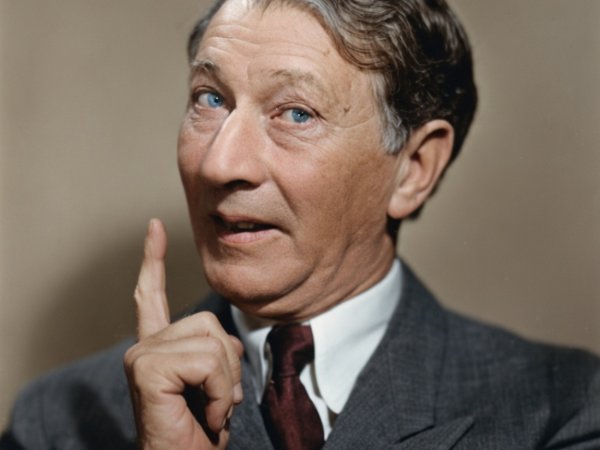
The testimony of his wife, actress Silvia Dumitrescu-Timică, preserved by the Museum of the National Theatre Bucharest, describes him as an actor who played young leading men and comic characters, but who was also a great tragedian. She remembered his tall stature, elegance, white hair, blue eyes and, above all, his naturalness on stage and the way he delivered his lines. The audience appreciated him for his natural manner, while in private life he was considered a good and generous man.
The superstitions of a beloved actor
Beyond the stage, Gheorghe Timică was also known among his colleagues for his superstitions. In 1937, the magazine “Ilustrațiunea română” reported several of the actor’s habits, presenting him as a witty comedian and a very superstitious man.
One of his most unusual talismans was an old straw hat, which he wore at rehearsals regardless of the season. It was worn out, dirty and full of holes, but Timică refused to give it up, believing that it protected him from bad luck.
He also always carried a piece of wood in his pocket, so that he could “knock on wood” whenever he wanted to drive away a possible misfortune. Another great fear of his was the color green. According to the account in “Ilustrațiunea română”, he used to feel ill when a female partner appeared on stage dressed in green.
His wife, Silvia Dumitrescu, tried to overcome this superstition in an ingenious way. For Christmas, she gave him a green tie. Timică wore it fearfully, but after a week, noticing that nothing had happened to him, he began to accept the idea that perhaps the color did not bring him bad luck. Naturally, the traditional “knock on wood” could not be missing from this story.
The legacy of an actor who became a Bucharest name
Gheorghe Timică remained in the history of Romanian theater as one of those artists who managed to transform naturalness into a true art. From the chorister of an operetta company to the established actor of the great Bucharest stages, his professional journey was built through perseverance, talent and the ability to adapt to different theatrical genres.
He was awarded the title of Artist of the People in 1953, for his artistic merits and his activity in the field of theater. He died in 1954 and was buried in the Sfânta Vineri Cemetery in Bucharest.
His memory did not disappear with his physical passing. Bucharest preserves his name on its map, and Gheorghe Timică Street in Sector 1 today reminds passers-by of the actor born in 1886 and deceased in 1954.
The story of Gheorghe Timică is, ultimately, the story of an artist who did not begin with the privileges of a famous name and did not follow a perfect academic path. He started as a restless young man, passed through military school, the orchestra of a regiment, the Conservatory and the chorus of an operetta company, only to eventually become one of the emblematic figures of the Romanian stage. In interwar Bucharest, where theater was one of the great forms of entertainment and socializing, Timică earned his place through a talent that audiences recognized and loved.
That is why his name remains connected not only to the history of theater, but also to the cultural history of the capital. Gheorghe Timică was one of the artists who made Bucharest laugh, become emotional and return to the theater halls. And the fact that a street bears his name today represents a discreet but important way in which the city preserves the memory of its great actors.
We also recommend: The stars of interwar Bucharest: Lisette Verea left the Alhambra to shine as an actress in Hollywood