She performed alongside Matei Millo and impressed Mihai Eminescu in Bucharest. Great actress Frosa Sarandy died poor and all alone
- Articles
- 15 JAN 26
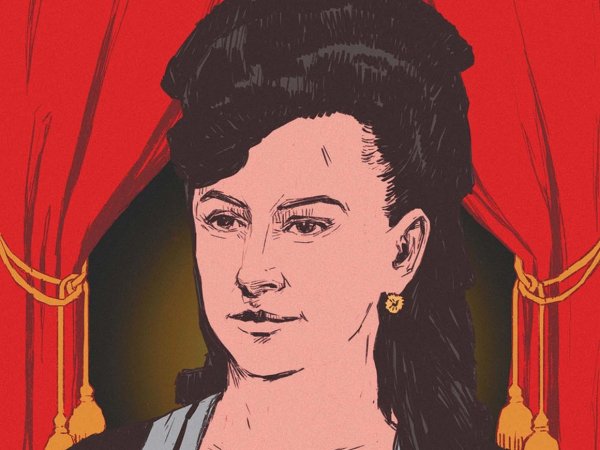
The history of Romanian theatre in the 19th century is full of resounding names, but also of unjust destinies, covered by oblivion. Among these essential figures, today almost unknown to the general public, is Frosa Sarandy, one of the most talented and appreciated actresses of her time. A pupil and stage partner of Matei Millo, a collaborator of major theatrical personalities and admired by Mihai Eminescu, Frosa Sarandy had an impressive career, followed, however, by an end marked by poverty and loneliness.
The debut of a remarkable career in Romanian theatre
Born on April 15, 1840, Frosa Sarandy belongs to that generation of artists who decisively contributed to the formation of modern Romanian theatre. At a time when the national stage was still in the process of defining itself, Sarandy trained under the guidance of Matei Millo, one of the founders of Romanian dramatic art. The relationship between the two was not only one of teacher and student, but also of stage collaborators, which offered the actress a major artistic advantage.
From her very first appearances, Frosa Sarandy stood out through naturalness, expressiveness, and a stage presence that won over the audience. Her talent was quickly recognized, and the roles she interpreted became increasingly diverse and demanding. For more than 25 years, she performed constantly, proving rare professional endurance and passion.
Alongside the great names of the Romanian stage
Frosa Sarandy’s career unfolded in an exceptional artistic context. She took the stage alongside important names of Romanian theatre such as Mihail Pascaly, Dimitriade, Ion Luca Caragiale, Velescu, as well as Frosa Popescu. This proximity to the theatrical elites of the time only strengthened her status and refined her interpretative style.
Her repertoire was extremely varied, but the actress knew how to choose her roles intelligently. She interpreted characters that highlighted her comic qualities, the naturalness of her acting, and her ability to create vivid, recognizable figures. Many of her performances were considered to be on the level of Western productions, and her talent could have honored without reservation any major European stage.
Mihai Eminescu’s appreciation and the echo of contemporary criticism
One of the most important proofs of Frosa Sarandy’s value comes from Mihai Eminescu. In a review published in 1876, the national poet analyzed the actress’s performance with finesse, noting the authenticity and lack of artificial mannerisms. Eminescu emphasized that Sarandy had not adopted the faulty pronunciation habits of the Bucharest theatre and that she built her characters starting from truth.
Although the poet sometimes observed an excessive intensity in the coloring of her roles, he considered this a minor flaw compared to her major merit: training in a “school of truth.” In the context of the time, such appreciation coming from Eminescu represented a confirmation of the highest prestige.
In turn, writer Victor Bilciurescu described Frosa Sarandy as having a very sympathetic and attractive style of acting, especially in comedy. He recalled that her appearance on stage always put the audience in a good mood and that applause was difficult to restrain. A memorable example was her interpretation of the main role in the comedy Une mission délicate, staged in Paris and poorly translated into Romanian as O slujbă grea (A hard job), where Sarandy provoked bursts of laughter through an arch-comic character.
The wisdom of knowing her vocation and limits
A rare and extremely valuable aspect of Frosa Sarandy’s career was her artistic discernment. Unlike many artists of the time, she had the lucidity to recognize her vocation and limits. From the very beginning, she understood that her true calling was comedy and refused to accept dramatic roles, even though these might have brought additional prestige.
This choice was not one of convenience, but of honesty toward herself and toward the public. By concentrating on the comic genre, Frosa Sarandy managed to achieve excellence and to create memorable characters, without forcing registers that did not suit her. In an artistic world often dominated by vanity, this attitude demonstrates rare professional maturity.
Withdrawal from the stage and the beginning of oblivion
After a career of more than a quarter of a century, Frosa Sarandy left the stage of the National Theatre in May 1897. Her retirement took place under the 1894 Law regarding the “pensioning of company artists,” benefiting from a modest allowance. Although she had been a central figure of Romanian theatre, the support provided by the state was insufficient to ensure her a decent living.
In February 1891, the actress had been awarded the Bene Merenti medal by King Carol I, an official recognition of her merits. However, honors were not followed by material security, and the years that followed her retirement were marked by poverty and isolation.
A tragic end, between loneliness and injustice
Only five years after her withdrawal, Frosa Sarandy was living in a peripheral neighborhood, in extremely difficult conditions. Her testimonies from that period are heartbreaking. The actress spoke about rumors according to which she was considered “mad,” about neighbors who avoided her, and about the profound feeling of abandonment. Although she had a pension of around 190 lei and some small savings, loneliness and the lack of moral support weighed heavier than material deprivation.
Her words, full of pain and lucidity, reveal the drama of a woman who gave everything to the stage and who, in the end, felt abandoned by society. It is one of the most telling testimonies about the ingratitude of the era toward its artists.
The legacy of a great forgotten actress
Frosa Sarandy passed away in June 1904, at the age of 64. She was buried in the cemetery near the Samurcășești Monastery, in Ciorogârla, far from the stage lights she had served her entire life. Today, her name is rarely mentioned, although her contribution to Romanian theatre is undeniable.
The story of Frosa Sarandy is not only the biography of a talented actress, but also a lesson about the fragility of fame and about the duty of cultural memory. She remains a symbol of artistic devotion and sacrifice, a figure that deserves to be rediscovered and restored to her rightful place in the history of Romanian theatre.
We also recommend: Who was the great actor Matei Millo and why a street in central Bucharest bears his name