Pen nib and cap. What the first day of school looked like in interwar Bucharest
- Articles
- 04 SEP 26
Bucharest, September, sometime between 1920 and 1938. On the streets around the city's downtown high schools, groups of children began to appear with new satchels, smelling of unbroken leather and freshly bought uniform fabric, still stiff to the touch. Shoes creaked on the cobblestones, and in the mornings, instead of summer's quiet, you'd hear again the hurried patter of children's feet and the bell of the horse cabs bringing wealthier students right up to the school gate. School started in the first half of September, usually on the first or the first working day right after; in the countryside, the start often depended on the harvest and could slip toward the end of the month. Still, the excitement before the first day was the same for every child: new clothes, freshly bought supplies, and the fear of getting something wrong from the very first hour.
For a child in 1920s or '30s Bucharest, the first day of school looked nothing like what a first-grader experiences today. In the years after the Great Union, education was treated as a matter of nation-building, not just individual instruction, and that showed from the first day, in the seriousness with which everything was handled — from how you dressed to how you behaved.
The day began with putting on the uniform, and here things varied from school to school. At Gheorghe Lazăr High School, boys wore khaki uniforms, topped with a cap with a blue cord at the visor and a blue band on the sleeve — starched so stiff it would chafe your neck the first week. Every Bucharest high school had its own colors and distinguishing details, useful for spotting a classmate's school from a distance on the street. Uniforms were usually made to order by a tailor, an expense many families felt keenly at the start of every autumn.
Every uniform had a registration number sewn onto the sleeve. That number wasn't just an administrative detail — it was how the school's management kept track of students and their misbehavior, a fairly effective control tool, hard to get around.
The satchel didn't hold today's gadgets. Students had a few notebooks with rough paper, basic textbooks that smelled of fresh printer's ink, and, for the younger grades, a pen holder with a nib and an inkwell, carried carefully so it wouldn't spill on the way. The characteristic sound of a lesson was the nib scratching across the paper, broken now and then by too heavy a stroke and the inevitable ink blot that followed. These supplies were bought separately from the uniform, at the stationery shops downtown.
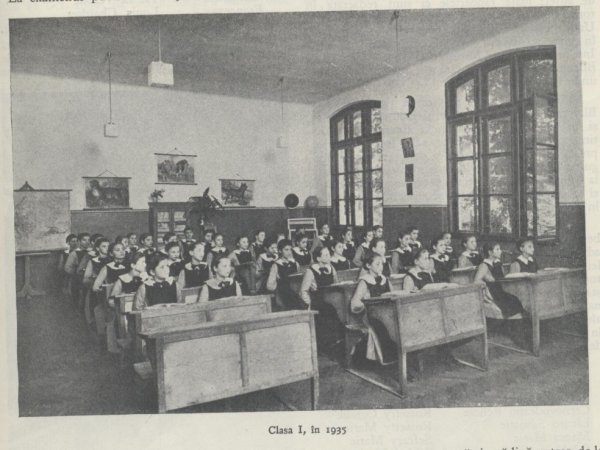
Discipline was considered essential to building character, and punishments were more common than they are today. The teacher's voice filled the classroom without needing any amplification, and the silence enforced during lessons was so complete you could hear a wooden desk creak or a student with a cold holding back a cough. What made a good student wasn't just grades: camaraderie, diligence, and honesty counted just as much as doing well in class.
Not every child in Bucharest went through this ritual equally. In other parts of the country, the lack of money for supplies and winter clothes kept many children out of school or delayed their enrollment — a phenomenon documented mostly in rural areas, but one that very likely echoed in the poorer outskirts of the capital too. The gap between a downtown high schooler in a full uniform and cap and a child from a modest family said a lot about a city still marked by sharp social contrasts.
The first day ended early, often without any special ceremony, just the announcement of the schedule and the textbooks needed. Children went home with satchels heavy with new books, hands stained with fresh ink, and the excitement of a year that had just begun.