Orbital Bucharest: Radial Road 3, or how the city could ease congestion on Iuliu Maniu
By Bucharest Team
- Articles
- 20 JAN 26
Traffic in western Bucharest has become one of the biggest challenges for residents in recent years. Iuliu Maniu Boulevard and Chitila Road are overcrowded on a daily basis, especially during rush hours, making access to nearby areas in Ilfov and Giurgiu counties increasingly difficult. In this context, the “Orbital Bucharest” project, through the development of Radial Road 3, is emerging as one of the concrete solutions that could significantly change traffic flow in this part of the capital.
What Radial Road 3 is and why it matters
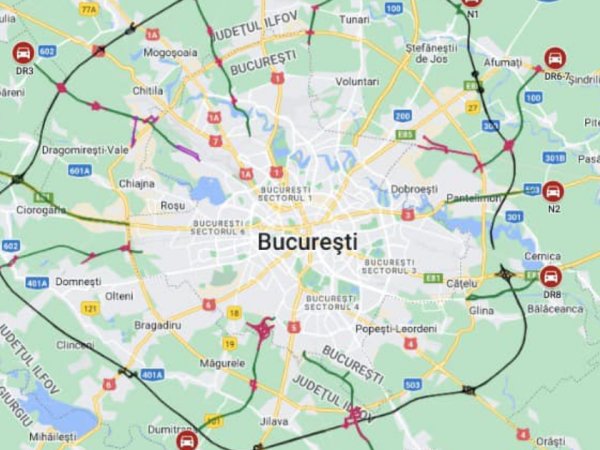
The Municipality of Bucharest has launched a tender for the feasibility study of Radial Road 3, a road infrastructure project included in the broader “Orbital Bucharest” concept. The road is designed to create a direct connection between Calea Giulești and the localities of Săbăreni (Giurgiu County), Chitila and Dragomirești-Vale (Ilfov County), without forcing drivers to pass through the heavily congested boulevards inside the city.
The main role of Radial Road 3 is to ensure a fast connection between Bucharest, the current ring road (DNCB), and the future A0 motorway. In practice, the project is conceived as a real alternative to urban routes choked by traffic, offering a bypass that is modern, efficient, and better adapted to current mobility needs.
Technical details and estimated costs
According to the project specifications, the road will have a total length of approximately 10.37 kilometers. It is planned with four traffic lanes—two in each direction—separated by a median, allowing for safer and smoother traffic flow.
The starting point will be at the intersection of Calea Giulești and Drumul Săbăreni. Along the route, grade-separated interchanges are planned at the intersections with the A0 motorway and the DNCB ring road. These interchanges are essential, as they will ensure uninterrupted traffic flow, without traffic lights, all the way beyond Ilfov County.
The feasibility study is estimated to cost around 20 million lei. As for the actual construction of the project, previous estimates place the total cost at approximately 72 million euros, covering infrastructure works and related developments.
Who will benefit directly from the new road
The direct beneficiaries of Radial Road 3 are residents in western Bucharest, especially those living in Sector 6, as well as people from rapidly developing nearby localities such as Săbăreni and Dragomirești-Vale.
Authorities estimate that once the road is completed, travel time between these areas and central Bucharest could be reduced by up to 20 minutes compared to the current situation. This reduction is particularly significant for commuters who face daily traffic jams and delays.
In addition, easing congestion on Iuliu Maniu Boulevard and Chitila Road could have positive effects on local traffic, helping to reduce pollution levels and relieve pressure on the existing urban infrastructure.
Timeline and funding sources
The completion of the feasibility study and the approval of the technical and economic indicators are expected to take up to 17 months. This stage would be followed by the launch of the tender for construction works, a step that will also depend on the necessary administrative approvals.
The project is supported through the Transport Program 2021–2027 and is financed by European funds, complemented by allocations from the state budget. This funding structure is important, as it increases the chances that the project will be completed within a reasonable timeframe, without relying solely on local budget resources.
You might be also interested in:
A medium-term solution for an overburdened traffic system
Radial Road 3 will not solve all of Bucharest’s traffic problems, but it represents an important step toward a more coherent infrastructure and better connections with the metropolitan area. By being integrated into the “Orbital Bucharest” project, this road could become a model for similar investments aimed at diverting transit traffic out of the city and offering drivers real alternatives.
In a city that continues to expand, where pressure on infrastructure grows year after year, such projects can make the difference between permanently gridlocked traffic and a more manageable, functional urban mobility system.