Icoanei Church, a 300-Year Story. The Historic Monument Is Today One of the Most Beautiful Churches in the Capital
- Articles
- 26 JUN 26
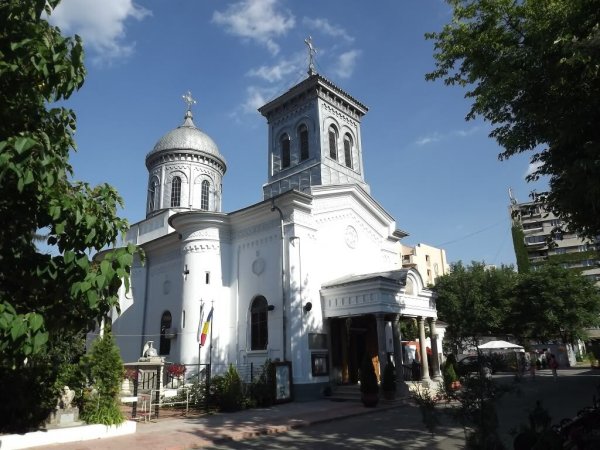
Few places of worship in Bucharest manage to combine history, spirituality, and architectural heritage as harmoniously as Icoanei Church. Built on the site of an old wooden hermitage and having gone through numerous trials over time, the church is today one of the Capital's most valuable historic monuments. Its story begins more than three centuries ago, during a period when Bucharest was a city undergoing continuous development, and religious communities played an essential role in the lives of its inhabitants. Throughout its existence, Icoanei Church has been rebuilt, restored, and embellished by successive generations of founders and benefactors. Each stage of its evolution added new heritage elements, transforming it into a symbol of the continuity of the Orthodox faith and of Bucharest's history.
From a wooden hermitage to an important place of worship
The origins of Icoanei Church can be traced back to the years 1681–1682, when a modest wooden hermitage stood on the site of the present-day building. Although the construction was simple, it served the local community and represented an important center of religious life in the neighborhood located on the outskirts of Bucharest at that time.
At the beginning of the 18th century, the care of the hermitage was entrusted to David Corbea Ceauș, who came from Brașov. He held an important position in the chancery of Prince Constantin Brâncoveanu, distinguishing himself as one of the trusted diplomats of the princely court. His diplomatic missions to Russia and Poland brought him prestige, and his influence was also reflected in the community surrounding the church.
It is believed that David Corbea owned houses and properties nearby, because the entire neighborhood had come to bear his name – Ceauș David. For a period, the church itself was also known by this name before the current name became permanently established in Bucharest's tradition.
The change of name is connected to an icon of great artistic and spiritual value. Tradition says that the Icon of the Mother of God, covered in silver and made in 1682 by the silversmith Filip Nicolau, was a gift from Prince Constantin Brâncoveanu himself. This icon, still preserved today in the nave of the church, became so well known and so deeply venerated by the faithful that, over time, the entire place of worship came to be known as Icoanei Church.
The first stone church and the contribution of the Băbeanu family
An important stage in the monument's history began between 1745 and 1750, when the old hermitage was replaced by the first stone church. The new building, designed with a trefoil floor plan and featuring three domes, was erected at the initiative of the monk Misail Băbeanu, a former confidential chancellor. The construction took place during the reigns of Constantin Mavrocordat and Grigore II Ghica.
The new church was considerably more imposing than the old hermitage and reflected the architectural style specific to that era. At the same time, it met the needs of a continuously growing community.
In 1777, the role of principal founder was taken over by Panait Băbeanu, commander of mercenary troops and nephew of Misail Băbeanu. He would play an essential role in the church's development. Between 1784 and 1786, during the reign of Mihai Suțu, Panait Băbeanu ordered the complete reconstruction of the building and the creation of new fresco paintings, executed with the support of the renowned painter Grigore Zugravul.
His contribution was not limited to restoring the church. Near the church he built twelve monastic cells intended to shelter poor widows, women of noble birth who had fallen into hardship, and nuns. Through this initiative, the church also became a center of social assistance, reflecting the founders' concern for helping those in need.
Panait Băbeanu also established clear rules regarding the administration of the church's property and the organization of religious activities. He decided that two priests and one deacon should permanently serve there, with the mission not only of enhancing the beauty of the religious services but also of contributing to the education of the community's children.
Princely privileges and the strengthening of the church's heritage
At the beginning of the 19th century, the administration of the church was taken over by Pana Băbeanu, Panait's nephew. He continued the family's tradition and succeeded in obtaining important privileges for the place of worship.
Princes Ion Gheorghe Caragea, Alexandru Suțu, and Grigore IV Ghica granted the church princely charters confirming various donations and exemptions from taxes. These documents helped strengthen the church's financial situation and made it possible to maintain the buildings and carry out religious activities without major financial difficulties.
Thanks to this continuous support, the heritage of Icoanei Church expanded considerably, and the surrounding community continued to grow.
The 1838 earthquake and the rebirth of the church
One of the most difficult moments in the monument's history was the earthquake of 1838. The seismic event caused such severe damage that the church collapsed almost entirely.
Its reconstruction, however, began immediately, in the same year. The new building was rebuilt while largely preserving its previous appearance and was completely repainted. At that time, portraits of the members of the Băbeanu family, the church's principal benefactors, were also painted in the narthex.
The frescoes depict Misail Băbeanu, Panait Băbeanu, as well as Ioniță Băbeanu together with his wife Sofia and their children Elena, Nicolae, Maria, and Panait, also known as Pana, who coordinated the restoration after the earthquake. These portraits remain today an important artistic and historical testimony to the family that linked its destiny to that of the church.
Successive restorations preserved the beauty of the monument
The second half of the 19th century brought new important restoration works. In 1873, Elena Băbeanu initiated an extensive restoration based on the plans of architect Alexandru Orăscu, one of the most highly regarded specialists of the time.
On this occasion, the current altar was installed. It had been created in 1850 and was later restored in 1967 by the sculptor Ion Taflan. The interventions aimed both to strengthen the building and to highlight its existing artistic elements.
A new stage followed in 1889, when Mihai Băbeanu ordered the restoration of the church starting from its foundations and the construction of the exonarthex. During the same period, the old frescoes were covered with oil paintings executed by one of the students of the great painter Gheorghe Tattarescu, adapting the interior to the artistic taste characteristic of the late 19th century.
In 1928, another major restoration campaign was carried out under the supervision of architect Smărăndescu. At that time, the central dome was removed, the roof and the towers were covered with sheet metal, the interior paintings were restored, and the neighboring buildings were rearranged.
The 20th century was not without challenges either. After the 1940 earthquake, the church was structurally reinforced to prevent further damage. Additional important restoration works were carried out in 1965, 1977, and 1989, each contributing to preserving the monument's historical and architectural value.
An impressive heritage built over three centuries
Throughout its existence, Icoanei Church benefited from numerous donations made by the faithful and by the families of its founders. Its heritage included land, houses, shops, vineyards, liturgical objects, furniture, and numerous religious books.
Among the most valuable pieces is a Triodion printed in Râmnic in 1777, the oldest book preserved in the church's collection. Together with the old icons and liturgical objects, this volume illustrates the continuous concern for preserving religious tradition and culture.
Around the church are also the graves of the members of the Băbeanu family, who made a decisive contribution to the development of the place of worship. The funerary stones, the oldest of which dates from 1846, are complemented by the funeral monuments of the Polizu, Odobescu, Nicolescu Cita, Urdăreanu, Tâmpeanu, Dobrowolsky, and Steriopol families.
This funerary ensemble gives the site a special memorial value and transforms the churchyard into a true space of Bucharest's history.
A symbol of faith and Bucharest's heritage
Today, Icoanei Church is regarded as one of the most beautiful historic churches in Bucharest. Its harmonious architecture, paintings, ancient icons, and peaceful atmosphere attract both worshippers and tourists interested in the Capital's cultural heritage every day.
The church's patronal feasts are celebrated on August 15, the Dormition of the Mother of God, and on December 6, Saint Nicholas' Day, two important occasions that bring together large numbers of believers.
Viewed as a whole, the history of Icoanei Church is one of resilience and continuity. Built on the foundations of a modest wooden hermitage, having survived devastating earthquakes and numerous restorations, the church has managed to preserve its identity and beauty.
For more than 300 years, successive generations of founders, priests, and parishioners have contributed to preserving this monument, which remains one of Bucharest's most valuable historical and spiritual landmarks. Visitors who cross its threshold today discover not only a place of prayer but also an impressive lesson in history, art, and faith, written over the course of three centuries.
We also recommend: The White Church in Bucharest, 300 years of history. How the most beautiful holy place on Calea Victoriei came into being