How Young Ladies Were Courted in Belle Époque Bucharest: Between Strict Rules, Discreet Glances and Forbidden Whispers of Love
- Articles
- 21 SEP 26
At the beginning of the 20th century, Bucharest was a city caught between two worlds. On the one hand, there were the old rules of patriarchal society, in which family, reputation, and wealth played a decisive role in choosing a husband. On the other hand, the capital was modernizing rapidly, and Calea Victoriei, theaters, confectioneries, restaurants, balls, and salons were becoming places where young people could see each other, talk, and, with enough discretion, fall in love. For a young woman from a wealthy family, courtship looked almost nothing like what we understand today as dating. A young lady was not, as a rule, free to go out alone with an unknown man, accept a spontaneous invitation, or turn a sympathy into a relationship without her family knowing. Social rules were strict, and a girl’s reputation could matter enormously for her matrimonial future. However, this does not mean that love was absent. On the contrary. Letters, glances exchanged at balls, conversations held in salons, meetings during walks, and small gestures of attention offered numerous opportunities for two young people to grow closer. There were even etiquette books that included models of love letters, expressions of jealousy, reproaches, and declarations, a sign that romanticism had found its place in society around 1900.
Bucharest, where a young lady first had to be “introduced” to society
In the upper-class world of Bucharest around 1900, young women did not simply enter social life according to their own rules. Their debut in society was an important moment, and the family played an essential role in determining the circle of people the girl would socialize with. Good manners dictated even the way a conversation had to be conducted, the forms of address, the permitted gestures, and the limits of physical contact.
For a family concerned with protecting its reputation, the behavior of its daughter was important not only for moral reasons, but also for matrimonial ones. A young woman had to be seen in the right company, in the right places, and on the right occasions. At balls, soirées, performances, or promenades, every appearance could become an opportunity for social evaluation. It was not only about beauty, but also about education, family, wealth, clothing, and the ability to converse.
This world can be better understood if we take into account that women had, in antebellum Romanian society, a legal and social status inferior to that of men. Historians discussing the period emphasize the central role of dowry and family in marriage, as well as the fact that women were largely defined through the roles of wife and mother.
Thus, a love story between two young people was not always only their story. Around them were parents, relatives, family friends, and the entire social community, which could observe, comment on, and sometimes influence the relationship.
The ball, the great theater of elegant flirting
If there was a place where a young man could make his interest in a young lady known without immediately breaking social conventions, it was the ball. Balls occupied an important place in Bucharest’s social life, and accounts of upper-class society from the late 19th and early 20th centuries describe soirées organized in private homes, at the Court, and within aristocratic circles.
Ulysse de Marsillac, in his description of 19th-century Bucharest, mentioned houses such as Oteteleșanu, Șuțu, and Grădișteanu among the places known for the elegance of their soirées. Balls held at the Royal Court, in turn, were extremely selective, and access required a certain social position and, in the case of some guests, an official introduction.
In such a setting, dancing could become a form of courtship. An invitation to dance was not a declaration of love, but it could be a clear sign of interest. A young man could ask a young lady to dance, and accepting allowed him to stand very close to her for several minutes, in a space where conversation and gestures were carefully observed.
For a young woman, however, choosing a dance partner could also have social consequences. Not every approach was appropriate, and a gentleman’s insistence could quickly become unpleasant. Precisely for this reason, courtship often took place through a succession of small gestures rather than direct declarations.
A repeated glance across the crowd of guests, an invitation to dance, a few words exchanged after the soirée, or interest shown through mutual friends could represent the beginning of a closer relationship. In the Belle Époque world, flirting was often a game of nuances.
Calea Victoriei, promenades and “accidental” meetings
The promenade was another important opportunity for people to see one another. Bucharest had several places associated with walks, including Șoseaua, Băneasa, Herăstrău, Cișmigiu, Grădina Episcopiei, and Cotroceni. Sources about the fashionable Bucharest of the period record these spaces as destinations for walks and social encounters.
A walk should not, however, be confused with a romantic date in the modern sense. For young women from conservative families, going out in public was generally connected to family or to an accepted social setting. Precisely because of this, a glance exchanged on an avenue, a repeated meeting at the same hour, or the appearance of a certain gentleman near the walking group could acquire a particular significance.
Calea Victoriei offered another setting. By 1900, the avenue had become one of the principal stages of urban life. Shops, restaurants, confectioneries, hotels, and theaters attracted people who wanted not only to shop or have fun, but also to be seen.
Fashion played an important role in this social scenery. French, Viennese, and Berlin influences were strongly felt, and clothing had become a true language of status. A carefully chosen dress, a spectacular hat, gloves, jewelry, or a parasol could say a great deal about a woman’s social position and tastes.
For men, elegance meant impeccable suits, frock coats, waistcoats, hats, and discreet accessories. A gentleman had to demonstrate not only that he had money, but also that he knew how to behave.
The love letter, the safest path to a heart
If gestures in public had to be discreet, paper could become much bolder. The love letter was one of the means through which feelings could be expressed in an era when direct conversation between a young man and a young lady was limited by social conventions.
The existence of actual models of love letters in etiquette books from the late 19th and early 20th centuries is relevant. These volumes offered formulas for declarations, jealousy, reproaches, or separation.
A famous example from around 1900 is the relationship between Nicolae Iorga and Catinca Bogdan. Iorga sent the young woman numerous letters during the period when he was courting her, and their correspondence shows how intensely the letter could be used as an instrument of emotional closeness. According to historical sources, Iorga wrote her a total of 129 love letters throughout his life, beginning precisely during the period of their courtship.
Their correspondence also reveals the contrast between the ceremonious exterior of society and the intimacy permitted by the written word. In public, one could be reserved, attentive to every gesture and every form of address. In a letter, however, one could speak about longing, love, and the hope of a life together.
The letter also had the advantage of discretion. There was no need to declare anything in front of an entire salon. A sheet of paper could cross the distance between two houses and preserve words that might never have been spoken in public.
When love had to pass the family test
Courtship did not have romantic closeness as its only purpose. In that world, the natural destination of an accepted relationship was marriage. Therefore, a family examined much more than the feelings of the two young people.
The dowry was of considerable importance. Historical sources concerning marriage around 1900 emphasize the role of wealth, dowry, and family interests in arranging a marriage. In wealthy families, the future husband was expected to be evaluated also according to his social position, wealth, and reputation.
This does not mean that all marriages were arranged or devoid of love. There were relationships that began from genuine affection, and examples from correspondence demonstrate that personal feelings could be extremely strong. But love had to meet, in one way or another, the realities of society.
For a young woman, choosing a husband could mean changing her status and her entire life. For the family, marriage could strengthen social, economic, and prestigious connections. Therefore, courtship was also a process of mutual observation, in which it was not only the young man who tried to win the girl, but the families as well tried to determine whether the future alliance was suitable.
Forbidden whispers and the boundary between discretion and scandal
In a society so attentive to reputation, discretion was essential. An overly obvious flirtation, a repeated meeting without supervision, or a relationship that exceeded accepted limits could quickly become the subject of gossip.
The press and literature of the period intensely exploited these contradictions. Behind the elegant façade of balls and soirées existed jealousy, affairs, adultery, clandestine relationships, and scandals. Historical sources about Romanian society around 1900 also mention the existence of such situations, including among privileged social classes.
That is why a whisper could be more powerful than a declaration. A young man who looked insistently at his chosen one, a note slipped discreetly, a letter hidden in a drawer, or an apparently accidental meeting could carry enormous emotional weight.
Belle Époque Bucharest was thus a city of appearances and contrasts. In salons, people spoke about respectability, while young people constantly searched for their own ways of becoming closer. The rules could be strict, but people continually found spaces within them for their feelings.
A world where love was read between the lines
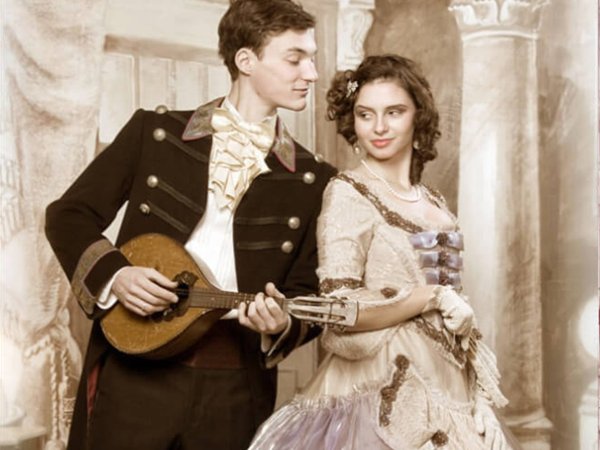
The courtship of young ladies in Belle Époque Bucharest cannot be reduced to the romantic image of a gentleman in a top hat kissing the hand of a young woman in a long dress. In reality, it was a complex social ritual influenced by family, wealth, reputation, education, religion, and gender conventions.
Balls offered dancing and conversation, promenades offered apparently accidental encounters, salons allowed conversations in a controlled setting, and letters opened an intimate world that social rules kept hidden from the public sphere. Good manners were not merely ornaments of an elegant society, but mechanisms through which people learned how to approach one another without crossing too quickly the accepted boundaries.
In this Bucharest of the early 20th century, love was not necessarily less intense than it is today. It was simply expressed differently. A glance could take the place of a message, a dance could mean a promise, and a letter could say what could not be spoken in a salon full of people.
And beyond the spectacular dresses, feathered hats, luxurious balls, and walks along Calea Victoriei, there was the same emotion that has always accompanied the beginning of a love story: the question of whether the other person feels the same. The difference was that, around 1900, the answer often had to be deciphered between the lines.
We also recommend: How home visits were conducted in Belle Époque Bucharest: Guests were served with a chibouk, coffee, and the latest gossip