How the profession of servant was regulated and what it looked like at the end of the 19th century in Bucharest
By Bucharest Team
- Articles
- 26 JAN 26
At the end of the 19th century, Bucharest was a whirlwind of carriages splashing mud on the ladies' skirts on Calea Victoriei, a city of brutal contrasts where the smell of coffee from Capșa clashed with the sweat of the more than ten thousand servants who kept the heart of the capital beating.
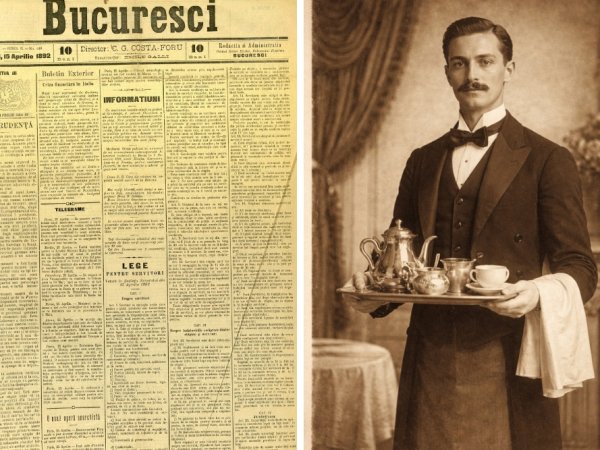
In this landscape of cruel elegance, on April 15, 1892, the Bucuresci newspaper published the text of a law that would transform domestic life into a barracks-like discipline: the "Law for Servants." The document represented a clear verdict: the moment a person entered the service of another, they surrendered not only their labor but also their dignity, morality, and freedom of movement into the hands of their master and the Capital Police Prefecture.
The service "condicuța," or "passport," that decided your fate
The legal existence of any Bucharest servant necessarily began at the police station. The law required the "service record book," a document of vital importance that cost three lei (a huge sum for those who had come from the countryside in search of fortune in the city). This register was the absolute mirror of the man, containing his name, age, particular characteristics, and, most feared of all, a certificate of good character issued by the local authorities or the mayor of his last place of residence.
Without this domestic "passport," no one could be hired. The law was fiercely strict. Any master who dared to take in a person without a register or with an unstamped one risked heavy fines. In practice, Bucharest became a fortress where access to work was filtered by a bureaucracy that saw every cook or servant as a potential criminal who had to be constantly monitored.
The hierarchy behind closed doors. Who were the "servants"?
The text of the 1892 law provides a fascinating social inventory of Bucharest's courtyards. A servant was defined as a person who indebted themselves to another person for "personal services at the disposal of a house, a family, a person, a hotel, or any institution." The classification was clear and rigid:
• The aristocracy of the kitchen: cooks, confectioners, and coffee makers occupied the top of the hierarchy.
• Representative staff: visitors, courtyard attendants, and doormen were the facade of any self-respecting house.
• The invisible army: housekeepers, maids, laundresses, and nannies who did the heavy lifting of the household.
• Court staff: boyars' court stewards and forest or vineyard guards.
An interesting detail, full of social implications, is the exception made for "governors and governesses." Although they worked in the same house, they were exempt from the humiliation of the service register, being considered of a higher moral class, sheltered from the police control applied to others.
Code of conduct and total submission under threat of imprisonment
Article 12 of the law was the cornerstone of modern servitude at that time. Servants were required to be "faithful and perform all the services for which they were hired." Any form of insubordination, any rude response, or any gesture of inattention could be interpreted as a breach of contract.
Personal freedom was a non-existent luxury. The law prohibited servants from leaving the house without their master's permission or from receiving "under any circumstances" any stranger in their room. Furthermore, the master had the legal right to keep the servant working beyond the usual hours if the needs of the household required it, without the servant being able to protest.
If the servant exhibited vices such as "drunkenness, debauchery, or the habit of disturbing the peace of the house," the master had the right to dismiss him on the spot. On the other hand, if the servant wanted to leave, he was bound by a 15-day notice period in Bucharest. Leaving without this notice led to the loss of wages for the days worked and a bad mark in the service record, which was equivalent to professional death throughout the city.
Fines and "re-education" through arrest
The penalties provided for in Chapter III of the law are so harsh that they are reminiscent of Dickens' novels. In Bucharest, fines for offenses ranged from 10 to 100 lei. For a servant who earned a few lei a month, such a fine was a sentence to starvation.
The harshest part of the law, however, came for those who had no means to pay: "For those who are insolvent, the fine will be converted into imprisonment." Thus, a simple misunderstanding with the master or a delay at the gate could throw a young man into the police cellars. The law clearly stipulated that "corrupt" or "vicious" servants could be sent to "correctional facilities," with the state assuming the role of educating the domestic workforce by force.
Servants' wages and prices at the end of the 19th century in Bucharest
Beyond the rigor of the law, the pockets of Bucharest servants in 1892 accurately reflected their place in the social hierarchy, with wages often being a combination of cash, food, and a roof over their heads.
A farmhand or a maid received on average between 15 and 25 lei per month, while a skilled cook or a distinguished coachman could claim sums of up to 60-80 lei. To understand their real value, we must look at the purchasing power of the "gold leu" during the reign of Carol I: at that time, 20 lei could buy about 60 kilograms of beef or over 200 large loaves of bread.
Based on today's prices and consumption standards in modern Bucharest, the salary of an ordinary maid would be equivalent to about 1,200-1,500 lei, while the "aristocracy" of domestic service, such as great chefs, would earn the equivalent of over 4,500 lei today. It was a wage that ensured survival and allowed a few coins to be sent to relatives in the countryside, but the fines mentioned in the law, which could reach 100 lei, represented for many the equivalent of half a year's work, a financial barrier that was almost impossible to overcome.
In addition to the modest salary, the shopping basket of a servant in Bucharest at the end of the 19th century was dictated by prices in markets such as Obor or Amzei, where every penny really counts.
In 1892, with a single leu, you could buy 10 kilograms of cornmeal or 4 kilograms of beans, the staple foods that filled the bellies of those in the rooms at the back of the courtyard. If a servant wanted to taste luxury on a Sunday, a kilogram of first-quality beef cost about 60 bani, and a liter of table wine sold for 30-40 bani.
Eggs were affordable, at about 5 bani each, but delicacies remained a distant dream: a kilogram of sugar cost over 1 leu, which was a whole day's work for a laundress.
Considering that a pair of sturdy leather boots cost around 15-20 lei, an ordinary servant had to set aside his entire monthly salary just to avoid walking barefoot through the mud of the capital, which explains why many remained tied to the same house for years, caught in a vicious circle of debt and immediate needs.
The rights of the master vs. the obligations of the servant
The law tried to maintain a semblance of balance, but the scales always tipped in favor of those who owned capital. The master was obliged to provide "sufficient food" and "healthy housing," but the definition of these terms was left to the discretion of the employer. If the servant fell ill, the master had to care for him for the first 25 days, but after that period, the contract could be terminated without any further obligation.
Justice in these conflicts was swift and often biased. The administrative authorities and the local police had the final say. Their decisions were "final and enforceable," which meant that a servant had virtually no recourse against a decision made by the local policeman, who often shared meals and drinks with the master of the house.
Bucharest at the end of the 19th century was, therefore, a city where order in the boyar living rooms was guaranteed by an iron law. For the servant, the capital was a place of hard labor, where the yellow ledger was the only link to a society that viewed him more as a tool than as a citizen.