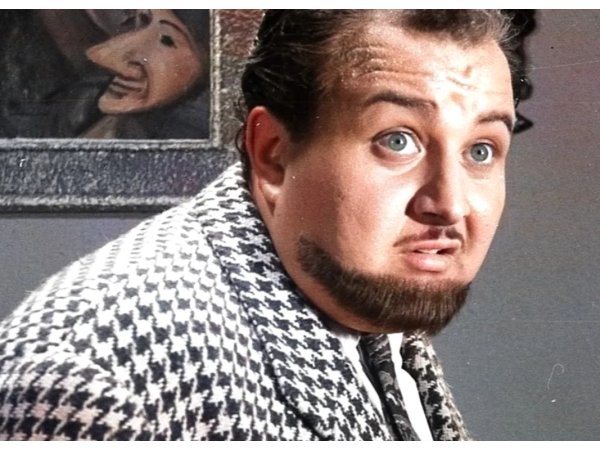
He was born with acting in his blood. The life of Ovid Teodorescu, the son of the interwar actress Silly Vasiliu, the great love of Ilinca Cerbacev
- Articles
- 04 FEB 26
The history of Romanian theatre in the 20th century is closely linked to personalities who burned intensely on stage, leaving behind memorable roles and impressive life stories. One of these names is Ovid Teodorescu, the actor who seemed to be born directly under the spotlights, with acting in his blood and a smile ready for the audience. Cheerful, effervescent and extremely talented, Ovid Teodorescu was a landmark of revue theatre, an artist who knew glory, downfall, suffering and rebirth. His life unfolded under the sign of art, love and the harsh trials of history, and his destiny remains closely tied to two exceptional women: his mother, Silly Vasiliu, the great star of interwar theatre, and Ilinca Cerbacev, the love of his life.
A childhood under the sign of the stage and of art
Ovid Teodorescu was born on March 10, 1926, in Bucharest, into a family with a special destiny. His mother, Silly Vasiliu, was one of the most loved and appreciated actresses of the interwar period, a true starlet of the Alhambra Revue Theatre. The audience adored her, the press followed her, and her name was synonymous with elegance, charm and scenic success. Ovid’s father, in contrast with the bohemian world of theatre, was a general in the Romanian royal army, a man of discipline and military honor.
Raised among backstage areas, rehearsals and applause, little Ovid breathed theatre from his very first years of life. The stage was not foreign to him, and the actors who entered and exited his mother’s life had become natural reference points. In this artistic environment, the fascination with performance took deep root. Play, music, lines and the light of the spotlights shaped him without his realizing it, preparing him for an artistic destiny that seemed inevitable.
Early debut and the first steps in revue theatre
At only 19 years old, in 1945, Ovid Teodorescu stepped onto the stage of the Revue Theatre for the first time, during a period of transition and uncertainty for Romanian culture. His debut took place at a delicate moment, marked by the death of Constantin Tănase, the founder of Romanian revue theatre and an emblematic figure of the Bucharest stage. In the autumn of that year, Ovid Teodorescu appeared in the show “Gioconda at Savoy”, a title that would mark the beginning of a promising career.
The premiere took place on the stage of the “Savoy” Theatre, and the cast was impressive. Alongside the young actor were major names of the time, such as Mia Apostolescu, Cornelia Teodosiu, Ion Antonescu-Cărăbuș and Zizi Șerban. Although at the beginning of his path, Ovid Teodorescu drew attention through his scenic naturalness, his overflowing energy and the ease with which he communicated with the audience. It was clear that he was not only “Silly Vasiliu’s son”, but an actor with his own personality and remarkable potential.
An ascent brutally interrupted by the communist regime
The promise of a brilliant career was abruptly cut short in the 1950s, with the establishment of the communist regime. His family origin became a burden. His father, a general in the royal army, was declared an enemy of the people and deported to the Bărăgan, a fate shared by many officers of the former regime. Inevitably, Ovid Teodorescu also entered the authorities’ sights.
Considered suspicious and accused of having connections with members of the Turkish Embassy in Bucharest, the actor was arrested in 1952 by the Securitate. One of the harshest periods of his life followed: being sent to forced labor on the construction site of the Danube–Black Sea Canal. Detention, extreme physical effort and humiliation left deep marks, both physical and psychological. Nevertheless, his love for theatre was not defeated.
Returning to the stage and rebuilding a career
After his release, Ovid Teodorescu was allowed to return to artistic life, but under the close supervision of the communist authorities. His return to the stage of the Revue Theatre took place in the 1954–1955 season, and the audience welcomed him with enthusiasm. His energy, humor and charisma were intact, and the desire to recover lost time was evident.
One of the successful performances of this period was the musical comedy “Dreams come true”, directed by Nicușor Constantinescu and Bițu Fălticineanu. The cast was exceptional, including Grigore Vasiliu-Birlic, Virginica Popescu and Luigi Ionescu. Ovid Teodorescu integrated perfectly into an ensemble of great actors, managing to shine through spontaneity and expressiveness.
Memorable roles and artistic consecration
Success continued with productions such as “A song for you”, signed by Eugen Mirea and Sașa Georgescu. In this show, Ovid Teodorescu performed alongside Silvia Chicoș, Nicolae Nițescu and Gigi Marga, to the music of famous composers of the time, such as George Grigoriu and Edmond Deda. The audience appreciated not only his acting performance, but also his musical qualities, which perfectly suited the revue genre.
Another important moment was his appearance in the show “Vox… Boema” by Alecu Popovici, where he shared the stage with Horia Căciulescu, Luigi Ionescu and the duo Anton and Romică. His versatility became increasingly evident, and the name Ovid Teodorescu was already associated with successful performances.
“The Pit” and the peak of his career
A culminating point of his career was the role in the musical “The Pit”, directed by Nicolae Dinescu and inspired by the famous novel by Eugen Barbu. The premiere took place in 1967 and enjoyed resounding success. The show was performed to sold-out audiences for three seasons, becoming a theatrical phenomenon of the time.
The cast was legendary, including names such as Nicu Constantin, Alexandru Arșinel, Olga Bucătaru and Ion Dichiseanu. In this context, Ovid Teodorescu’s performance was considered one of the most accomplished, consolidating his status as an elite actor of the Revue Theatre. The audience adored him, and critics recognized his value.
The great love: Ilinca Cerbacev
Beyond professional success, Ovid Teodorescu’s life was deeply marked by his love story with Ilinca Cerbacev, an appreciated actress and singer. The two met at the Constantin Tănase Revue Theatre and quickly formed an admired couple, both on stage and in personal life.
Their appearances together were electrifying, and the songs they performed as a duet captivated audiences. The refrain “Where are my illusions / That I once had?” became emblematic, being associated with the sensitivity and artistic chemistry between the two. Ovid Teodorescu and Ilinca Cerbacev recorded several records together at the “Electrecord” label and participated in successful tours alongside important artists of the time, such as Horia Moculescu, Marina Voica and Constantin Drăghici.
Exile and the last years of life
In 1975, Ovid Teodorescu made a difficult decision: he left Romania and settled in the United States of America. The desire for freedom, away from political constraints, was decisive. In exile, he continued to perform in shows organized by the Romanian community, but the former success was hard to replicate far from the audience that had consecrated him.
His life ended prematurely on May 21, 1981, at only 55 years old, in Los Angeles, California. The actor was buried in the famous Hollywood Forever Cemetery, alongside great personalities of the film industry, a symbolic place for an artist who lived for the stage.
The legacy of a legendary actor
Ovid Teodorescu remains one of the emblematic figures of Romanian theatre. An actor of rare versatility, who went through suffering, detention and exile, but who returned each time with the strength of a true artist. His talent, infectious cheerfulness and love for the stage turned him into a landmark of revue theatre.
His artistic legacy is unquestionable, and his memory continues to live on through the performances of the time and through the stories of those who knew him. Ovid Teodorescu, the man who “ate acting on bread” from childhood, remains a reference name in the history of Romanian theatre, a symbol of passion and resistance through art.
We also recommend: The story of the artist Ilinca Cerbacev, descendant of Dimitrie Bolintineanu. She gave up skiing to dedicate herself to music