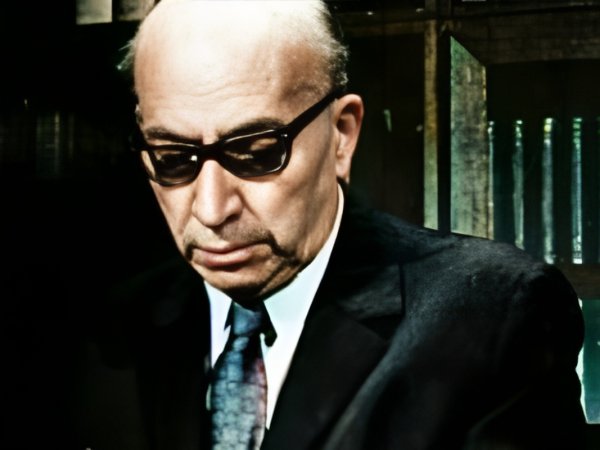
He “christened” Birlic and lived only for Romanian theatre. The story of director Sică Alexandrescu
- Articles
- 13 FEB 26
Few people have burned for theatre with the intensity with which Sică Alexandrescu did. For him, the stage was not just a space of creation, but a way of existing. He was born in theatre, he grew up in theatre, and he died working for theatre. He discovered and launched huge names, staged performances that became legendary, and took Romanian theatre to the great stages of the world. He was the director who “christened” Birlic and the mentor who formed entire generations of actors. His story is, in essence, the story of a life lived with a rare, almost obsessive passion.
Childhood in the wings of the National Theatre
Sică Alexandrescu was born on August 15, 1896, in Bucharest, into a family in which theatre was more than a profession: it was a tradition. His father, Vasile Alexandrescu, was an actor at the National Theatre in Bucharest, and the atmosphere around young Sică was dominated by rehearsals, premieres, emotions, and discussions about roles.
From an early age, he accompanied his father to rehearsals and spent long hours in the wings, fascinated by the transformation of the actors and the magic of the stage. He learned early what discipline, rigor, and responsibility the artistic act required. He was not just a privileged spectator, but a silent apprentice, attentive to every detail.
He completed his formal education at the “Sfântul Sava” High School, but his true school was the stage. Direct contact with the great personalities of the Bucharest theatre shaped his sensitivity and defined his vocation.
The first steps in theatre and the encounter with backstage work
After graduating from high school, Sică Alexandrescu naturally stepped into the world of theatre. His first important experience was as backstage director at the National Theatre in Bucharest. He worked on the staging of the play “Patima roșie” by Mihai Sorbul, a performance in which Elvira Popescu made her debut.
This period placed him face to face with the mechanisms behind the stage. He discovered how much work, organization, and precision are hidden behind a successful performance. The moment was decisive: he understood that his calling was not only to admire the stage, but to lead it, to build it, to shape it.
Subsequently, he held the position of stage director at the National Theatre in Cluj, then at the Comedy Theatre in Bucharest. From 1947, he became a director of the Bucharest National Theatre, the place where he would reach artistic maturity and consecration.
The master of comedy and the charm of boulevard farce
In the interwar period, Sică Alexandrescu established himself as a director with a sure hand in the area of comedy. He staged boulevard farces and modern adaptations of vaudeville, attracting the public through brisk rhythm, savory lines, and direction attentive to detail.
He had a special talent for adapting and dramatizing texts, for giving them new breath without betraying their essence. He perfectly understood the role of comedy in a tense society: laughter was a form of release, but also a subtle mirror of reality.
His performances were not simple entertainments, but true cultural events. The public came in large numbers, and success became almost a constant. Sică Alexandrescu knew how to build balanced casts and create authentic chemistry among actors.
Landmark stagings and consecration at the National
The 1940s brought a new stage in his career. He gathered leading actors of the Romanian stages and staged performances of great dramatic force: “The Lower Depths” by Maxim Gorky, “The Robbers” by Schiller, “A Stormy Night” by I.L. Caragiale. These productions demonstrated his versatility: he could combine humor with profound drama, energy with psychological analysis.
His great directorial work began in the 1948–1949 season. On September 17, 1948, the National Theatre in Bucharest presented the premiere of “A Lost Letter.” The cast was impressive: Grigore Vasiliu-Birlic, Marcel Anghelescu, Alexandru Giugaru, Nicky Atanasiu, Radu Beligan, Carmen Stănescu, Ion Finteșteanu.
The performance was a triumph. In 1950, it had reached 500 performances—a record for that time. The actors’ interpretations became a benchmark for the following generations, and Sică Alexandrescu’s staging remained a reference.
The director also made the screen adaptation of the play, consolidating his renown in the world of theatre and Romanian cinematography. He demonstrated that Romanian theatre could be adapted for the big screen without losing its strength and authenticity.
The international triumph: Moscow and Venice
International consecration came in the 1950s. The tour in Moscow, in 1956, with “The Government Inspector” by Gogol, was a resounding success. Critics noted the precision of the direction and the strength of the performances.
A year later, in 1957, in Venice, the staging of the play “The Boors” by Carlo Goldoni produced extraordinary enthusiasm. The event marked 250 years since the birth of the Italian playwright, and the Romanian performance impressed through style and plasticity.
The Italian press wrote in praise of the Bucharest troupe, and one episode remained memorable: spectators continued to watch the play under a torrential rain, refusing to leave. It was proof that Romanian theatre, under the baton of Sică Alexandrescu, had a universal language.
The “christening” of Birlic and the formation of great actors
One of the most well-known episodes of his career is connected to Grigore Vasiliu. Cast in a performance in which he played a character named “Birlic,” the actor received this name as a pseudonym. From then on, the world of theatre knew him as Birlic, becoming a symbol of Romanian comedy.
Sică Alexandrescu was also the one who discovered Mihail Sebastian, supporting Romanian dramaturgy and promoting native authors. He understood that a nation’s theatre must support its own voices.
He staged memorable performances such as “Doctor in Spite of Himself” (1955) and “The Imaginary Invalid” (1962) by Molière, “Bălcescu” by Camil Petrescu (1949), “The Girl Without a Dowry” by Ostrovsky (1954), “King Lear” by Shakespeare (1955). Each production bore the mark of rigorous, yet vibrant direction.
A demanding and generous mentor
Romania’s great actors always spoke with emotion about him. Radu Beligan described him as a man for whom theatre was a vital necessity, comparable to hunger or thirst. He woke up in the early hours of the morning and until late at night did nothing but think, dream, and build theatre.
He supported young people, encouraged them, and trained them. Florin Piersic recalled how, still at his graduation performance, Sică pulled him aside and struck him across the cheek—a rare gesture which, in the master’s language, meant appreciation and affection.
Carmen Stănescu spoke about the rehearsals full of humor, about Birlic’s jokes, and about the way Sică Alexandrescu combined severity with tenderness. He treated the actors like his own children, taking care of them on tours, making sure they were well accommodated and lacked nothing.
He had a just severity, but also a paternal generosity. He knew how to scold, to correct, but also to encourage. Around him an atmosphere of family was created, in which discipline and affection coexisted.
The writer and the man of memories
Besides his directorial activity, Sică Alexandrescu also left three volumes of memoirs: “A Comedian and a Girl from a Good Family,” “My Traveling Companion, Tobacco!” and “A Road in Theatre.” In these books, he captured the backstage life, portraits of actors, and stories full of flavor.
His texts offer a valuable perspective on the evolution of Romanian theatre and on the spirit of an era in which the stage was a space of maximum cultural effervescence.
The end of a life dedicated to the stage
Sică Alexandrescu died on August 6, 1973, in Cannes, only nine days before turning 77. He left us while working, preparing the staging of the play that was to open the new hall of the National Theatre in Bucharest.
His disappearance left an immense void. Yet his legacy continues to live through landmark performances, through the generations of actors he formed, and through the spirit of total dedication to art.
Today, the Dramatic Theatre in Brașov and a street in Bucharest bear his name. It is a natural tribute to a man who made theatre a personal religion and the stage a destiny.
Sică Alexandrescu was not only a director. He was a builder of worlds, a shaper of artistic consciences, and a visionary who believed, until the end, in the strength of Romanian theatre. And the fact that he “christened” Birlic remains only one of the many proofs that he knew how to recognize and shape authentic talent.
We also recommend: The incredible story of the great director Liviu Ciulei: He was banned by the communists and fled Romania by boat