From Paris to Bucharest, the “Black Pearl” captivated Constantin Tănase with her exotic dance. The story of Josephine Baker
- Articles
- 30 JAN 26
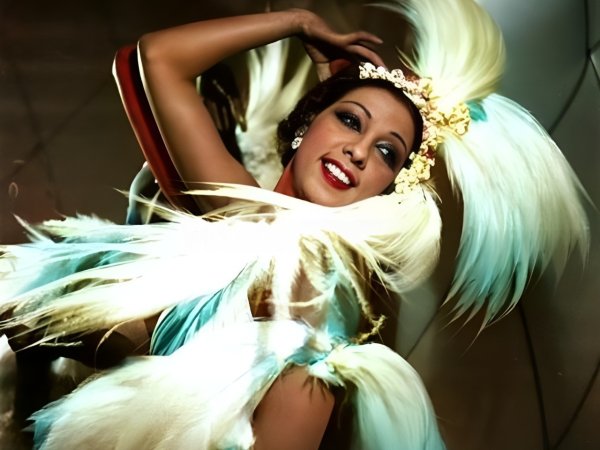
Josephine Baker, nicknamed the “Black Pearl,” was one of the most fascinating and influential personalities of the twentieth century. A dancer, singer, actress, and activist, she managed to overcome the racial and social barriers of her time, transforming herself into a symbol of artistic freedom and courage. Her journey, from a childhood marked by poverty to the glittering stages of Paris and, for a time, Bucharest, is a story of talent, survival, and the desire to change the world through art.
A difficult childhood and the first trials of life
Josephine Baker was born on June 3, 1906, in St. Louis, Missouri, under the name Freda Josephine McDonald. Her life began under the sign of abandonment and deprivation. Her father, Eddie Carson, left the family immediately after her birth, and her mother, Carrie McDonald, was forced to raise four children alone, working relentlessly to support them.
Josephine’s childhood was marked by extreme poverty and by the deep racial discrimination that dominated early twentieth-century America. Although from an early age she showed a strong attraction to music and dance, daily reality forced her to work from a very young age. The traumatic experiences of those years would shape her character and fuel her desire to flee from a world that rejected her.
Early marriage and flight toward freedom
At only 13 years old, Josephine was forced to marry Will Baker, a man much older than herself. The marriage was, in fact, an attempt to escape the hardships of home rather than a conscious choice. The relationship quickly proved unhappy, and the young girl felt her dreams fading before they had a chance to take shape.
Before long, she decided to run away, leaving behind her husband and the life imposed upon her. Later, Josephine would confess that escape became a way of survival: she fled from St. Louis, then from the United States, because of discrimination — the terrible beast that paralyzes both body and soul. This longing for freedom would ultimately carry her to Europe.
New York and the first artistic successes
After separating from her husband, Josephine Baker moved to New York, where she began working as a dancer in nightclubs and on theatrical stages. She quickly entered the city’s vibrant artistic world, and her energy, expressiveness, and unusual style caught the public’s attention.
Her dances combined African influences, American rhythms, and a rare bodily expressiveness. It was not just technique, but pure charisma. In a period when artists of color had limited access to major stages, Josephine managed to impose herself through authenticity and courage.
Paris, the place of artistic rebirth
The decisive moment of her career came in 1925, with her participation in the famous La Revue Nègre in Paris. On the French stage, Josephine Baker presented a provocative, sensual dance number, completely different from the conventions of the time. The Parisian public was instantly captivated.
Paris became the place where the artist felt free for the first time. Here she was not judged by the color of her skin, but admired for her talent. “In France I was never afraid. It was like a fairy-tale land,” she would later say. Her success was overwhelming, and the press christened her the “Black Pearl,” a symbol of exotic beauty and modernity.
An international star and a pioneer of the stage
With her consecration in France, Josephine Baker became an international celebrity. She performed on Europe’s great stages, sang in exclusive clubs, and appeared in fashion magazines. Her image — curly hair, radiant smile, and spectacular costumes — became emblematic of the 1920s and 1930s.
In a world dominated by prejudice, Baker was a true trailblazer. She proved that talent has no color and offered a model of success for artists of African descent who followed. Her presence on Broadway and major European stages represented a symbolic break from cultural segregation.
Constantin Tănase and the encounter with the “Black Pearl”
In the interwar period, Constantin Tănase was one of the most important figures of Romanian theatre. Actor, director, and composer, he had transformed the Romanian revue into a modern form of entertainment inspired by Western trends. Always in search of novelty, Tănase followed with interest Josephine Baker’s meteoric rise in Europe.
In the 1930s, when the artist was already a celebrated name, Tănase decided to invite her to perform in Romania. He sensed that her presence could bring an international spirit to the Bucharest stage and attract a diverse audience. For Josephine, the invitation was a new artistic challenge, which she accepted enthusiastically.
Performances in Bucharest and the public’s reaction
Josephine Baker’s arrival in Romania sparked enormous interest. The Bucharest public, accustomed to revue performances, was fascinated by her exotic style, boundless energy, and the blend of music, dance, and comedy. Each appearance became a major event.
Her provocative dances generated contradictory reactions. Some critics considered the performances too daring for traditional values, while others welcomed the artistic courage and modernity she brought. What was certain was that the shows were sold out, and the press of the time wrote extensively about the “Black Pearl.”
A cultural symbol of the interwar era
Beyond her stage success, Josephine Baker deeply influenced the culture of the 1920s and 1930s. Her fashion style, freedom of expression, and message of acceptance of diversity transformed her into a symbol of cultural revolution. She was not merely an artist, but a living statement against conformity.
Through her presence, including in Romania, Baker demonstrated that art can transcend national and mental borders. She brought with her not only spectacle, but also the idea of a more open world, in which differences could become sources of fascination rather than exclusion.
Activism and the fight against discrimination
Josephine Baker never limited herself to the status of a star. She used her fame to speak openly about racism and inequality. She was among the first artists to address these issues publicly, becoming an important voice in the struggle for civil rights.
Even after returning to the United States, where she continued to face prejudice, Baker refused to remain silent. She took part in social campaigns, supported humanitarian causes, and constantly promoted the idea of equality among races.
A heroine of the French Resistance
During the Second World War, Josephine Baker’s life took on a dramatic dimension. Living in France, she joined the French Resistance, becoming a liaison agent and engaging in espionage activities. She used her artistic tours as cover to transport secret information.
She also organized charity performances and raised funds for the war effort. Her courage earned her, after the conflict, numerous decorations and official recognitions for her contribution to the fight against Nazism.
The legacy of a legend
After the war, Josephine Baker continued to perform and to campaign for civil rights. Her name remained associated with the ideals of freedom, courage, and human dignity. Her story, from a poor child in St. Louis to the idol of Paris and interwar Bucharest, is one of the most impressive of the twentieth century.
The “Black Pearl” was not only an artist who conquered the world’s stages, but a woman who changed mentalities. Her exotic dance, which even enchanted Constantin Tănase, became the symbol of an era in which art began to fight openly for freedom and equality.
We also recommend: Mia Apostolescu, the diva of interwar Bucharest, the right hand of Constantin Tănase. The story of the stunning cupletist from Cărăbuș